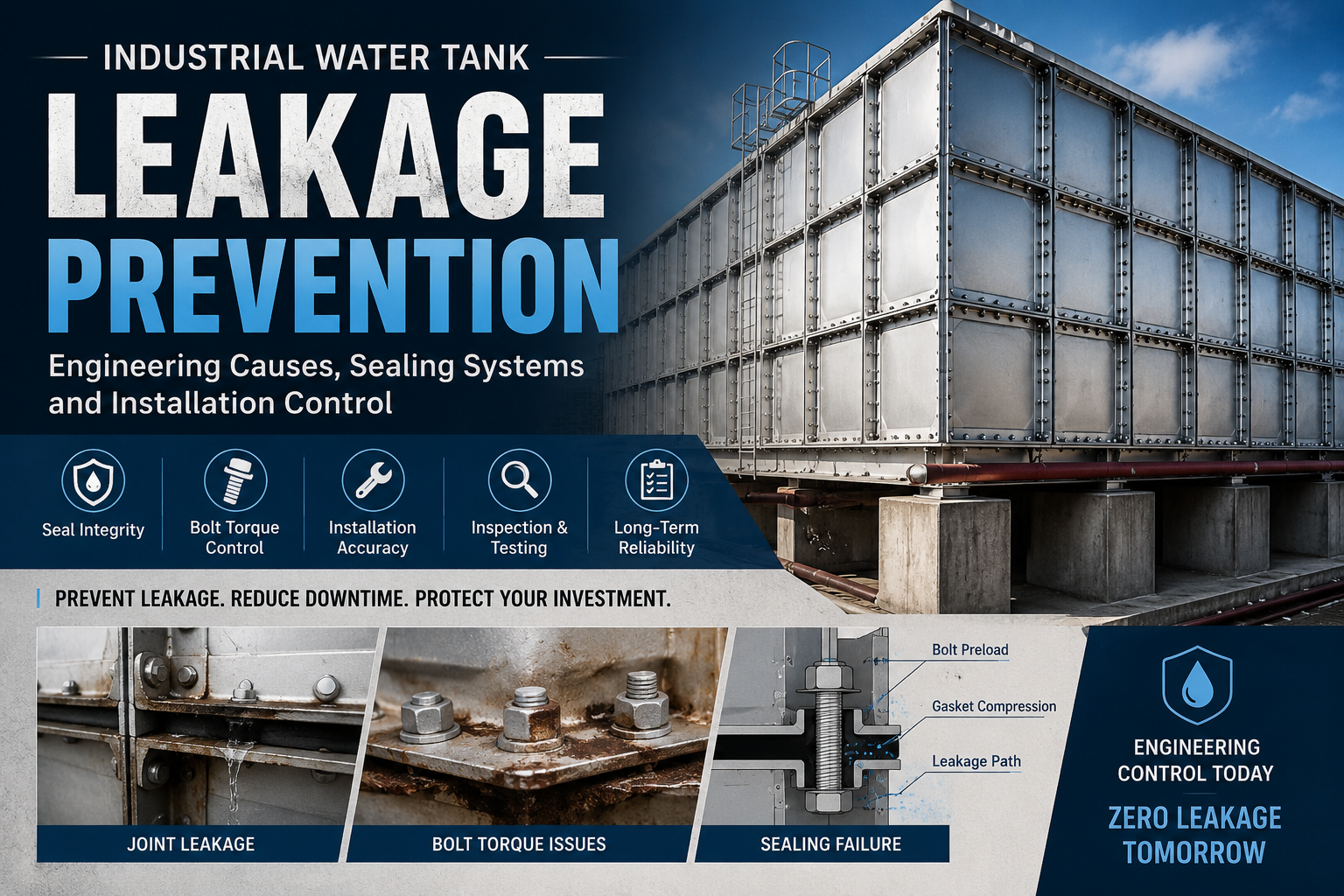
Table of Contents
Industrial Water Tank Specification should be treated as a system decision. Its purpose is to translate process, structural, water-quality, fabrication, and site needs into one coordinated procurement document. From bid review through long-term operation, the review must go beyond confirming that an item is shown; the complete arrangement must work across the expected operating range.
Poor industrial water tank specification creates a predictable risk: A specification that focuses only on capacity and material leaves interfaces, testing, documentation, and responsibilities open to conflicting assumptions. The review below follows the issue from design basis to handover. Use it alongside project calculations and jurisdictional requirements, not in place of them. It identifies the information that needs a clear basis, which interfaces require coordination, and what evidence should remain at handover.
Why Industrial Water Tank Specification Deserves an Early Review
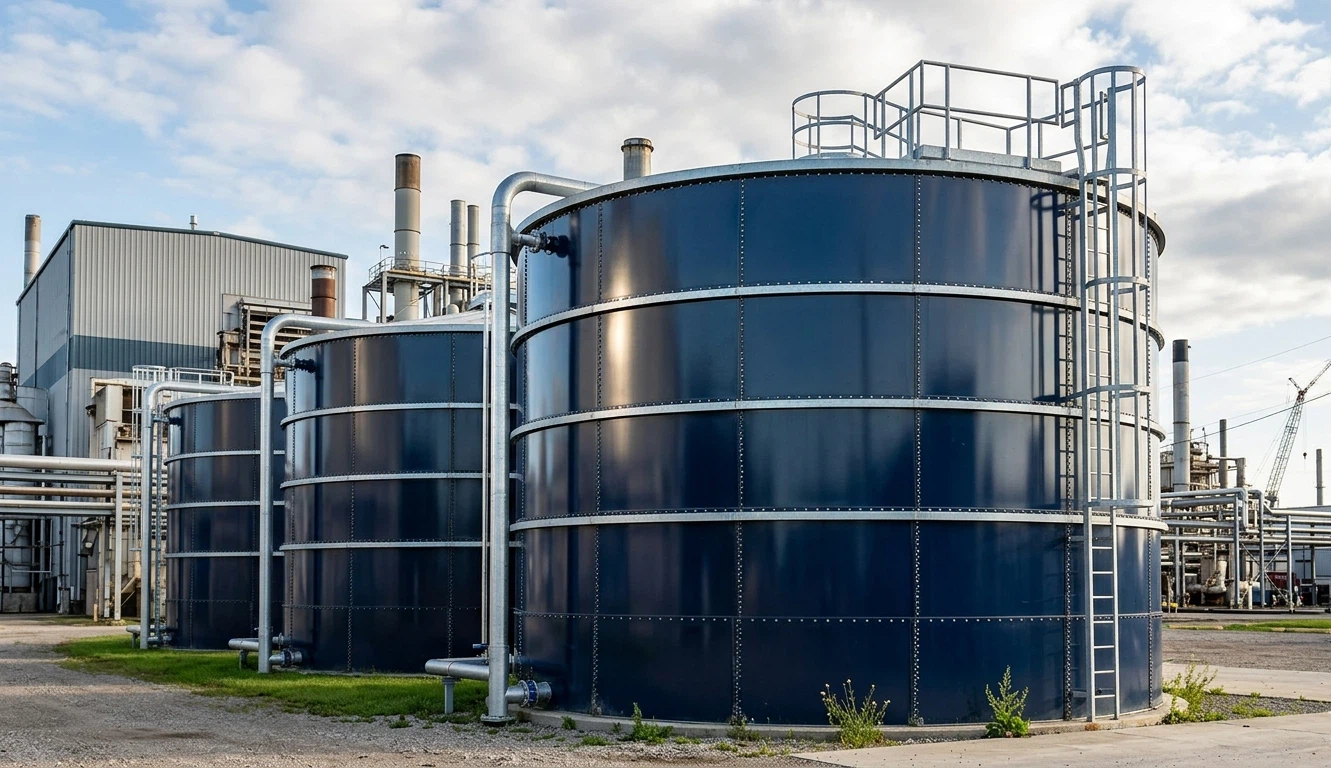
The most practical point to close industrial water tank specification is before fabrication drawings receive final approval. During coordinated drawing approval, tank construction and material, design life inputs without guarantees, and nozzles and accessories can still be resolved before procurement, fabrication, or site execution. If the answer arrives after fabrication, the installer inherits the conflict. The installer may not own the process or structural design basis.
Treat industrial water tank specification alongside every connected system and responsibility. The tank vendor and the process, civil, piping, controls, installation, and operating teams see a different part of the operating risk. The industrial water tank buying checklist provides a useful companion review for commercial and technical scope boundaries.
Define the Operating and Design Basis
A credible industrial water tank specification decision should begin with the duty and constraints. Define routine service before considering exceptions, the credible abnormal cases, environmental conditions, maintenance expectations, and the authority responsible for acceptance. When the data is provisional, record the assumption and the person who must close it.
- Stored-water service
- Required usable capacity
- Site and design loads
- Operating temperature and chemistry
- Installation constraints
- Applicable codes and owner standards
Do not use conservatism as a substitute for defining the duty. For industrial water tank specification, an incorrect flow, level, load, material, or service assumption can change the preferred arrangement. Configuration control matters when a drawing based on an earlier data sheet can look complete while answering the wrong operating case.
Map Every System Interface
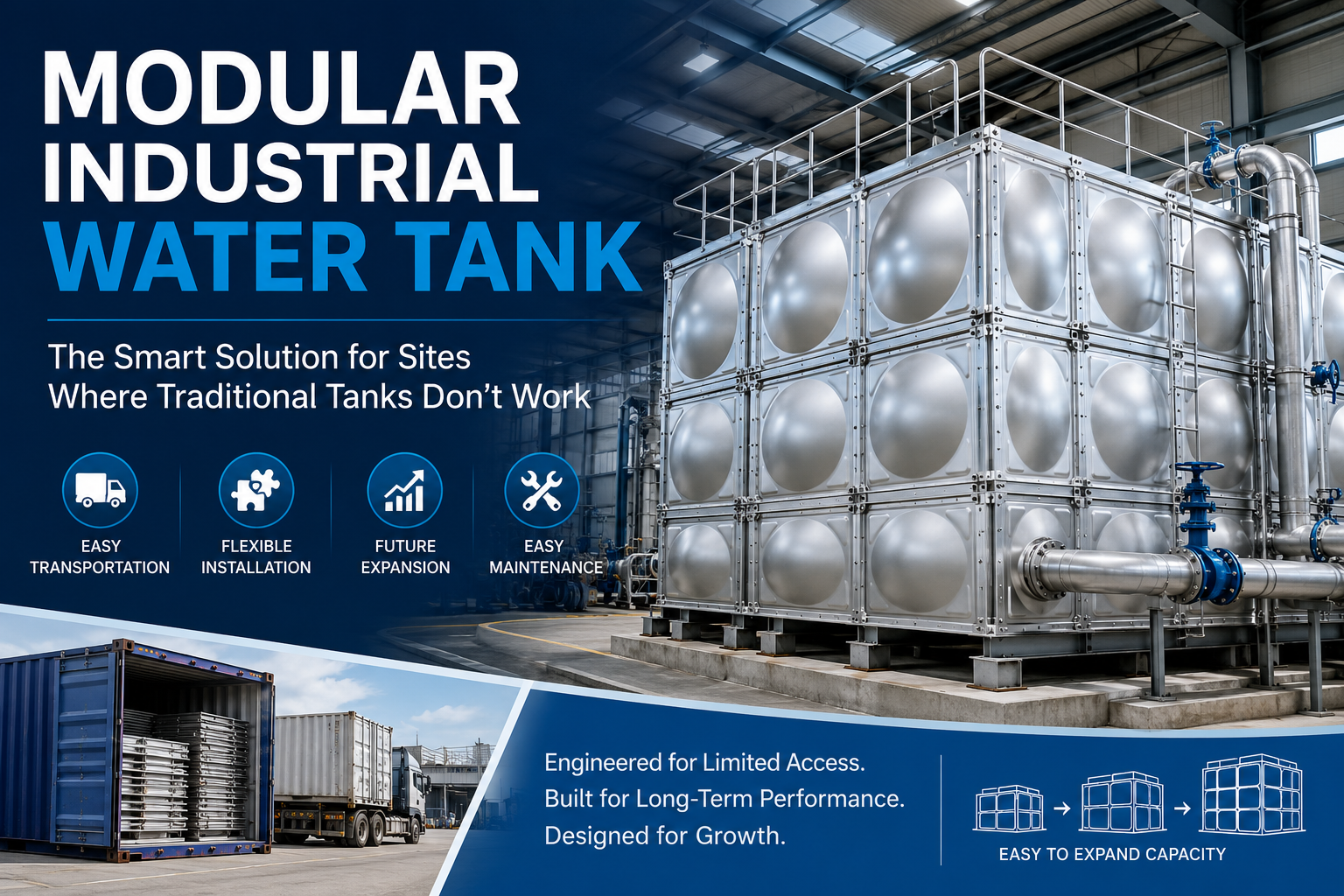
Several engineering scopes converge at the tank connection. Review industrial water tank specification against the inlet, outlet, overflow, drain, vent, level instruments, foundation, access system, and external piping as applicable. A change in one item may affect usable capacity, cleaning access, pipe loads, sanitary protection, or the sequence used to isolate the tank.
Avoid parallel nozzle lists; use one controlled source of location data. P&IDs describe function; general arrangements describe location; structural drawings describe support; electrical documents describe control; and operating procedures describe use. The industrial water tank installation guide helps teams connect those documents to site and erection checks.
Key Industrial Water Tank Specification Decisions
The workable arrangement depends on several linked decisions about industrial water tank specification. Assign an owner and acceptance record to every choice. An answer such as “by others” is only useful when the boundary and required input are also stated.
- Tank construction and material
- Design life inputs without guarantees
- Nozzles and accessories
- Coating or finish
- Inspection and testing
- Delivery, erection, and commissioning scope
If the initial calculation does not separate the choices, compare them against operation and maintenance rather than initial convenience alone. Good industrial water tank specification makes isolation, observation, cleaning, replacement, and inspection possible without transferring avoidable risk to the operator.
Materials and Service Compatibility
Review materials against both the liquid inside and the conditions outside the tank. In potable-water work, certification scope needs to be checked for the actual wetted coating, gasket, sealant, fitting, and component; one compliant part does not automatically establish compliance for the assembled system.
Coordinate industrial water tank specification with the selected tank construction. Details that work on a welded shell may not transfer directly to sectional or bolted panels. Review product-specific interfaces on the galvanized water tank page, then confirm the project specification, approved material schedule, and supplier drawings.
Installation, Access, and Maintainability
A specification-compliant industrial water tank specification detail may be unsuitable when construction and maintenance clearances are missing. Reserve tool clearance, lifting space, valve reach, safe access, and room to remove screens, sensors, gaskets, or internal parts. Keep external pipe loads off tank connections unless the tank designer has explicitly accepted them.
Access planning must also respect the site’s safety program. Internal entry may be regulated as confined-space work, and roof or platform tasks may require specific fall-protection measures. Design the routine inspection from outside the tank wherever practical, then document any entry-dependent task and its isolation needs.
Common Failure Modes to Prevent
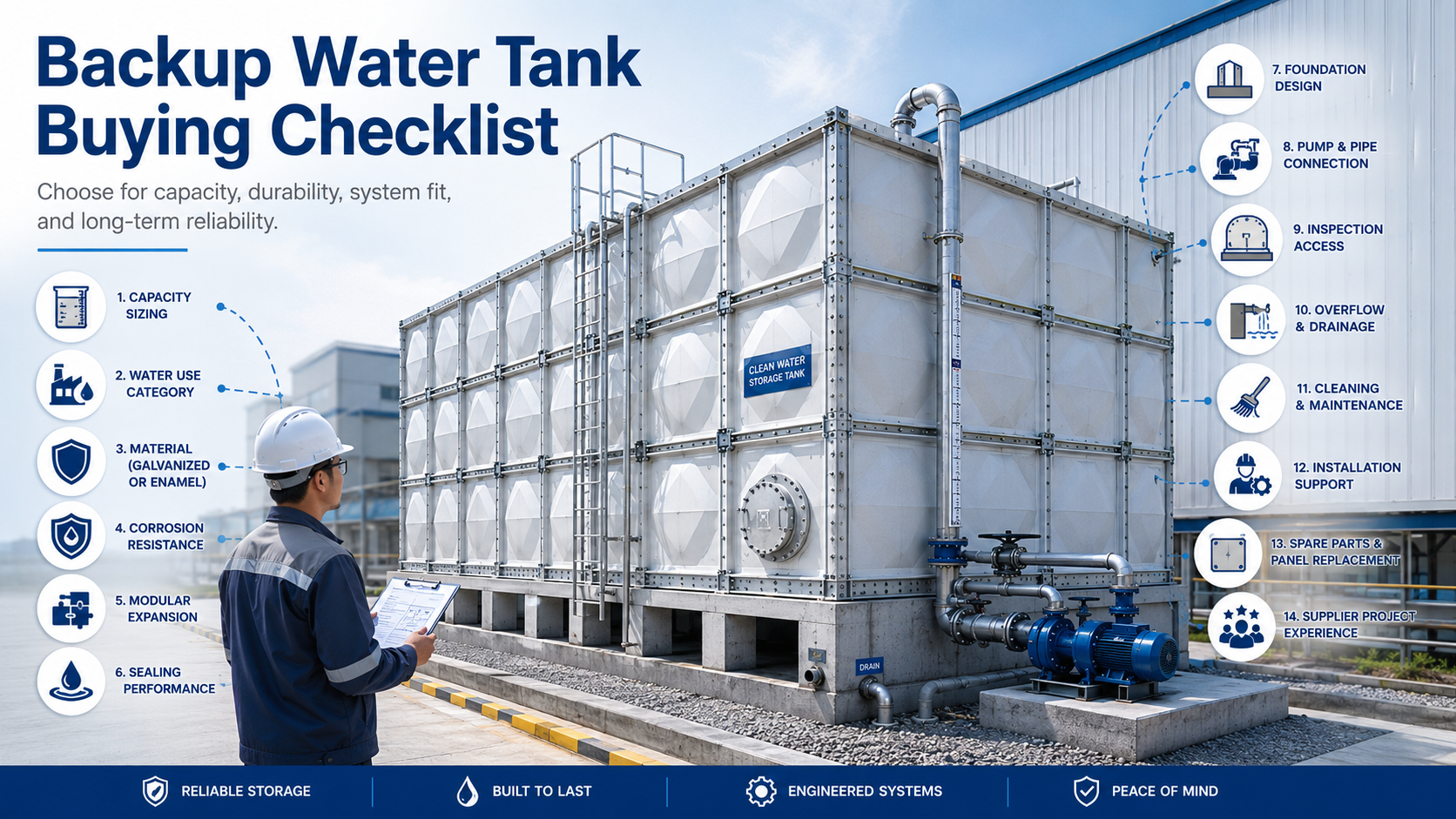
Reviewing credible failure keeps industrial water tank specification connected to actual operating consequences. Review the most likely causes, how they would be detected, and whether the system can be isolated without losing essential storage. The following issues deserve explicit discussion during drawing review:
- Copying requirements from an unrelated project
- Conflicting drawings and data sheets
- Undefined supplier boundaries
- Acceptance criteria added after award
None of these outcomes is prevented by a label alone. A sound industrial water tank specification package links the drawing to calculations, material data, installation instructions, inspection points, and an owner who will act on any nonconformance.
Industrial Water Tank Specification Review Table
| Review item | Question to close | Evidence to retain |
|---|---|---|
| Stored-water service | Confirm the project-specific value or arrangement for stored-water service. | Approved drawing, calculation, data sheet, or signed review record |
| Required usable capacity | Confirm the project-specific value or arrangement for required usable capacity. | Approved drawing, calculation, data sheet, or signed review record |
| Site and design loads | Confirm the project-specific value or arrangement for site and design loads. | Approved drawing, calculation, data sheet, or signed review record |
| Tank construction and material | Confirm the project-specific value or arrangement for tank construction and material. | Approved drawing, calculation, data sheet, or signed review record |
| Design life inputs without guarantees | Confirm the project-specific value or arrangement for design life inputs without guarantees. | Approved drawing, calculation, data sheet, or signed review record |
| Nozzles and accessories | Confirm the project-specific value or arrangement for nozzles and accessories. | Approved drawing, calculation, data sheet, or signed review record |
The value of the table comes from the evidence attached to it. The value of a industrial water tank specification review is the traceable answer behind each row, including the responsible party and the revision where the answer was approved.
What to Put in the RFQ and Drawings
A useful RFQ combines performance criteria with a responsibility matrix. For industrial water tank specification, request enough information to compare bids on the same basis and to prevent a supplier assumption from becoming an installer problem.
- Design basis and applicable project requirements
- Tagged drawings with dimensions, elevations, and interfaces
- Material and component data
- Calculations or selection records required by the specification
- Installation, inspection, and testing instructions
- Deviation list and final handover documents
A blank deviation list should be confirmed, not assumed. Silence should not be treated as proof that every requirement has been included. A complete industrial water tank specification submittal lets reviewers see what was selected, why it fits the duty, and what the site team must provide.
Verification Before Handover
Handover evidence should close the loop on the approved industrial water tank specification basis. Check identity, location, orientation, supports, materials, access, and associated controls before the tank is filled or returned to service. Where a functional test is safe and permitted, observe the result across the relevant operating range rather than only at one convenient point.
- Conduct a multidisciplinary review
- Issue a controlled clarification log
- Align the bid with deviations
- Freeze interfaces before fabrication
Build a handover record from actual readings, photographs, and signed punch-list status. The finished water storage tank inspection guide and tank hydrostatic test roadmap can help place industrial water tank specification within the broader inspection and commissioning sequence.
Authoritative References
The governing specification and authority having jurisdiction still control. The following public references are useful starting points for a industrial water tank specification review because they address tank operation, water quality, structural loads, fabrication safety, or inspection from recognized organizations:
- EPA drinking-water distribution tools and resources
- NSF/ANSI/CAN 61 testing and certification overview
- OSHA 29 CFR 1910.146 permit-required confined spaces
- ASCE/SEI 7-22 design-load overview
- Ontario treated-water storage design guidance
Every reference has limits that must be respected. A guidance document for public drinking-water storage may offer a helpful principle, but it does not automatically govern every industrial process-water tank. The responsible professional should reconcile industrial water tank specification with the project jurisdiction and contract documents.
Frequently Asked Questions
When should industrial water tank specification be finalized?
Finalize industrial water tank specification before fabrication approval, after the process duty and site interfaces are stable enough for coordinated review. Later changes should follow formal change control.
Who is responsible for industrial water tank specification?
Responsibility is normally shared across the tank supplier and the process, piping, structural, controls, installation, and owner teams. The purchase specification should define each boundary.
Can a standard detail be used for industrial water tank specification?
A standard detail can be a starting point, but its flows, loads, materials, elevations, environment, and maintenance assumptions must be checked against the actual project.
What should be checked during commissioning?
Check the installed arrangement against the approved industrial water tank specification drawing, then verify supports, access, materials, controls, and any safe functional test required by the commissioning plan.
What records should be kept after handover?
Retain approved drawings, calculations or selection records, material data, inspection and test reports, setpoints, photographs, nonconformance closeout, and maintenance instructions.
Final Project Takeaway
Effective industrial water tank specification connects an agreed operating case to drawings, materials, installation, and commissioning evidence. That chain is more valuable than a generic detail because it remains understandable to the people who will operate and maintain the tank.
For a project-specific tank interface review, prepare the stored liquid, capacity, operating levels, site conditions, flow or load data, required standards, and preferred connection details. Then contact Zhengling so the technical discussion can begin with a defined industrial water tank specification basis rather than an incomplete equipment list.