Table of Contents
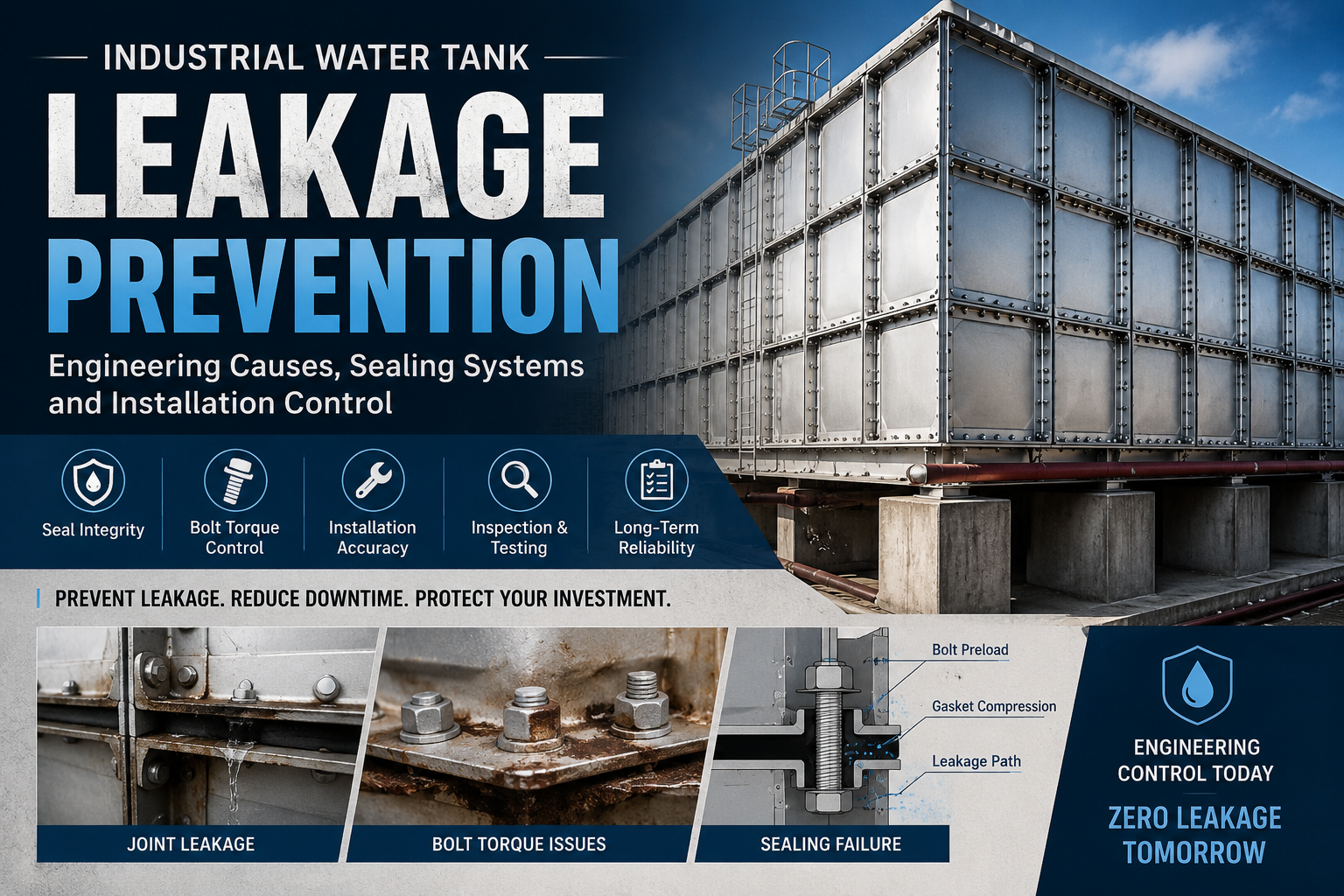
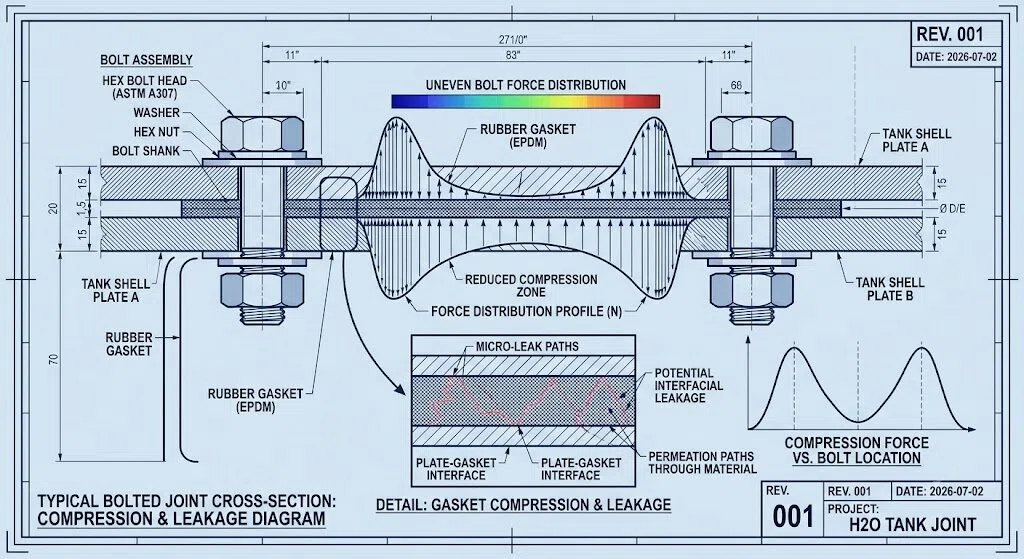
Water Tank Gasket Compression should be treated as a system decision. Its purpose is to create a continuous seal at panel and flange joints while keeping the gasket within its intended compression range. For project engineers, site teams, and asset owners, the review must go beyond confirming that an item is shown; the complete arrangement must work across the expected operating range.
Poor water tank gasket compression creates a predictable risk: Uneven or excessive compression can squeeze out material, open low-pressure zones, or damage the gasket and adjacent coating. The following method connects the risk to drawings, checks, and records. Use it alongside project calculations and jurisdictional requirements, not in place of them. It maps the information needed before approval, which interfaces require coordination, and what evidence should remain at handover.
What Good Water Tank Gasket Compression Must Achieve
The most practical point to close water tank gasket compression comes before the supplier freezes fabrication information. In the pre-fabrication window, joint preparation, gasket placement, and splice treatment can still be resolved before procurement, fabrication, or site execution. A post-fabrication change can leave the site team without a clean option. The installer may not own the process or structural design basis.
Treat water tank gasket compression inside the project’s coordinated interface schedule. The vendor, engineering disciplines, construction team, and asset owner must contribute information before the detail is complete. The industrial water tank buying checklist provides a useful companion review for commercial and technical scope boundaries.
Document Flows, Levels, Loads, and Limits
A credible water tank gasket compression decision depends on current project data. Describe the intended operating envelope, the credible abnormal cases, environmental conditions, maintenance expectations, and the authority responsible for acceptance. For information awaiting confirmation, record the assumption and the person who must close it.
- Gasket material and profile
- Joint geometry
- Bolt spacing
- Surface condition
- Stored-water chemistry and temperature
- Manufacturer assembly procedure
Make unknowns visible instead of burying them in margins. For water tank gasket compression, an incorrect flow, level, load, material, or service assumption can change the preferred arrangement. Disciplined revision control is essential because a drawing based on an earlier data sheet can look complete while answering the wrong operating case.
Review the Whole Tank System
Tank interfaces rarely belong to one discipline alone. Review water tank gasket compression against the inlet, outlet, overflow, drain, vent, level instruments, foundation, access system, and external piping as applicable. A change in one item may affect usable capacity, cleaning access, pipe loads, sanitary protection, or the sequence used to isolate the tank.
Keep elevations on one agreed datum and manage the nozzle schedule as a controlled record. P&IDs describe function; general arrangements describe location; structural drawings describe support; electrical documents describe control; and operating procedures describe use. The industrial water tank installation guide helps teams connect those documents to site and erection checks.
A Step-by-Step Water Tank Gasket Compression Review
The next group of choices determines how the project will implement water tank gasket compression. Every selection needs traceable approval and a final-document location. An answer such as “by others” is only useful when the boundary and required input are also stated.
- Joint preparation
- Gasket placement
- Splice treatment
- Bolt sequence
- Compression indicator or torque method
- Inspection access
If more than one arrangement can satisfy the duty, compare them against operation and maintenance rather than initial convenience alone. Good water tank gasket compression makes isolation, observation, cleaning, replacement, and inspection possible without transferring avoidable risk to the operator.
Compatibility and Water-Contact Details
Review materials against both the liquid inside and the conditions outside the tank. In potable-water work, certification scope needs to be checked for the actual wetted coating, gasket, sealant, fitting, and component; one compliant part does not automatically establish compliance for the assembled system.
Coordinate water tank gasket compression with the selected tank construction. Details that work on a welded shell may not transfer directly to sectional or bolted panels. Review product-specific interfaces on the enamel water tank page, then confirm the project specification, approved material schedule, and supplier drawings.
Construction and Maintenance Access
Even a technically sound water tank gasket compression detail must also be buildable, observable, and maintainable. Reserve tool clearance, lifting space, valve reach, safe access, and room to remove screens, sensors, gaskets, or internal parts. Keep external pipe loads off tank connections unless the tank designer has explicitly accepted them.
Access planning must also respect the site’s safety program. Internal entry may be regulated as confined-space work, and roof or platform tasks may require specific fall-protection measures. Design the routine inspection from outside the tank wherever practical, then document any entry-dependent task and its isolation needs.

Avoid These Design and Installation Mistakes
A failure-mode discussion keeps water tank gasket compression tied to observable project risks. Review the most likely causes, how they would be detected, and whether the system can be isolated without losing essential storage. The following issues deserve explicit discussion during drawing review:
- Stretched gasket installation
- Misaligned panel edges
- Sealant used to hide poor fit
- Uneven tightening around corners
None of these outcomes is prevented by a label alone. A sound water tank gasket compression package links the drawing to calculations, material data, installation instructions, inspection points, and an owner who will act on any nonconformance.
Water Tank Gasket Compression Checklist Table
| Review item | Question to close | Evidence to retain |
|---|---|---|
| Gasket material and profile | Confirm the project-specific value or arrangement for gasket material and profile. | Approved drawing, calculation, data sheet, or signed review record |
| Joint geometry | Confirm the project-specific value or arrangement for joint geometry. | Approved drawing, calculation, data sheet, or signed review record |
| Bolt spacing | Confirm the project-specific value or arrangement for bolt spacing. | Approved drawing, calculation, data sheet, or signed review record |
| Joint preparation | Confirm the project-specific value or arrangement for joint preparation. | Approved drawing, calculation, data sheet, or signed review record |
| Gasket placement | Confirm the project-specific value or arrangement for gasket placement. | Approved drawing, calculation, data sheet, or signed review record |
| Splice treatment | Confirm the project-specific value or arrangement for splice treatment. | Approved drawing, calculation, data sheet, or signed review record |
This table organizes questions but cannot supply the technical answers. The value of a water tank gasket compression review is the traceable answer behind each row, including the responsible party and the revision where the answer was approved.
Drawing and Submittal Requirements
State what the system must achieve and where supplier scope ends. For water tank gasket compression, request enough information to compare bids on the same basis and to prevent a supplier assumption from becoming an installer problem.
- Design basis and applicable project requirements
- Tagged drawings with dimensions, elevations, and interfaces
- Material and component data
- Calculations or selection records required by the specification
- Installation, inspection, and testing instructions
- Deviation list and final handover documents
Ask every bidder to list deviations clearly. Silence should not be treated as proof that every requirement has been included. A complete water tank gasket compression submittal lets reviewers see what was selected, why it fits the duty, and what the site team must provide.
Prove Performance Before Acceptance
Commissioning checks should mirror the approved water tank gasket compression basis. Check identity, location, orientation, supports, materials, access, and associated controls before the tank is filled or returned to service. Where a functional test is safe and permitted, observe the result across the relevant operating range rather than only at one convenient point.
- Inspect placement before closing the joint
- Observe staged tightening
- Check visible squeeze-out where applicable
- Investigate any leak before adding torque
Keep enough field evidence for a later reviewer to understand the result. The finished water storage tank inspection guide and tank hydrostatic test roadmap can help place water tank gasket compression within the broader inspection and commissioning sequence.
Useful Standards and Guidance
Always reconcile this review with the contract and jurisdiction. The following public references are useful starting points for a water tank gasket compression review because they address tank operation, water quality, structural loads, fabrication safety, or inspection from recognized organizations:
- AMPP overview of coating holiday testing
- OSHA 29 CFR 1910.252 welding, cutting, and brazing
- OSHA 29 CFR 1910.146 permit-required confined spaces
- NSF/ANSI/CAN 61 testing and certification overview
- EPA finished-water storage inspection checklist
Confirm that a cited document applies to the service and jurisdiction. A guidance document for public drinking-water storage may offer a helpful principle, but it does not automatically govern every industrial process-water tank. The responsible professional should reconcile water tank gasket compression with the project jurisdiction and contract documents.
Frequently Asked Questions
When should water tank gasket compression be finalized?
Finalize water tank gasket compression before fabrication approval, after the process duty and site interfaces are stable enough for coordinated review. Later changes should follow formal change control.
Who is responsible for water tank gasket compression?
Responsibility is normally shared across the tank supplier and the process, piping, structural, controls, installation, and owner teams. The purchase specification should define each boundary.
Can a standard detail be used for water tank gasket compression?
A standard detail can be a starting point, but its flows, loads, materials, elevations, environment, and maintenance assumptions must be checked against the actual project.
What should be checked during commissioning?
Check the installed arrangement against the approved water tank gasket compression drawing, then verify supports, access, materials, controls, and any safe functional test required by the commissioning plan.
What records should be kept after handover?
Retain approved drawings, calculations or selection records, material data, inspection and test reports, setpoints, photographs, nonconformance closeout, and maintenance instructions.
Conclusion
Effective water tank gasket compression turns an operating requirement into a documented and verified installation. That chain is more valuable than a generic detail because it remains understandable to the people who will operate and maintain the tank.
For a project-specific tank interface review, prepare the stored liquid, capacity, operating levels, site conditions, flow or load data, required standards, and preferred connection details. Then contact Zhengling so the technical discussion can begin with a defined water tank gasket compression basis rather than an incomplete equipment list.