Most water tank problems don’t start inside the tank.They start at the weak points people rarely check: vents, hatches, overflow lines, roof seals, and sediment zones that slowly turn into microbial risk areas.A proper finished water storage tank inspection is not about ticking boxes—it’s about catching contamination routes before they reach the distribution system.
Table of Contents
Why finished water storage tank inspection is not just routine maintenance
Finished water storage systems sit at a critical point in the drinking water chain. Once water leaves treatment, it can still be compromised inside storage.
According to the U.S. EPA’s guidance on storage facilities, risks often come from:
- structural gaps (vents, hatches)
- sediment buildup
- biofilm formation
- external contamination like birds or debris
Vent systems: small opening, large contamination risk
One of the most overlooked failure points in a tank is the vent.
A vent is supposed to equalize pressure—but it also becomes a direct contamination pathway if not protected.
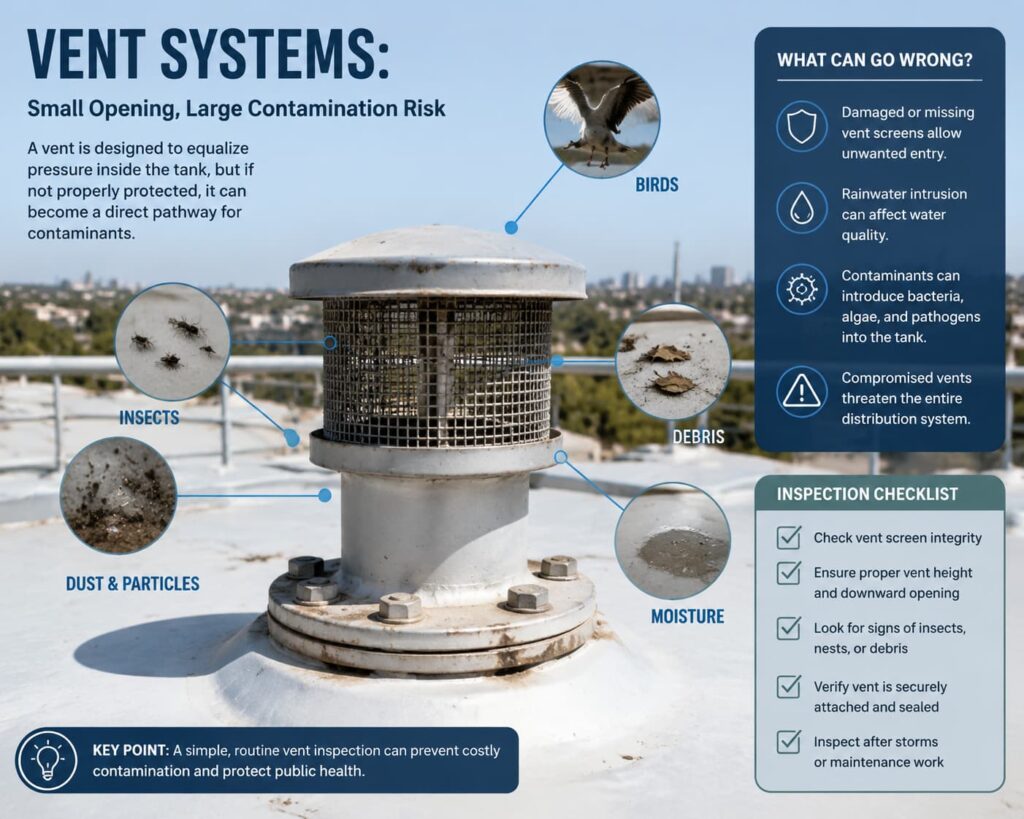
What inspectors actually check:
- mesh screen condition (corrosion or tears)
- insect and bird entry signs
- vent height above roof surface
- whether vent is properly downturned
Hatch sealing problems most operators underestimate
Access hatches are simple, but failure here leads directly to contamination.
Common issues:
- gasket aging and deformation
- loose locking mechanism
- improper sealing after entry
- roof hatch left slightly unlatched during maintenance
A real-world pattern seen in inspections:
Most contamination events are not structural failures—they are sealing failures.
Overflow line: why it is treated as a contamination pathway
Overflow is often misunderstood as a safety relief system.
But in inspection practice, it is treated as a high-risk contamination entry point if not properly designed.
EPA notes that overflow events should be rare and usually indicate system malfunction
What inspectors look for:
- insect screens or flap protection
- backflow prevention design
- pipe termination height above ground
- signs of external water intrusion
Sediment accumulation
Sediment is not just “dirt at the bottom.
It often indicates:
- dead zones in circulation
- pipe layout issues
- aging distribution system
- low turnover rates
Field practice insight:
If sediment is visible during inspection, operators usually check:
- inlet/outlet flow efficiency
- mixing performance
- turnover rate of tank volume
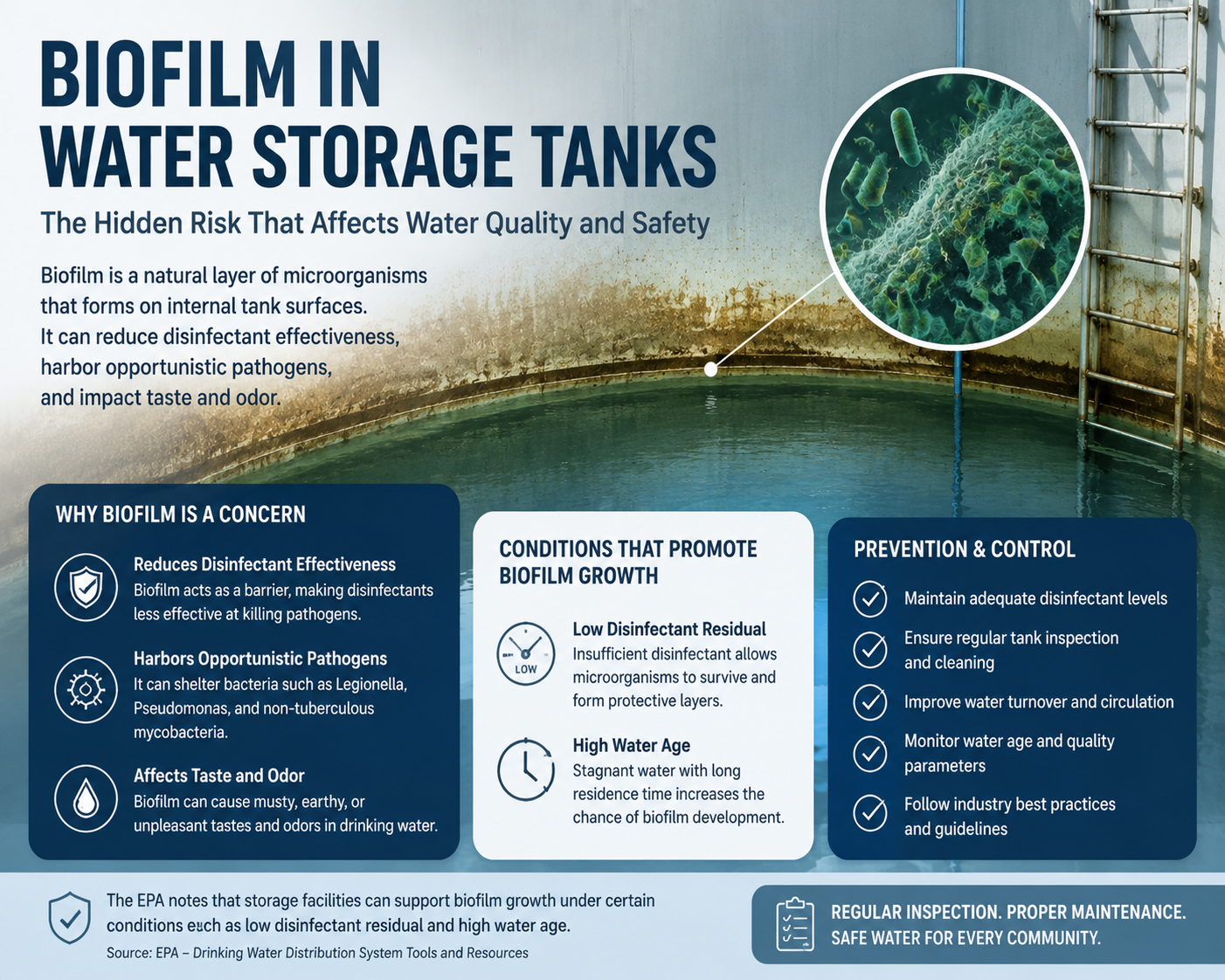
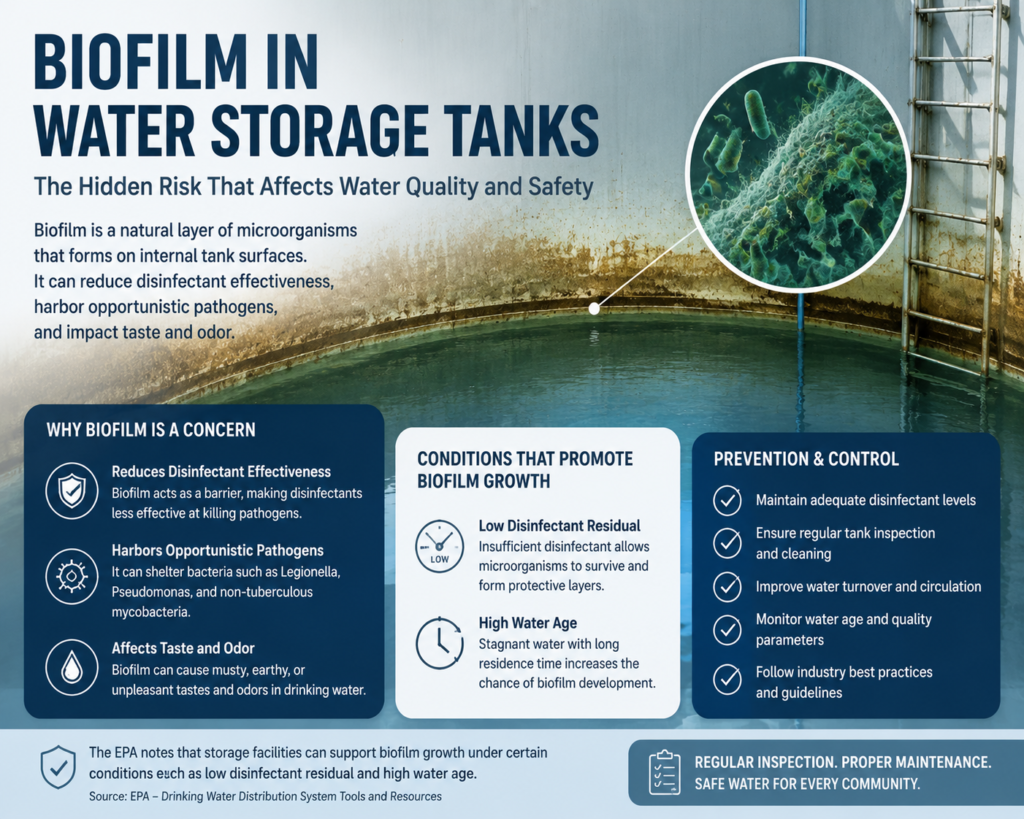
Biofilm in water storage tanks
Biofilm is one of the hardest problems to detect visually.
It forms slowly on internal surfaces and can:
- reduce disinfectant effectiveness
- harbor opportunistic pathogens
- affect taste and odor
why external environment matters more than structure
Tank roofs are constantly exposed to:
- bird droppings
- rainwater runoff
- dust accumulation
- vegetation debris
A small crack or poor drainage slope can slowly turn into contamination entry over time.
Recommended inspection frequency
Industry practice is usually:
- Monthly: external walkaround (vents, hatches, overflow)
- Quarterly: partial functional inspection
- Annually: full structural + sanitary inspection
- Every 5 years: internal inspection and coating review (AWWA practice)
AWWA standards emphasize periodic structural inspection for steel storage tanks and coating integrity evaluation.
Final note
A proper finished water storage tank inspection is less about checking equipment and more about understanding how contamination actually enters the system.
Most failures don’t happen suddenly—they build slowly at vents, hatches, overflow paths, sediment zones, and biofilm layers.
Once those points are controlled, the entire system becomes significantly more stable.
And that is exactly where most operators start seeing the difference.
FAQ
How often should vents be inspected?
Monthly visually, and after storms or maintenance work.
What is the biggest contamination risk in storage tanks?
Unsealed hatches and damaged vent screens are the most common entry points.
Does sediment always mean contamination?
Not always, but it indicates stagnation or circulation issues that must be checked.
Can biofilm be fully prevented?
No. It can only be controlled through cleaning, circulation, and disinfectant management.