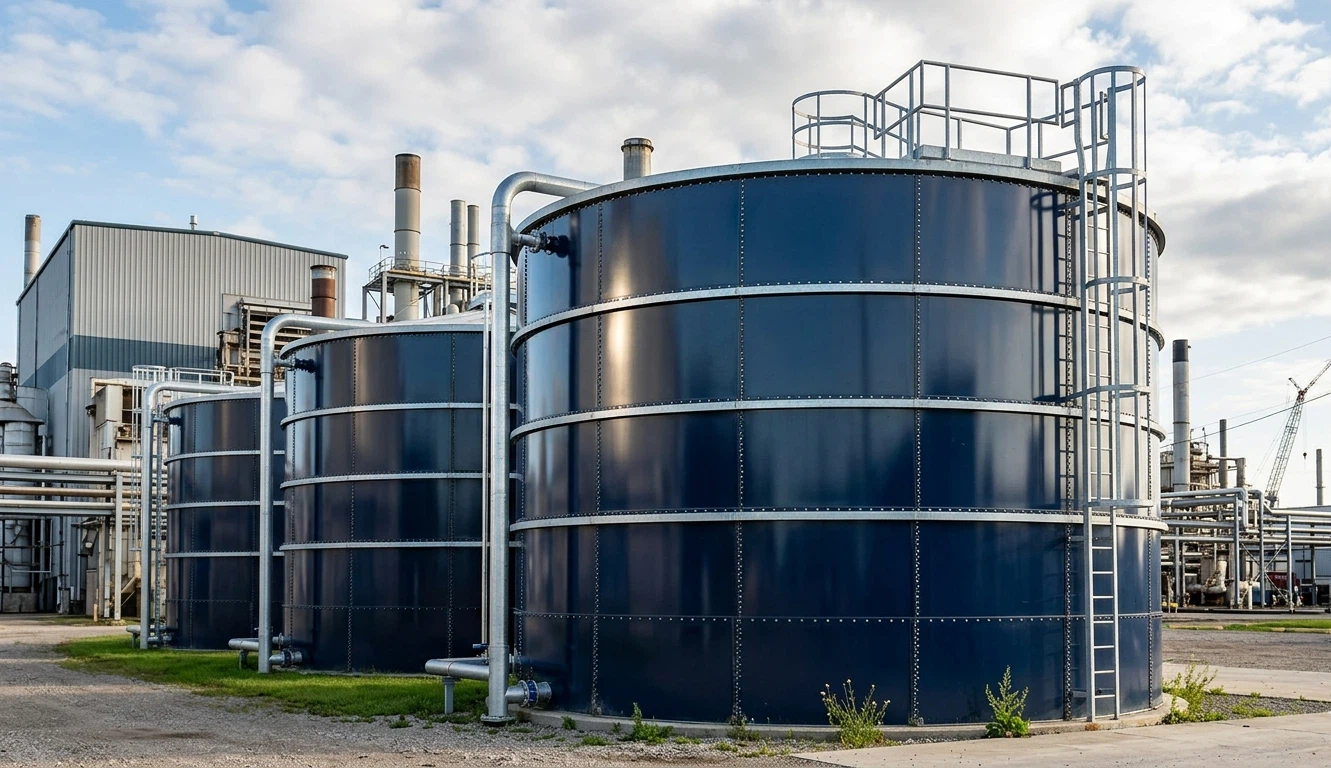
Purchasing departments often trim 15% off upfront capital expenditure (CapEx) by selecting standard industrial water tank materials without checking structural boundaries. Six months later, stagnant chloride pitting causes a microscopic seam leak. A 48-hour unplanned plant shutdown follows, costing tens of thousands of dollars—erasing the initial procurement savings instantly.
The goal of this engineering breakdown is to strip away marketing claims and look at the physical limits of fluid storage. We will directly examine how water chemistry, thermal cycling, and environmental stressors dictate failure rates.
جدول المحتويات
What Drives the True TCO in Industrial Water Tank Materials?
The price tag on a Purchase Order (PO) represents just the baseline. The real financial drain in fluid storage comes from operational expenditure (OpEx) and failure mitigation.
If you specify improper industrial water tank materials for aggressive media, you do not just pay for a new tank. You pay for confined space entry permits, hazardous liquid transfer, heavy crane rentals, and immediate plant downtime.
Before approving the final spec sheet, reviewing a hard-data industrial water tank cost guide exposes these hidden mechanical lifecycle costs. Structural engineers understand that metal gauge thickness and chemical inertness outrank initial discounts. As heavily debated by site managers in this civil engineering Reddit thread discussing early tank failures, prioritizing a cheaper carbon steel over a chemically compatible alloy is the most common fatal error in industrial site planning.
How Does Water Chemistry Dictate Water Tank Material Selection for Industry?
Drop the assumption that all heavy metals react the same way to stored liquids. pH fluctuations and total dissolved solids (TDS) dictate the exact survival timeline of your storage system.

For high-purity pharmaceutical processing, reverse osmosis (RO) systems, or food-grade storage, a stainless steel tank acts as the mandatory baseline. However, even premium 316L alloys will suffer rapid catastrophic failure if chloride levels exceed 200 ppm and the water remains stagnant.
According to The Engineering ToolBox’s technical breakdown of metal corrosion resistance, localized pitting aggressively attacks the passive oxide layers in stainless alloys when exposed to highly chlorinated environments. The metal does not thin out evenly; it forms microscopic pinholes that breach the tank wall rapidly.
This specific failure mode is exactly why rigorous stainless steel water tank maintenance focuses heavily on weld seam dye-penetrant inspections and repassivation, rather than just exterior washing. You must maintain the chemical film, not just the physical steel.
Which External Environments Destroy Standard Tanks?
Outdoor installations introduce UV degradation, C5 coastal marine salt spray, and extreme wind loads. Choosing the wrong exterior finish guarantees structural decay before the interior ever fails.
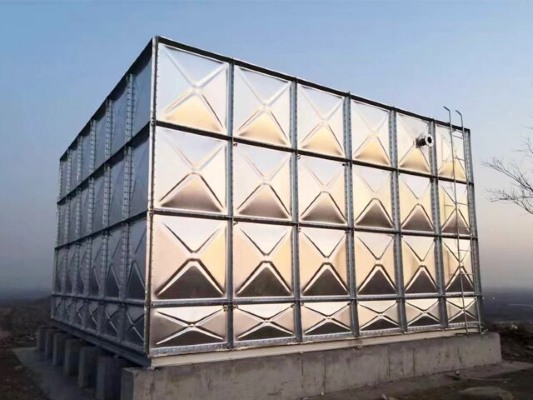
For standard municipal raw water or factory fire protection loops, a heavy-duty galvanized tank provides massive structural rigidity at a significantly lower initial CapEx. The 610g/m² zinc coating physically acts as a sacrificial barrier, oxidizing before the underlying steel does.
Yet, galvanic corrosion is mathematically inevitable if dissimilar metals touch within the piping connections, a chemical reaction thoroughly detailed in Wikipedia’s engineering reference on Galvanic Corrosion. Because the zinc is actively sacrificing itself, strict galvanized water tank maintenance scheduling is mandatory to monitor anode depletion and replace sacrificial blocks before the bare steel is exposed.
If the site is located in a coastal chemical plant subjected to severe salt fog, standard metal becomes a continuous liability. A fiberglass tank (FRP) eliminates atmospheric rusting entirely due to its non-metallic composite structure. While FRP perfectly handles external atmospheric harshness, site operators must execute standard fiberglass water tank maintenance tips to prevent internal resin micro-cracking caused by repetitive hydraulic fill-and-empty cycles over a decade.
When is an Enamel or Underground System the Only Valid Choice?
Boiler feedwater systems, anaerobic digesters, and industrial wastewater treatment plants involve severe thermal shocks (routinely exceeding 80°C) and wild pH swings from highly acidic to highly alkaline.
Standard epoxy linings blister and peel off the steel under these thermal expansions. An enamel tank solves this by physically fusing industrial glass to structural steel plates at temperatures over 850°C, creating a near-inert surface.
Your only operational requirement is scheduling proper enamel water tanks maintenance to ensure joint bolt torque remains to spec and the glass edges avoid mechanical impact during plant operations.
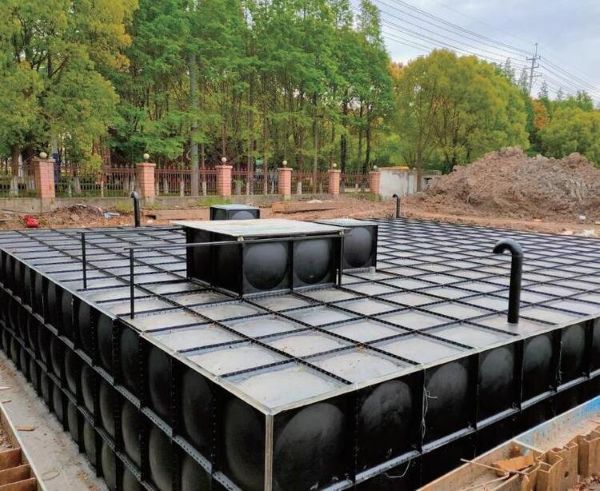
Furthermore, if above-ground real estate carries a massive premium, or if severe winter freezing is a constant threat in northern climates, material properties shift toward spatial engineering. An underground water tank
system leverages the natural geothermal insulation of the earth, removing the vessel from surface freezing hazards entirely. However, according to the EPA’s technical guide on drinking water storage tanks, underground containment requires highly specific soil-load-bearing engineering to prevent side-wall collapse under empty loads.
How to Compare Industrial Water Tank Materials Logically?
Do not look at the vendor’s price sheet first. Look at your site’s physical constraints. When evaluating different industrial water tank materials, use this hard-stop engineering checklist to filter out failing systems:
- Are Chlorides > 200ppm? Reject standard 304 SS immediately. Upgrade to 316L alloy or specify Enamel.
- Is it an extreme outdoor UV and coastal salt zone? Favor FRP composites over standard painted steel to eliminate external repainting costs.
- Does the ground space cost exceed the tank cost? Move directly to Underground modular systems.
- Does the continuous operating temperature exceed 60°C? Reject standard galvanized linings and epoxies; specify Enamel.
By applying these rigid physical limits, you filter out incompatible industrial water tank materials before a supplier even sends a quote.
التعليمات
What causes standard steel tanks to fail rapidly in factory settings?
Ignored water chemistry. Fluctuating pH levels, untreated chlorides, or stray electrical currents from nearby grounding equipment cause rapid localized pitting, which easily bypasses standard structural wall thickness calculations.
Does paying a higher CapEx upfront guarantee zero maintenance?
No. Even premium alloys require strict inspection schedules. Enamel requires bolt tension checks, FRP requires hydraulic stress monitoring, and stainless steel requires weld seam passivation layer testing.
How do I quickly compare industrial water tank materials for a specific project?
Start strictly with a water analysis report. Match the specific pH, temperature profile, and chloride concentration directly to the material’s maximum operating limits, ignoring the initial price tag until structural safety is confirmed.