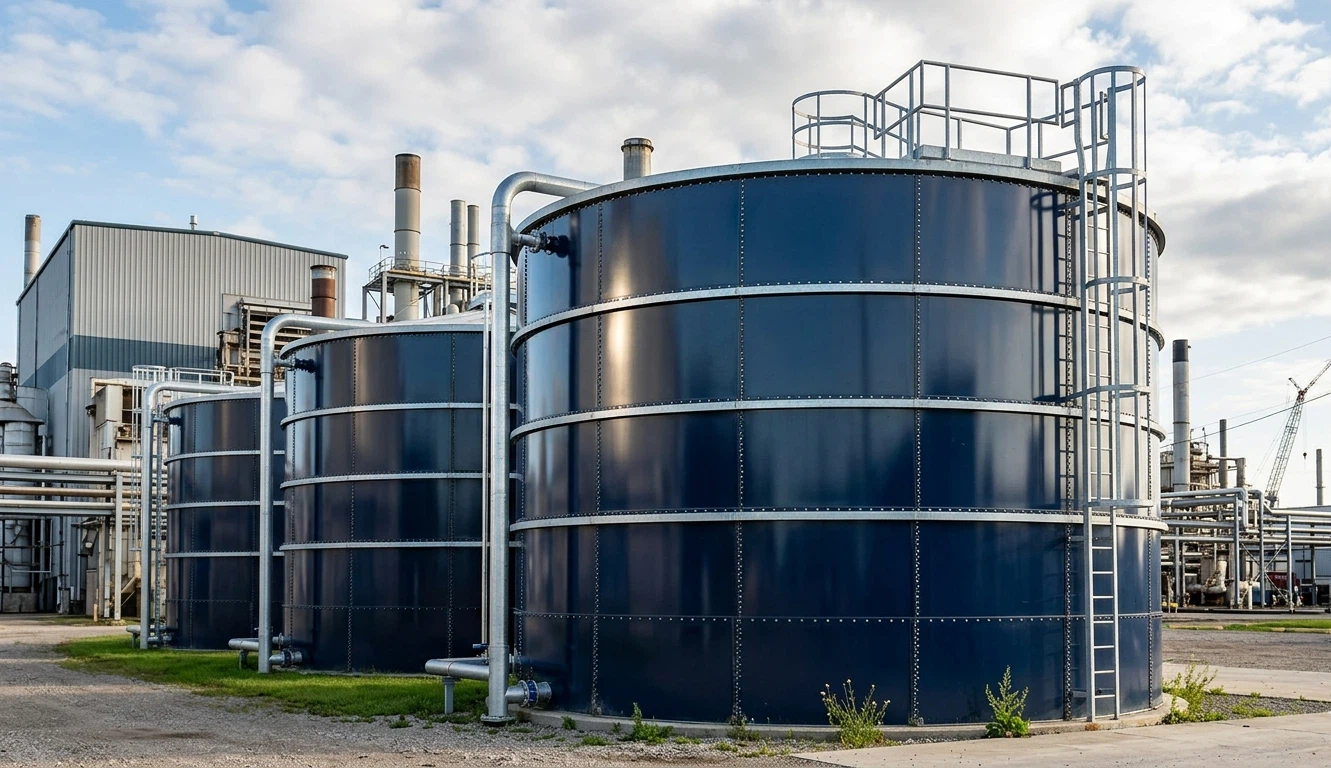
For industrial facility managers and engineers, the storage of water—whether for fire protection, potable use, or manufacturing processes—represents a significant capital investment. Understanding the industrial water tank lifespan is not merely a matter of maintenance; it is a critical component of long-term asset management and operational safety. A tank that fails prematurely can lead to catastrophic property damage, production downtime, and safety hazards.
In the current global market, where material costs are volatile, maximizing industrial tank longevity is a top priority. While many factors influence how long a storage system remains viable, the foundation of a long-lasting asset begins with material selection and environmental awareness. In this guide, we will break down the variables that define the life cycle of these essential structures.
Оглавление
Average Lifespan by Material
One of the most frequent questions procurement officers ask is: How long do industrial water tanks last? The answer varies significantly based on the substrate used in construction. A steel vs FRP tank lifespan comparison reveals that while steel offers superior structural rigidity, FRP (Fiberglass Reinforced Plastic) excels in specific corrosive environments.
Below is a comparative breakdown of the expected service life for common industrial tank materials under standard operating conditions:
| Тип материала | Estimated Service Life | Ключевое преимущество |
| Нержавеющая сталь (304/316) | 30–50+ Years | Superior water tank durability and hygiene. |
| Glass-Fused-to-Steel (Enamel) | 30–40 Years | Exceptional corrosion resistance tank properties. |
| Оцинкованная сталь (Bolted) | 20–35 Years | Cost-effective with modular installation. |
| Стекловолокно (FRP/GRP) | 20–30 Years | Zero rust; ideal for harsh chemical storage. |
| Concrete (Cast-in-place) | Более 50 лет | Maximum structural permanence, though prone to cracking. |
When analyzing the industrial water tank lifespan, it is important to note that these figures assume the tank was designed to meet specific site-loading requirements and seismic codes.
Factors That Affect Industrial Water Tank Lifespan
Determining what affects industrial water tank lifespan requires a multi-faceted approach. No two installations are identical, and the following variables play a decisive role in the degradation rate of the structure:
1.Water Chemistry: The pH level, chloride content, and presence of heavy metals in the stored water can accelerate internal corrosion.
2.Cycle Frequency: High-frequency filling and emptying cycles create mechanical stress on the tank joints and seals, potentially shortening the industrial water tank lifespan.
3.Coating Integrity: For carbon steel tanks, the internal lining acts as the primary barrier against oxidation. Once this barrier is breached, the structural integrity begins to decline.
4.Foundation Stability: Even the highest quality corrosion resistance tank will fail if the foundation settles unevenly, leading to structural stress fractures.
Corrosion and Environmental Impact
Corrosion is the single greatest threat to industrial tank longevity. In coastal regions or industrial zones with high sulfur dioxide levels, external atmospheric corrosion can be as damaging as internal oxidation. A high-quality corrosion resistance tank utilizes specialized coatings or alloys to mitigate these risks.
For instance, localized “pitting corrosion” in stainless steel or the depletion of the zinc layer in galvanized systems can compromise the industrial water tank lifespan long before the projected 30-year mark. Environmental factors such as UV radiation also impact fiberglass structures, leading to “fiber blooming” if the exterior is not properly gel-coated or painted.
Extending the Industrial Water Tank Lifespan
To maximize your ROI, proactive management is essential. The secret to industrial tank longevity lies in the transition from reactive repairs to predictive maintenance.
A critical component of this strategy is the Industrial Water Tank Cleaning Frequency
, which directly influences the buildup of sediment and microbial growth that can trigger localized corrosion. Consistent monitoring allows for the early detection of coating failures or minor leaks before they necessitate a full system overhaul, thereby preserving the industrial water tank lifespan.
Extending Tank Lifespan
To maximize your ROI, proactive management is essential. The secret to industrial tank longevity lies in the transition from reactive repairs to predictive maintenance.
A critical component of this strategy is the maintenance frequency, which should be determined by a professional risk assessment based on your specific water quality and usage. Consistent monitoring allows for the early detection of coating failures or minor leaks before they necessitate a full system overhaul.
Depending on your specific tank type, you should follow specialized protocols:
- Regular Galvanized Water Tank maintenance prevents the early onset of “white rust” on the zinc coating.
- For food-grade or pharmaceutical use, Техническое обслуживание резервуаров для воды из нержавеющей стали ensures the passive chromium oxide layer remains intact.
- The high-performance nature of Техническое обслуживание эмалированных резервуаров для воды involves checking the integrity of the glass-to-steel bond.
- Corrosion-free doesn’t mean maintenance-free; Fiberglass Water Tank maintenance focuses on structural sealants and UV protection.
- For hidden assets, Техническое обслуживание подземных резервуаров для воды requires specialized sensors to detect soil-side corrosion or structural shifts.
By adhering to these specific guides, you can effectively extend the industrial water tank lifespan by decades.
Replacement vs. Repair Decision Guide
Eventually, every facility faces the “Repair or Replace” dilemma. When evaluating the industrial water tank lifespan, consider the “Rule of 50.” If the cost of a comprehensive repair exceeds 50% of the cost of a new installation, replacement is often the more financially sound decision.
- Repair if: The issues are localized (e.g., minor lining failures), the structural shell is sound, and the repair can extend the industrial water tank lifespan by at least 10 years.
- Replace if: There is widespread structural thinning, chronic leaking at the floor-to-wall joints, or if the tank no longer meets updated fire or safety codes.
Prioritizing water tank durability in your replacement choice will ensure that the next cycle of investment yields even better results.
Заключение
The industrial water tank lifespan is not a fixed number, but a variable that can be controlled through smart engineering and diligent care. By selecting a high-quality corrosion resistance tank and implementing a rigorous maintenance schedule, you ensure that your facility remains operational and safe for decades.
Часто задаваемые вопросы
How long do industrial water tanks last on average?
Most modern industrial water tank lifespan expectations range from 20 to 50 years, depending heavily on material choice and environmental conditions.
Does water temperature affect industrial tank longevity?
Yes. Higher temperatures accelerate chemical reactions, including corrosion. Specialized linings are required for hot water storage to maintain the industrial water tank lifespan.
Is a steel vs FRP tank lifespan comparison always in favor of steel?
Not necessarily. In highly acidic or saline environments, an FRP tank may have a longer industrial water tank lifespan because it is naturally immune to rust, whereas steel requires constant coating maintenance.
How can I tell if my industrial water tank lifespan is coming to an end?
Visible signs include persistent weeping at the seams, significant external scaling, or internal “blistering” of the coating. A professional ultrasonic thickness test can provide a definitive answer regarding water tank durability.