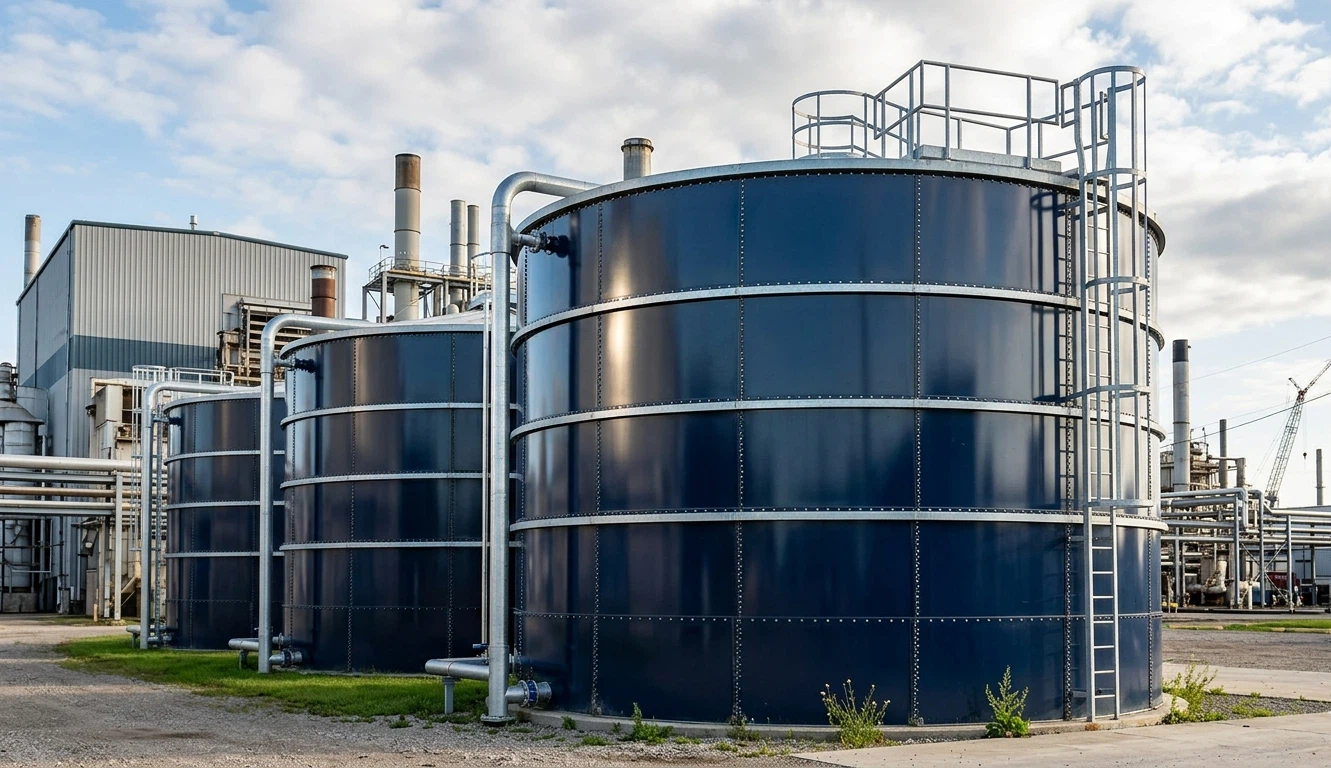
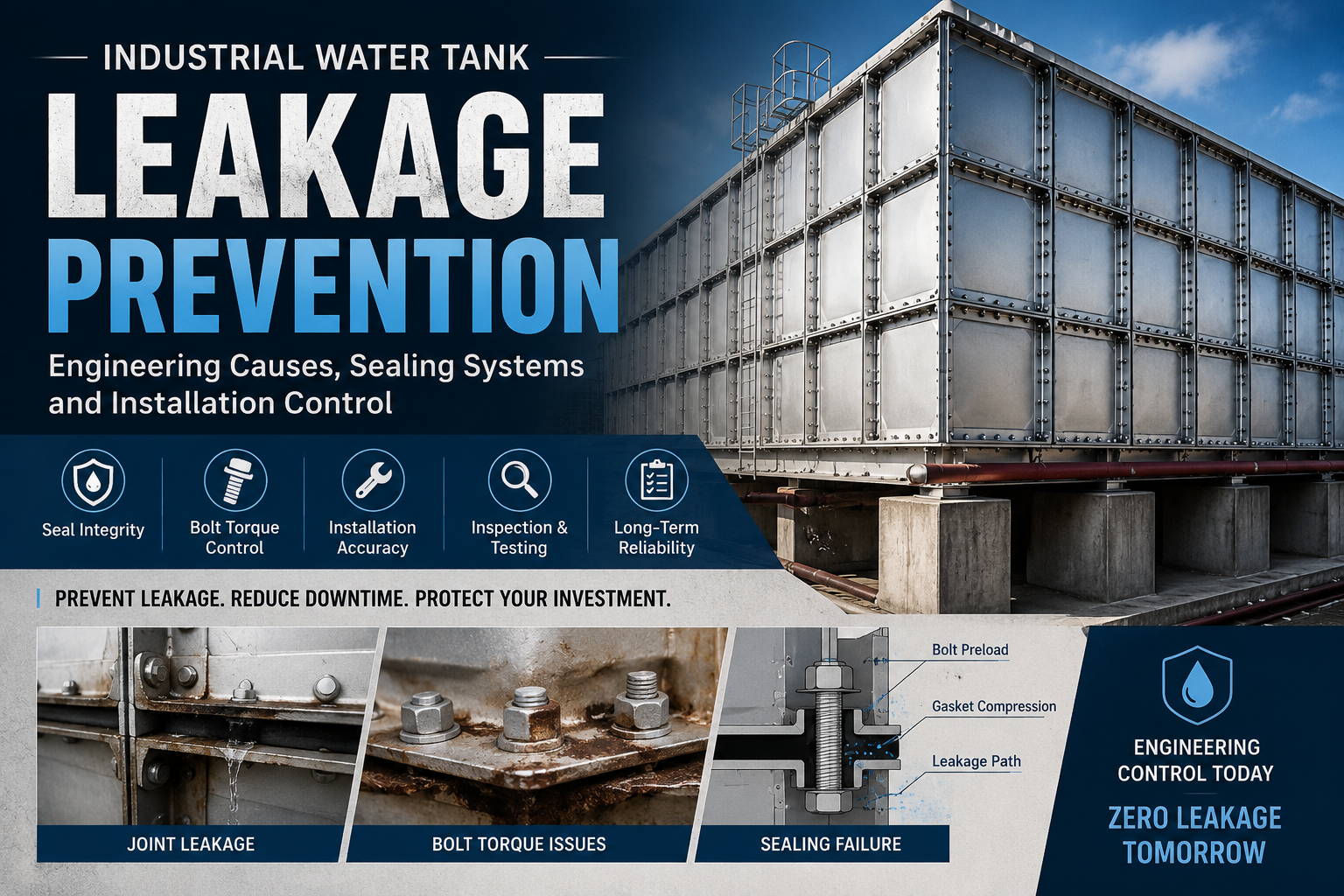
Most problems with an enamel coating potable water tank do not start in the middle of a glossy panel. They usually start at the edges, bolt holes, gasket contact areas, and panel joints—the places that are cut, handled, tightened, sealed, and exposed to water after assembly.
This article looks at the details buyers often miss: edge protection, bolt zone control, panel joint sealing, handling damage, and the inspection points that should be checked before the tank is filled.
Оглавление
Why a Smooth Panel Surface Is Not Enough
Most buyers first look at the large flat surface of an enamel tank panel. That is understandable. Scratches, color inconsistency, pinholes, and coating defects are easier to see on the main panel face.
But an enamel coated water tank is not assembled from flat panels alone. Once the tank is built, performance depends on many small contact points:
- panel edges
- bolt holes
- bolt washers
- gasket contact areas
- sealant lines
- panel overlap zones
- lifting and handling marks
- field assembly pressure
For an enamel coating potable water tank, the big flat area may look perfect, while hidden risk sits around the panel edge or bolt zone. That is why buyers should inspect the assembled-risk areas, not only the visible finish.
What Makes Edge Protection So Important in an Enamel Coating Potable Water Tank?
Panel edges are easy to underestimate.
They are handled during production, stacked during packing, exposed during transport, lifted during installation, and compressed near joints after assembly. Even if the panel face is well protected, the edge may see more mechanical contact.
Edge damage can happen when:
- panels rub against each other during transport
- lifting tools touch coated corners
- workers drag panels instead of lifting them
- bolts are aligned roughly on site
- sharp tools contact the coating during assembly
The risk is simple: if the coating chips at the edge, the steel substrate may become exposed. In potable water storage, exposed steel near a joint is not just a cosmetic issue. It can become a starting point for corrosion, staining, or future maintenance problems.
ISO 28765 covers vitreous enamel-coated bolted cylindrical steel tanks for storage or treatment of water and related liquids, which shows that enamel-coated bolted tank design has its own specific engineering context rather than being treated like ordinary painted steel.
For buyers, edge inspection should be practical. Before installation, check whether:
1.corners are chipped;
2.panel edges show exposed steel;
3.coating wraps consistently around the edge area;
4.packaging protected the panel perimeter;
5.any repair area is documented and approved.
A good enamel tank panel is not only smooth in the middle. It should arrive with the edges protected enough for real assembly conditions.
Are Bolt Zones Hidden Corrosion Points in Bolted Enamel Tanks?
Bolt zones are one of the most important inspection areas in a bolted enamel water tank.
A bolt hole is not just a hole. It is a mechanical connection point, a pressure point, a sealing area, and a coating boundary. When the tank is assembled, this area may involve:
- coated steel panel
- hole edge coating
- bolt shank
- washer
- gasket or sealant
- panel overlap
- installation torque
That is a lot of stress and contact in a small space.
For a glass fused to steel tank, bolt zone corrosion is usually not about one dramatic mistake. It often comes from several small issues working together:
- coating chips around the hole;
- gasket not seated evenly;
- incorrect bolt torque;
- dirt trapped around the joint;
- sealant discontinuity;
- repeated wet-dry cycles around the contact area.
This is why bolt holes should be checked before panels are lifted into position. Once the tank is assembled and filled, these areas are much harder to inspect.
How Do Panel Joints Affect Leakage and Potable Water Safety?
Panel joints decide whether a bolted enamel water tank behaves like a tank or just a collection of coated panels.
A tank panel joint must handle water pressure, panel movement, bolt tension, gasket compression, thermal change, and long-term contact with stored water. The surface coating helps protect the steel, but the joint must provide sealing and structural continuity.
In a bolted enamel water tank panel joint, buyers should pay attention to:
- panel alignment;
- bolt spacing;
- gasket continuity;
- sealant compatibility;
- overlap condition;
- torque sequence;
- whether the joint can be inspected after assembly.
That means buyers should not only ask about the enamel panel. They should also ask about sealants, gaskets, coatings, and other water-contact components.
For a potable water tank coating system, joint safety is not only about preventing leaks outside the tank. It is also about avoiding hidden areas where poor sealing, damaged coating, or unsuitable materials could affect long-term storage conditions.

Where Does Coating Damage Happen Before the Tank Is Filled?
Many coating problems begin before the first water test.
The tank may be well designed and the panels may leave the factory in good condition. Then the damage happens during:
- container loading;
- unloading at the project site;
- stacking on uneven ground;
- lifting with unprotected slings;
- panel dragging;
- temporary storage in rain or dust;
- bolt alignment with hard tools;
- rushed installation.
This matters because enamel coating is hard and chemically stable, but it is not immune to impact. A hard coating can still chip if it is struck at an edge or corner.
For buyers, this creates a simple rule: inspection should happen before assembly, during installation, and before filling. Waiting until the tank is full makes many panel edges, bolt zones, and joints harder to access.
What Should Buyers Inspect Before Accepting Enamel Tank Panels?
This checklist is not for laboratory testing. It is for practical project inspection before installation and during acceptance.
| Inspection Area | What to Check | Why It Matters |
|---|---|---|
| Panel surface | Scratches, pinholes, uneven coating | Prevents exposed steel on large areas |
| Panel edges | Chips, impact marks, exposed steel | Edges are high-risk handling points |
| Bolt holes | Coating continuity around holes | Reduces hidden corrosion under bolts |
| Panel joints | Alignment, overlap, sealant continuity | Prevents leakage and crevice risk |
| Sealant contact area | Clean surface and correct material | Supports long-term water-tightness |
| Installation handling | Tool marks, lifting damage, storage scratches | Avoids damage before water filling |
The table is useful because it changes the buying question.
nstead of asking, “Is the enamel coating good?” buyers should ask, “Are the highest-risk areas still protected after production, shipping, and installation?”
That is the real inspection logic for an enamel coating potable water tank.
When Should Buyers Compare Enamel and Stainless Steel Tanks?
Enamel tanks can be a strong choice for many drinking water storage projects, especially when modular assembly, factory coating, and large-volume storage are important. But some projects still compare enamel panels with stainless steel tanks.
That comparison is reasonable when the buyer is looking at:
- site installation limits;
- water quality requirements;
- cleaning methods;
- budget;
- expected service life;
- maintenance access;
- whether the tank should be bolted or welded;
- whether the internal surface should have fewer fastener contact points.
If the project team is still comparing enamel panels with stainless steel tank options, this practical guide on enamel vs stainless steel potable water tank can help frame the material decision before looking deeper at coating details.
The key is not to force one material into every project. The better decision comes from matching the tank structure, water quality, installation site, and maintenance plan.
What Makes an Enamel Coating Potable Water Tank More Reliable After Assembly?
A reliable tank is not proven by one claim. It is proven by several controlled details working together.
For an enamel coating potable water tank, buyers should look for evidence that:
- coating thickness and visual quality are controlled;
- edges are protected during shipping;
- bolt holes are coated and inspected;
- joint sealant is suitable for potable water contact;
- panel alignment is controlled during installation;
- bolt torque is managed instead of guessed;
- installation damage is recorded and repaired correctly;
- the tank is inspected before being filled.
That is the practical reason to focus on edge, bolt, and joint details. They are not small details once the tank is storing drinking water.
What Documentation Should a Serious Buyer Ask For?
For overseas projects, the inspection should not depend only on verbal promises.
Ask for documents that connect the coating system to real project conditions:
- coating specification;
- panel inspection record;
- water-contact material information;
- sealant or gasket data;
- installation manual;
- bolt torque guidance;
- repair procedure for small coating damage;
- packing and handling instructions;
- project photos before filling;
- hydrostatic test record after assembly.
For project buyers, documentation makes later disputes easier to solve. If a leak or corrosion point appears after assembly, good records help determine whether the problem came from manufacturing, transport, installation, repair, or operation.
What Buyers Should Check Before the Tank Is Accepted
A glossy enamel panel is easy to approve. The harder part is checking the areas that will actually be stressed after the tank is assembled.
Edges can be damaged during handling. Bolt holes can hide coating chips under washers or gaskets. Panel joints can look acceptable before filling, then become the first place where seepage or maintenance work appears.
For an enamel coating potable water tank, the better question is not only “Is the coating good?” It is:
Can the coating survive the way the tank is packed, lifted, bolted, sealed, inspected, and used?
That is why buyers should ask for clear details on edge protection, bolt zone treatment, joint sealing, potable-water-contact materials, and installation checks before the tank is accepted. These small areas are where long-term tank performance is often decided.
Часто задаваемые вопросы
Is enamel coating safe for potable water tanks?
It can be, but buyers should not judge safety by the word “enamel” alone. They should check the coating system, water-contact materials, sealants, gaskets, inspection records, and project requirements.
Why do enamel water tank panels fail at joints?
Common reasons include damaged coating near the joint, uneven panel alignment, poor sealant continuity, incorrect bolt torque, gasket problems, or installation scratches around the joint area.
Are bolt holes weak points in bolted enamel water tanks?
They are not automatically weak points, but they are important inspection points. Bolt holes combine coating edges, mechanical pressure, washers, gaskets, and sealant contact in one small area.
How should buyers inspect enamel coating on water tank panels?
Buyers should check the panel face, edges, bolt holes, joint contact areas, packaging condition, lifting marks, and any repair points before installation begins.
Is enamel better than stainless steel for potable water tanks?
Not always. Enamel and stainless steel tanks solve different project problems. The right choice depends on budget, water quality, tank size, installation method, cleaning needs, and long-term maintenance access.
What is the biggest hidden risk in a bolted enamel water tank?
The biggest hidden risk is usually not the middle of the panel. It is more often found around edges, bolt zones, panel joints, sealant lines, and areas damaged during handling or installation.