An NSF 61 water tank certificate does not always mean the whole tank system is approved for every potable water project. It may cover a coating, liner, gasket, sealant, fitting, or a specific product series only. This guide shows buyers how to read the certificate scope, match it with drawings and BOMs, and avoid approval delays before ordering a potable water tank.
Table of Contents
Does an NSF 61 Water Tank Certificate Cover the Whole Tank?
The first question buyers should ask is simple: does the NSF 61 water tank certificate cover the full tank, or only one water-contact material?
The answer is: not always.
NSF explains in its article on NSF/ANSI/CAN 61 for drinking water system components that the standard applies to products and materials that contact drinking water, including protective barriers, joining and sealing materials, pipes, fittings, and mechanical devices. That scope is useful, but buyers still need to check what the actual certificate lists.
For a broader explanation of how the standard applies to potable water projects, start with this guide to NSF 61 water tank verification. Then use this article to review certificate scope in more detail.
A coating certificate does not automatically approve the gasket. A gasket certificate does not automatically approve the tank shell. A stainless steel material record does not automatically approve sealants, fittings, vents, or accessories.
That is why the certificate must be checked against the real tank configuration.
What Should Buyers Check on the Certificate?
A buyer should not only look for the words “NSF 61.” The details matter. A valid NSF 61 water tank certificate should point to a specific certified product or material, not a vague sales claim.
When reviewing an NSF 61 water tank certificate, check these items:
1.Manufacturer name
2.Product or trade name
3.Certification standard
4.Certified product type
5.Water-contact material
6.Model, series, or size range
7.Temperature or use limitation
8.Listing status
9.Certificate issue or listing date
The NSF official Certified Drinking Water System Components search page allows users to search listed components under Standard 061. Buyers can use this kind of listing to confirm whether the certificate matches the supplier, product name, and intended water-contact use.
If the information is unclear, ask the supplier for the full listing page, not only a cropped certificate image.
What Does NSF 61 Certification Scope Include?
The phrase “NSF 61 certification scope” means the exact product, material, or component covered by the certification.
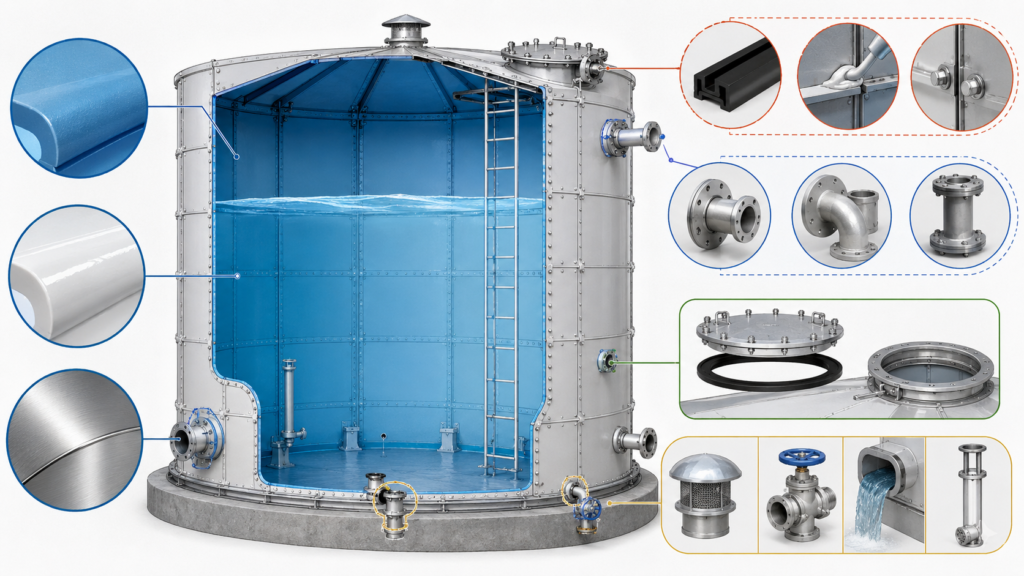
For potable water tanks, the scope may include:
- internal coating or lining
- enamel or glass-fused contact
- surfacestainless steel contact surface
- gasket material
- sealant or joint compound
- nozzles and fittings
- manhole components
- vents, drains, and overflows
- internal accessories exposed to stored water
This is where many projects get confused. The NSF 61 water tank certificate may be valid, but not broad enough for the actual tank supplied.
UL Solutions’ page on health effects testing and certification for drinking water system components explains that products evaluated to NSF/ANSI/CAN 61 are exposed to test water and analyzed for contaminants based on materials of construction. This reinforces a key point: the tested material and the supplied material must match. If the NSF 61 water tank certificate names only one material, buyers should not assume other wetted parts are included.
For practical purchasing review, this potable water tank compliance checklist explains how buyers can connect certification, drawings, wetted parts, and delivery records before confirming an order.
Why Component Certification Is Not the Same as Tank Approval
A potable water tank is a system. It is not only a panel or shell.
An NSF 61 water tank certificate can be misleading if the buyer does not ask what it covers. For example, a tank supplier may provide documentation for an internal coating. That may be helpful, but the project may also need confirmation for gaskets, sealants, bolts, fittings, and other wetted parts.
This is especially important for bolted tanks. Panel joints may use gaskets and sealants that contact stored water. If those parts are not suitable, the project can face questions even when the main tank panel looks correct. For this reason, the NSF 61 water tank certificate should be reviewed together with the complete water-contact parts list.
For stainless steel tanks, buyers should still check welded areas, surface finish, nozzles, fittings, and sealing materials. If the project is still comparing materials, this enamel vs stainless steel potable water tank guide can help connect material choice with inspection and documentation.
How to Match the Certificate With Drawings and BOM
The fastest way to avoid confusion is to compare three documents together:
- the certificate or official listing
- the tank drawing
- the bill of materials
The drawing shows what will touch the water. The BOM shows what will be supplied. The certificate shows what has been certified.
If those three do not match, the buyer should pause. An NSF 61 water tank certificate that cannot be matched to the drawing is weak evidence for project approval.
A good review should ask:
- Does the listed product name match the quotation?
- Does the model or series match the drawing?
- Are the same gaskets and sealants listed in the BOM?
- Are the nozzles, vents, manholes, drains, and overflows identified?
- Are all wetted parts reviewed?
- Are substitutions controlled before shipment?
This step turns the NSF 61 water tank certificate from a marketing claim into a project approval document.
Which Water-Contact Materials Are Easy to Miss?
The most common mistake is checking the large visible surface and ignoring smaller parts.
Buyers should pay special attention to:
- gasket strips between panels
- sealants used at joints
- internal bolt areas
- flange gaskets
- manhole seals
- nozzle liners
- overflow screens
- drain parts
- vent screens
- internal ladders or supports, if exposed to stored water
In potable water projects, small parts can become approval risks because they may stay in contact with stored water for years. The NSF 61 water tank certificate should therefore be checked against every wetted component, not only the tank wall.
This is also where water tank safety standards matter. NSF 61 focuses on drinking water contact health effects, but other standards may affect structural design, coating performance, inspection, and maintenance requirements.

How to Verify NSF 61 Water Tank Certificate Before Ordering
Buyers searching for “how to verify NSF 61 water tank certificate” usually need a simple workflow.
Use this process to confirm whether the NSF 61 water tank certificate is useful for the actual project:
1.Ask the supplier for the certificate and official listing link.
2.Search the manufacturer name in the certification database.
3.Confirm the standard is NSF/ANSI/CAN 61 or the project-required version.
4.Compare the product name with the quotation.
5.Check whether the scope covers the actual wetted material.
6.Match the scope with the drawing and BOM.
7.Ask whether gaskets, sealants, fittings, and accessories are included.
8.Keep the verification record in the submittal package.
If the supplier cannot explain the scope, do not assume the NSF 61 water tank certificate covers the whole project.
Does NSF 61 Replace Cleaning, Inspection, or Maintenance?
No. Certification is not the same as installation control or long-term tank hygiene.
The EPA’s Finished Water Storage Tank Inspection/Cleaning Checklist asks systems to document tank components and submit labeled photos. That type of inspection mindset is useful because potable water storage depends on more than material selection.
The CDC’s guide on safe water storage also emphasizes cleaning and sanitizing water storage containers before use. Industrial tanks are much larger, but the principle remains useful: the water-contact surface must be protected, cleaned, and managed before service.
An NSF 61 water tank certificate supports material review. It does not replace site cleaning, installation inspection, disinfection requirements, sampling, or maintenance records.
Common Certificate Mistakes That Delay Approval
Many approval problems are avoidable.
Watch for these mistakes:
1.The certificate belongs to another manufacturer.
2.The certificate covers only coating, not the full tank system.
3.The product name does not match the quotation.
4.The model or series is different.
5.Gaskets and sealants are not documented.
6.The supplier says “food grade” instead of providing the scope.
7.The official listing cannot be found.
8.The tank drawing changes after approval.
9.Substituted fittings are not reviewed.
10.Delivery documents do not match the approved submittal.
An NSF 61 water tank certificate with unclear scope does not automatically fail, but it does require clarification.
A buyer does not need to reject every difference immediately. But every difference should be explained before production, shipment, or installation.
Conclusion
An NSF 61 water tank certificate is valuable only when buyers understand what it actually covers. Do not treat one certificate as proof for every panel, gasket, sealant, fitting, vent, drain, or accessory. Match the certificate with the official listing, tank drawing, BOM, potable water tank documentation, water-contact materials, delivery records, and project approval requirements. When the scope is clear, the approval process is easier to defend. When the scope is vague, ask questions before the tank is produced.
FAQ
Does an NSF 61 certificate cover the whole tank?
Not always. It may cover the full tank system, or it may cover only one material or component. Buyers must check the certification scope.
What should buyers check first?
Check the manufacturer name, product name, certified material, model range, standard number, and official listing status.
Are gaskets and sealants part of the review?
Yes. If gaskets or sealants contact stored water, they should be reviewed as water-contact materials.
Is “food grade” the same as NSF 61?“
No. “Food grade” is not the same as a listed NSF 61 certification scope for a potable water tank project.
Can a coating certificate approve the whole tank?
Usually not by itself. The tank system may also include gaskets, sealants, fittings, vents, drains, and other water-contact parts.