In the demanding world of industrial liquid storage, the integrity of a structure isn’t defined by its vast surface area, but by its microscopic boundaries. While Glass-Fused-to-Steel (GFTS) technology has revolutionized the longevity of water and wastewater systems, a persistent “Achilles’ heel” remains: the exposed steel edge. Tank edge encapsulation represents the frontline in the battle against environmental degradation, addressing the physical reality that most coatings fail not on the face of the panel, but where the steel ends.
The reality of liquid storage is that corrosion is opportunistic. It seeks out the path of least resistance, which almost always begins at a sharp corner or an unprotected edge. Understanding the engineering behind these vulnerabilities is the difference between a tank that lasts 30 years and one that requires catastrophic repairs within five.
Table of Contents
Why Coating Pulls Back at the Edge
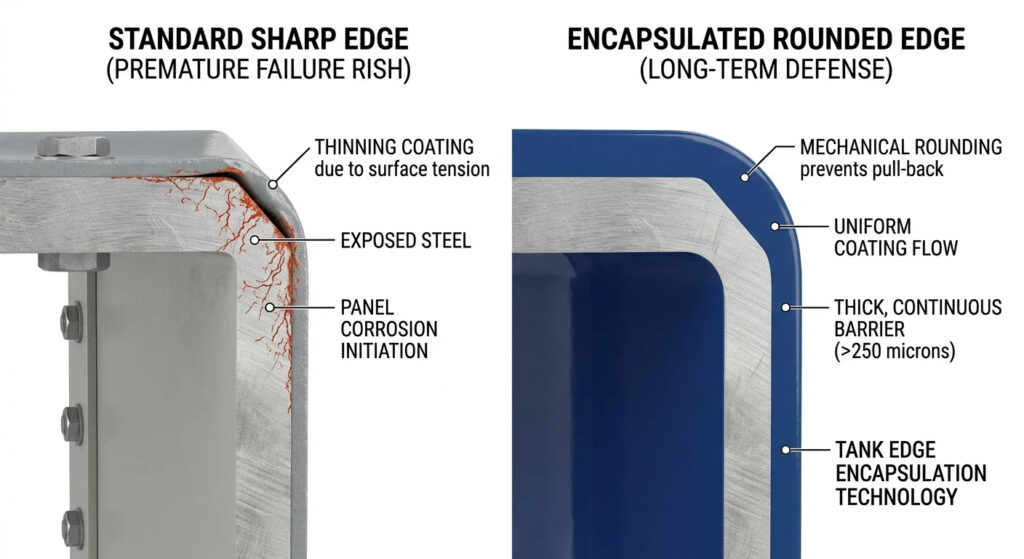
To understand why tank edge encapsulation is a non-negotiable requirement for high-spec projects, we must first look at the physics of surface tension. During the firing process of enamel coated tanks, the liquid frit (glass slurry) behaves like any other fluid. On a flat surface, it levels out perfectly. However, at a 90-degree sharp edge, surface tension causes the liquid to “pull back” or shrink away from the corner.
This results in a coating that is significantly thinner at the very point where the steel is most vulnerable. Without proper tank edge encapsulation, this thin layer becomes the primary site for oxygen and moisture to penetrate the barrier. Once the electrolyte reaches the raw steel, the electrochemical process of panel corrosion begins, often hidden beneath the surface of the enamel until the structural integrity is already compromised.
Why Edge Protection is Critical for Enamel Coated Tanks
When engineers ask why edge protection is critical for enamel coated tanks, the answer lies in the “Anode-Cathode” relationship. In a bolted steel tank, the large surface area of the enameled panel acts as the cathode, while any exposed or thinly coated edge acts as a small, concentrated anode. This imbalance accelerates the rate of metal loss at the edge, leading to rapid pitting and eventual leakage.
Furthermore, industrial environments—especially those involved in wastewater treatment or anaerobic digestion—expose tanks to aggressive chemical vapors. If the edge is not fully sealed through professional tank edge encapsulation, these vapors can cause a fish-scale defect, where hydrogen gas builds up between the steel and the enamel, causing the glass to pop off in small, scale-like flakes. Proper edge treatment provides a continuous barrier that mitigates this internal pressure and ensures a permanent chemical bonding between the glass and the substrate.
Engineering Standards for Tank Edge Encapsulation
Not all edge treatments are created equal. The industry has moved away from simple “edge painting” toward a more robust mechanical approach. The first step in effective tank edge encapsulation is the mechanical rounding or chamfering of the steel edges before the coating process. By removing the “knife-edge,” the enamel can flow evenly around the corner, maintaining a consistent thickness.
Modern tank edge encapsulation often involves the application of a specialized, high-build epoxy or a secondary enamel layer specifically designed for high-stress areas. This ensures that the edge has the same, if not greater, protective thickness than the face of the panel. For projects following the Standard requirements for tank edge protection in wastewater treatment, this level of detail is often the deciding factor in project approval.
Comparing Edge Encapsulation vs Simple Coating
From a GFTS tank maintenance perspective, the cost of prevention is a fraction of the cost of a cure. Many budget-tier manufacturers skip the encapsulation step to reduce production costs, offering a simple “perimeter spray” instead. However, comparing edge encapsulation vs simple coating for enamel tanks reveals a stark difference in service life extension.
| Feature | Simple Edge Coating | Professional Tank Edge Encapsulation |
| Coating Thickness | < 150 microns at edge | > 250 microns (Uniform) |
| Edge Geometry | Sharp / 90-degree | Rounded / Chamfered |
| Corrosion Resistance | Low (Susceptible to chipping) | High (Mechanical bond) |
| Maintenance Interval | 3-5 Years | 15-20 Years |
| Risk of Rust Bleed | High | Near Zero |
The application of tank edge encapsulation eliminates the need for frequent “touch-ups” during the first decade of service. When you factor in the labor costs of scaffolding and downtime for a tank inspection, the ROI on premium edge protection becomes undeniable.
How to Prevent Corrosion on Bolted Steel Tank Edges
If you are currently managing a facility or specifying a new build, knowing how to prevent corrosion on bolted steel tank edges is vital. The process begins during the design phase. Specify that all panels must undergo a CNC-controlled edge rounding process. This ensures that the tank edge encapsulation is not an afterthought but a core part of the manufacturing sequence.
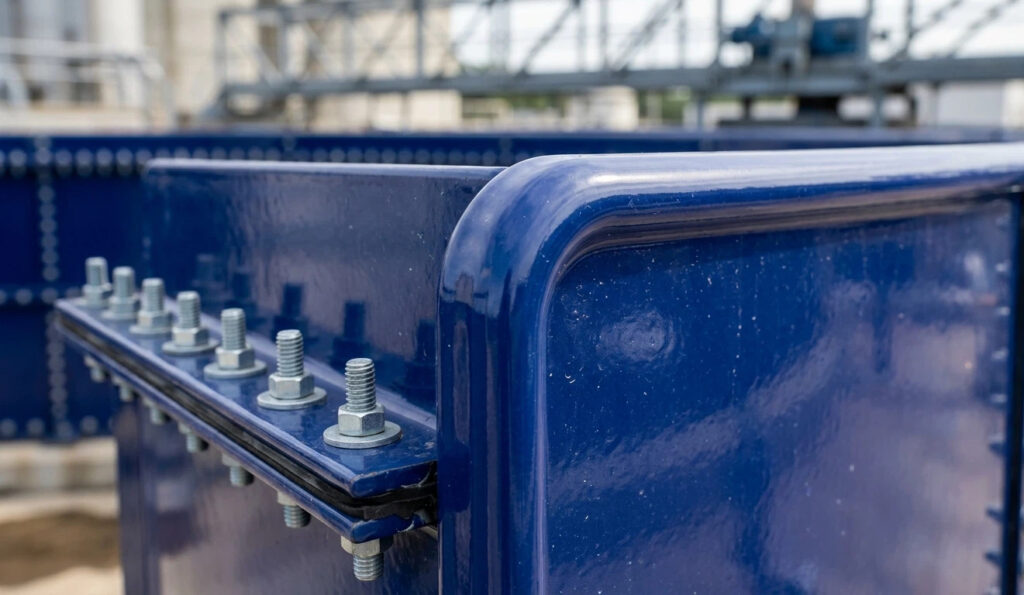
Additionally, during installation, the use of high-grade EPDM gaskets and specialized bolt covers provides a secondary layer of protection. These components work in tandem with tank edge encapsulation to create a hermetically sealed joint. If the edge is properly encapsulated, even if a gasket were to seep slightly, the steel remains shielded by the glass barrier, preventing the spread of panel corrosion behind the liner.
Reference to Global Standards and Authority
Professional tank manufacturing must adhere to stringent global standards to ensure public safety and environmental protection. For instance, ISO 28765:2016 (Vitreous and porcelain enamels — Design of bolted steel tanks for the storage or treatment of water or municipal or industrial effluents and sludges) explicitly details the requirements for coating integrity.
Adhering to these standards is why tank edge encapsulation is considered a benchmark for quality. You can review the full scope of these industrial requirements here: ISO 28765 Standard Documentation.
Conclusion
Ultimately, the quality of an enamel tank is determined by the details that are hardest to see. While a glossy blue finish looks impressive from a distance, it is the integrity of the hidden corners that keeps the system operational. Choosing a partner that prioritizes tank edge encapsulation is a choice to prioritize the long-term viability of your infrastructure.
By understanding why edge protection is critical for enamel coated tanks, project managers can move away from low-bid traps that lead to early failure. Instead, they can invest in systems like the Zhengling Enamel Water Tank, where advanced tank edge encapsulation is a standard of excellence, not an optional upgrade. Protect your edges, and the rest of the tank will take care of itself.
FAQ
Does tank edge encapsulation affect the fit of the bolted panels?
No. When performed correctly during the manufacturing phase, the rounding and encapsulation account for the tolerances required for the EPDM gaskets, ensuring a tighter, more uniform seal than sharp-edged panels.
Can tank edge encapsulation be applied on-site after a tank is built?
It is far less effective. True encapsulation requires the high-heat fusion of enamel to the steel. On-site “cold” applications are usually just edge-sealing with mastics, which do not offer the same chemical bonding or longevity.
Is this necessary for clean water storage?
Yes. While clean water is less aggressive than sewage, the oxygen concentration at the water line (the splash zone) is a prime environment for oxidation. Tank edge encapsulation is essential for any liquid storage intended to last beyond 15 years.