Liquid asset managers frequently overlook the vapor space above a liquid’s crest, mistakenly assuming that corrosion only threatens submerged steel. This engineering oversight leads to severe structural failure, as trapped moisture and corrosive gases aggressively destroy the dry interior upper zone of the tank. This guide breaks down proactive engineering strategies for tank condensation control to eliminate rust and prevent expensive unexpected rebuilds. You will learn how to design airflow systems, evaluate specialized material backbones, and execute a permanent strategy for preventing interior roof corrosion in bolted steel tanks.
Table of Contents
The Physics of Vapor Space Corrosion and Dew Point Dynamics
Industrial storage assets experience internal micro-climates driven by diurnal temperature swings. During peak daylight hours, solar radiation heats the exterior steel shell, causing rapid evaporation of the stored liquid. This moisture accumulates in the enclosed zone above the waterline, known as the vapor space.
When the ambient temperature drops at night, the temperature of the uninsulated roof steel plummets faster than the stored liquid, crossing the threshold of tank dew point dynamics. As the air reaches its saturation point, water vapor condenses directly onto the raw interior roof plate and top shell ring.
Implementing a systematic tank condensation control strategy requires tracking these temperature shifts and understanding vapor space corrosion. Without automated or passive tank condensation control, acid or humid gases concentrate in the vapor space. This constant moisture cycle causes severe accelerated degradation, often leading to localized panel corrosion right at the upper ring where liquid meets air.

Selecting the Right Tank Armor for Tank Condensation Control
The first line of defense against atmospheric deterioration is the chemical composition of your tank panels. Standard carbon steel with cheap field-applied coatings degrades rapidly when exposed to continuous condensation cycles. To solve this issue long-term, asset owners must evaluate advanced materials.
Stainless Steel Water Tanks: High-Purity Engineering
For applications involving potable water, ultra-pure process water, or food-grade storage, specifying a Stainless Steel Water Tank provides an elite baseline of defense.
However, engineers must address a critical question: Is stainless steel roof prone to pitting in closed vapor spaces? While stainless alloys like 304 or 316 resist uniform rust exceptionally well when fully submerged, they behave differently in an enclosed, humid, low-oxygen vapor space.
If the liquid contains traces of volatile chlorides, these ions evaporate and concentrate in the condensation droplets on the roof. Lacking the washing action of bulk liquid, these concentrated chlorides break down the material’s protective chromium oxide passivation layer, causing localized pitting and eventual panel corrosion near the roof joints, demanding careful tank condensation control measures.
Enamel Water Tanks: Complete Chemical Isolation
For harsher environments, such as municipal wastewater treatment, anaerobic digestion, or industrial effluent storage, an Enamel Water Tank serves as the premier solution for preventing corrosion above the water line in wastewater storage.
Often referred to as Glass-Fused-to-Steel (GFS), this manufacturing process molecularly bonds an inorganic glass coating to both sides of the steel panel at temperatures exceeding 800°C.
| Performance Metric | Stainless Steel (304/316) | Enamel / Glass-Fused-to-Steel |
| Vapor Space Acid Resistance | Moderate (Vulnerable to high $H_2S$) | Excellent (Inert to most industrial gases) |
| Chloride Pitting Defense | Susceptible in stagnant zones | Immune (Glass barrier blocks ion attack) |
| Structural Flexibility | High (Ductile metal) | Moderate (Requires precise bolt torquing) |
| Roof Maintenance Interval | Medium (Requires periodic passivation check) | Very Low (Glass layer does not degrade) |
The resulting Glass-Fused-to-Steel (GFS) roof possesses an inert glass shield that blocks moisture and corrosive gases from reaching the iron matrix. It prevents the chemical reactions that drive structural panel corrosion. Consequently, an enamel tank reduces the complexity of managing heavy mechanical tank condensation control setups in wastewater facilities.
Engineering Venting and Aerodynamics for Bolted Steel Tanks
Material selection alone cannot completely solve the dew point dilemma; you must also optimize the tank’s aerodynamics. Proper tank ventilation acts as a pressure valve, evacuating saturated air before it transforms into liquid droplets.
Engineers designing these ventilation paths must ask: How to calculate minimum ventilation area for bolted steel tanks? The total open area must accommodate the maximum liquid pumping rate (influx and efflux) while allowing sufficient convective air current to lower the relative humidity within the vapor space.
Unregulated humidity levels bypass standard ventilation, turning minor moisture patches into a severe challenge that demands dedicated tank condensation control protocols. If vents clog due to air vent crystallization—a common occurrence where off-gases solidify in cold weather—moisture becomes trapped, skyrocketing the risks of panel corrosion and roof structural failures.
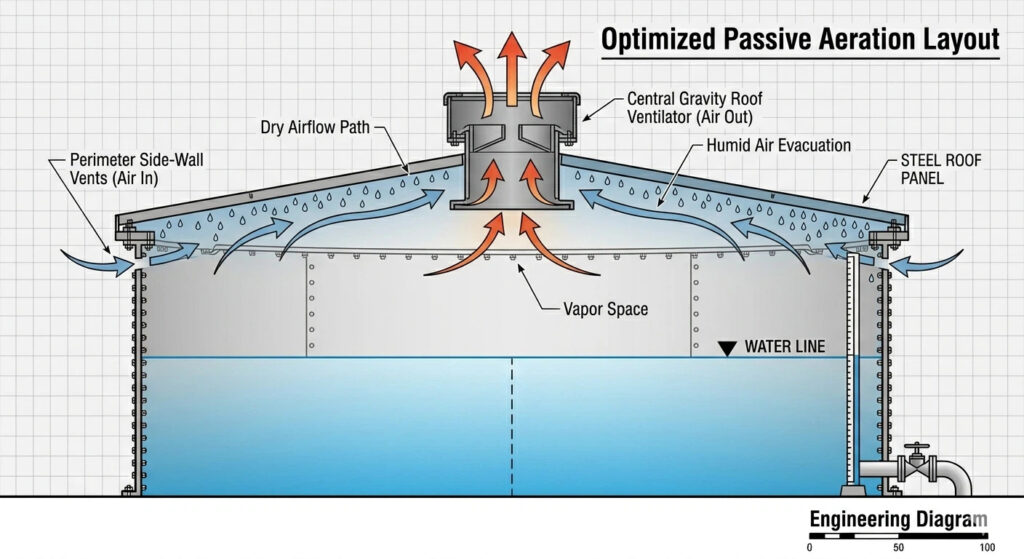
Effective tank condensation control relies heavily on balanced air exchange. Utilizing passive tank aeration through peripheral eave vents and a central gravity roof ventilator creates a natural draft, sweeping out humid air.
However, in extreme climates, relying solely on natural airflow is insufficient, prompting the need for specialized thermal insulation or mechanical tank condensation control systems. This approach is essential when engineering the best roof design for tank condensation control in cold climates.
To see the direct correlation between aerodynamic venting and structural fatigue in steel sheets, engineers can review the open-access technical research paper available via the NCBI PMCU Industrial Materials Database, which documents how mechanical processes and environmental fatigue alter steel longevity.
Protecting Infrastructure Capital Through Targeted Prevention
Securing the long-term integrity of your storage infrastructure requires addressing the environmental dynamics occurring above the liquid line. Choosing between a specialized stainless asset or an elite enamel coating determines your baseline defense, but combining proper material selection with rigorous tank condensation control ensures a 30+ year lifespan. By deploying smart engineering instead of reactive repairs, you optimize your capital allocation and achieve ultimate tank condensation control from the roof down.
FAQ
How to stop condensation on a water tank using modern tank condensation control?
You can eliminate internal condensation by establishing a continuous air exchange using passive tank aeration to equalize internal temperatures, installing external polyurethane insulation on the roof panel to keep steel surfaces above the dew point, or selecting a GFS tank with a glass roof that natively repels moisture adhesion. Deploying systematic tank condensation control prevents structural decay.
What causes rapid panel corrosion near the roof of a bolted tank?
This failure occurs when warm water vapor rises into the uninsulated vapor space,contacts the colder roof metal, and condenses. These droplets absorb volatileheadspace gases like hydrogen sulfide (H2S) or carbon dioxide (C’O2), forminghighly acidic solutions that cause aggressive localized panel corrosion.
What are the long-term maintenance costs of bolted steel tank roof repair vs replacement?
Ignoring tank condensation control leads to premature structural roof failure. The maintenance costs of bolted steel tank roof repair vs replacement can equal up to 40% of the initial tank capital cost due to crane rentals, confined-space labor, and operational downtime. Proactive prevention through material selection reduces life-cycle expenditures.