A stainless steel water tank used in beverage production does far more than store water. It becomes part of the production process, affecting product consistency, cleaning efficiency, and production uptime. Choosing the wrong tank can create sanitation risks, increase maintenance costs, and limit future expansion.
If you’re planning a new beverage facility or upgrading an existing production line, this guide explains how to select a stainless steel water tank based on beverage type, hygienic requirements, tank capacity, and long-term operating needs. Whether you’re a beverage manufacturer, engineering contractor, system integrator, or procurement manager, understanding these factors helps reduce operational risks and supports stable production.
Table of Contents
Why Do Beverage Production Lines Need a Specialized Stainless Steel Water
Unlike general industrial water storage, beverage production requires water that remains clean throughout every stage of processing. The tank is not simply a storage vessel—it is part of the hygienic production system.
Water may be used for:
- ingredient preparation
- bottle rinsing
- equipment cleaning
- CIP (Clean-in-Place) systems
- cooling processes
- purified water storage
Each application places different demands on the tank’s material, internal finish, and sanitary design.
For example, a bottled water plant storing reverse osmosis (RO) water has different requirements than a juice factory that performs frequent CIP cleaning with alkaline and acidic solutions.
According to the U.S. Food and Drug Administration (FDA) guidance on food processing equipment, product-contact surfaces should be corrosion-resistant, cleanable, and designed to prevent contamination throughout food and beverage production.
For facilities seeking HACCP or ISO 22000 compliance, hygienic equipment selection begins with storage systems rather than filling equipment alone.
Production Stability Depends on More Than Storage Capacity
Many first-time buyers compare tanks only by volume and price.
Experienced beverage manufacturers evaluate additional factors, including:
- hygienic weld quality
- internal surface finish
- drainage efficiency
- cleaning accessibility
- compatibility with CIP
- future production expansion
A poorly designed outlet or an uneven tank bottom may leave standing water after cleaning, increasing the risk of microbial growth and extending sanitation time.
This is why many engineering contractors include hygienic water storage in the early design phase instead of treating it as a standard utility component.
Which Beverage Applications Require Different Water Tank Configurations?
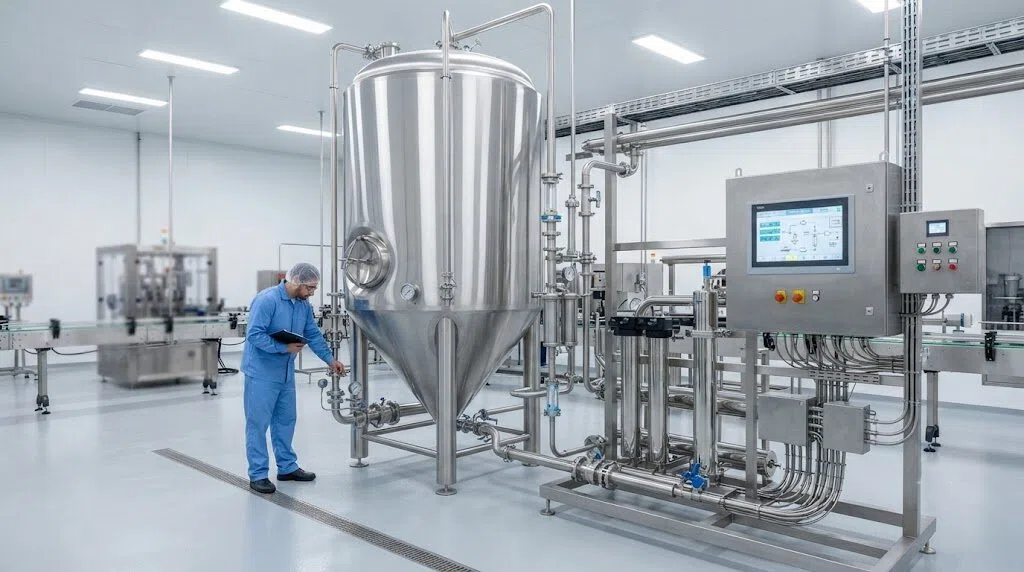
Not every beverage facility uses water in the same way. Understanding the production process helps determine the most suitable food grade stainless steel water tank configuration.
Bottled Water Production
For bottled water plants, water quality is the product itself.
Storage tanks are typically installed after reverse osmosis or ultrafiltration systems to provide a stable buffer before filling.
Key considerations include:
- polished internal surfaces
- sealed tank construction
- sanitary vents
- level monitoring
- easy inspection access
Because purified water has very low mineral content, maintaining cleanliness inside the storage tank becomes especially important.
The World Health Organization (WHO) discusses the importance of hygienic water storage in its Guidelines for Drinking-water Quality, emphasizing contamination prevention throughout the distribution and storage process.
Juice and Soft Drink Manufacturing
Juice and soft drink production places additional demands on cleaning procedures.
Facilities typically perform frequent CIP cycles using cleaning chemicals that remove sugar residues and organic deposits.
In these environments, buyers should evaluate:
- compatibility with CIP spray
- complete tank drainage
- corrosion resistance
- smooth internal welds
Choosing the correct stainless steel water tank reduces cleaning time and minimizes production interruptions between batches.
Breweries and Beverage Mixing Systems
Breweries and beverage blending facilities rely on process water consistency rather than simple storage capacity.
Water is used for:
- ingredient dilution
- equipment washing
- recipe consistency
- process stabilization
A properly sized process water storage tank also helps maintain stable water supply during peak production periods, preventing interruptions caused by fluctuating incoming water flow.
Engineering teams often calculate tank capacity based on hourly production demand rather than total daily consumption to ensure continuous operation.
Dairy Beverage Facilities
Milk-based beverages, protein drinks, and nutritional products require some of the highest sanitary standards in food processing.
These facilities typically prioritize:
- sanitary TIG welding
- polished internal surfaces
- dead-leg reduction
- complete drainage
- easy maintenance access
According to the 3-A Sanitary Standards, hygienic equipment should be designed to facilitate effective cleaning and minimize areas where product residues can accumulate.
These design details become increasingly important for manufacturers operating multiple production shifts or producing beverages with strict hygiene requirements.
304 vs. 316L Stainless Steel: Which Material Fits Your Beverage Process?
One of the first questions procurement teams ask is whether 304 or 316L stainless steel is the better investment. The answer depends on the production process, cleaning chemicals, and water quality—not simply on material cost.
For many bottled water, juice, and soft drink plants, 304 stainless steel provides sufficient corrosion resistance and is widely used for food grade water tanks. However, facilities that handle high-chloride water, aggressive CIP chemicals, or coastal environments may benefit from 316L stainless steel, which contains molybdenum for improved corrosion resistance.
According to the Nickel Institute’s technical article on stainless steels in food and beverage processing, selecting the appropriate stainless steel grade should consider the process media, chloride concentration, operating temperature, and cleaning methods rather than relying on a single material recommendation.
| Selection Factor | 304 Stainless Steel | 316L Stainless Steel |
|---|---|---|
| Drinking water | ✓ Suitable | ✓ Suitable |
| RO water storage | ✓ Common choice | ✓ Suitable |
| Juice production | ✓ Common | ✓ Better for aggressive cleaning |
| High-chloride process water | Limited | Recommended |
| CIP chemical resistance | Good | Higher |
| Initial investment | Lower | Higher |
Instead of asking “Which material is better?”, ask:
- What type of water will the tank store?
- How often will CIP cleaning be performed?
- Does the facility use chlorine-based disinfectants?
- Will production expand in the future?
For many beverage manufacturers, these questions are more valuable than comparing material prices alone.
What Hygienic Design Features Matter Most in a Beverage Water Tank?
Material selection is only one part of hygienic design. A well-designed stainless steel water tank should also reduce cleaning time and eliminate areas where residues can remain after production.
Interior Surface Finish
A smoother internal surface is easier to inspect and clean.
Many beverage facilities specify polished interiors because rough surfaces can trap mineral deposits or organic residues over time.
Sanitary Welding
Poor weld quality creates crevices where contamination may accumulate.
Look for:
- continuous TIG welding
- smooth weld transitions
- polished weld seams
These details become especially important for beverage plants operating multiple production shifts each day.
CIP Compatibility
A food grade stainless steel water tank should integrate with the plant’s cleaning process rather than requiring manual washing.
Typical CIP-related features include:
- spray balls
- complete drainage
- sanitary inlet and outlet connections
- inspection manholes
- vent filtration
According to the European Hygienic Engineering & Design Group (EHEDG) guidance on hygienic equipment design, equipment should be constructed to allow effective cleaning while preventing product accumulation and microbial growth.
Drainage Design
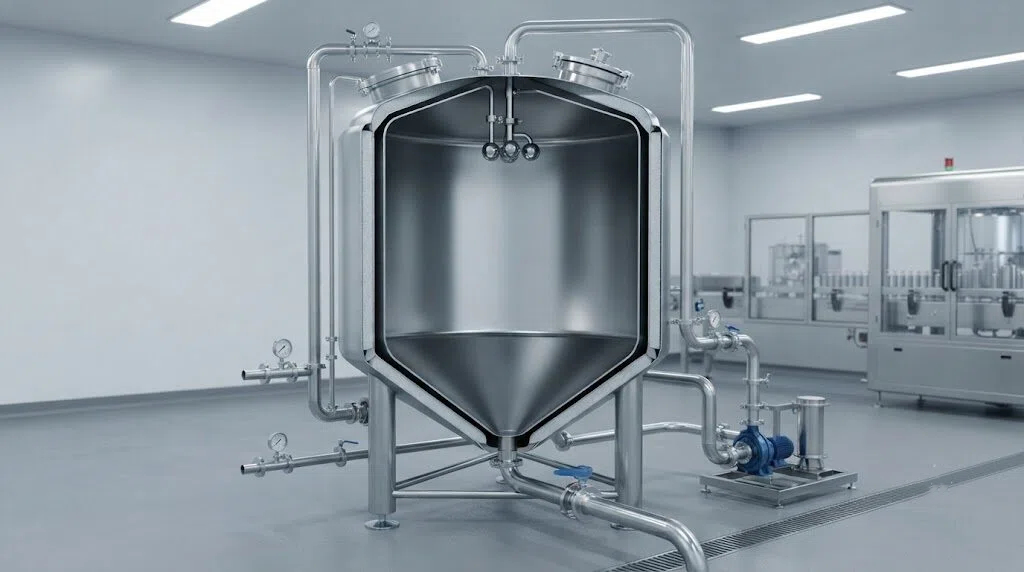
A flat-bottom tank may leave standing water after cleaning.
Many beverage manufacturers prefer sloped bottoms that direct water toward the outlet, reducing cleaning time and minimizing residual moisture before the next production cycle.
How Do You Determine the Right Tank Capacity?
Tank sizing is often underestimated during project planning.
Choosing a larger tank does not always improve production efficiency, while an undersized tank can interrupt the entire process during peak demand.
Instead of selecting capacity based only on daily production, engineering teams typically evaluate several operating conditions.
Consider Daily Water Consumption
Start with:
- production water
- equipment cleaning
- bottle rinsing
- employee use
- process losses
These figures provide the baseline requirement.
Plan for Peak Production Instead of Average Demand
Production lines rarely operate at average capacity throughout the day.
For example, during continuous filling operations or CIP cycles, water demand may increase significantly for a short period.
A properly sized beverage water storage tank provides a buffer that helps maintain stable production during these peak periods.
Leave Room for Future Expansion
One of the most common purchasing mistakes is sizing a tank only for today’s production.
If a second filling line or additional beverage products are planned within the next few years, replacing the storage tank later can be far more expensive than allowing additional capacity from the beginning.
For EPC contractors and system integrators, this often means evaluating:
- available installation space
- future piping connections
- instrumentation upgrades
- automation compatibility
These considerations help ensure that the water storage system continues to support production as the facility grows.
What Mistakes Do Beverage Manufacturers Make When Buying Water Tanks?
Choosing a stainless steel water tank for beverage production is not only a technical decision. Many problems appear because buyers focus on the initial purchase instead of the entire operating process.
Understanding common mistakes can help manufacturers, engineering contractors, and procurement teams avoid unnecessary costs.
Only Comparing Tank Price
The lowest quotation is not always the lowest operating cost.
A cheaper tank may use:
- lower-grade stainless steel
- basic welding methods
- limited inspection access
- unsuitable internal finishes
These issues may create additional expenses through:
- longer cleaning time
- frequent maintenance
- replacement requirements
- production downtime
For beverage facilities, the tank should be evaluated as part of the production system rather than as an isolated storage product.
Choosing the Wrong Stainless Steel Grade
A common mistake is selecting 304 stainless steel only because it is less expensive.
While 304 is suitable for many applications, some beverage processes require additional corrosion resistance.
Examples:
- high chloride water
- frequent chemical cleaning
- aggressive CIP procedures
- coastal production facilities
In these cases, 316L stainless steel may provide better long-term performance.
The correct choice depends on the actual process conditions.
Ignoring Cleaning and Maintenance Requirements
Some buyers consider tank capacity and material but overlook daily operation.
Before ordering, ask:
- How will operators inspect the tank?
- Can the tank be fully drained?
- Is the CIP system compatible?
- Are replacement components available?
A tank that is difficult to clean can increase labor requirements and affect production schedules.
Final Thoughts
Selecting a stainless steel water tank for beverage production requires more than choosing a storage volume. Material grade, hygienic design, cleaning methods, and future production plans all influence whether the tank can support stable manufacturing.
For beverage manufacturers, engineering contractors, and procurement teams, the best choice is the tank that matches the actual production environment.
FAQ
What type of stainless steel is best for beverage water tanks?
304 stainless steel is commonly used for many beverage applications, while 316L is preferred when higher corrosion resistance or more aggressive cleaning conditions are required.
Is 304 stainless steel safe for drinking water storage?
Yes. 304 stainless steel is widely used for food and beverage applications when properly manufactured with suitable hygienic design.
When should I choose 316L stainless steel instead of 304?
Choose 316L when the tank is exposed to higher chloride levels, stronger cleaning chemicals, or demanding sanitary conditions.
How are stainless steel water tanks cleaned in beverage factories?
Many beverage plants use CIP systems with spray balls, cleaning chemicals, and controlled circulation to clean tank interiors without manual disassembly.
What tank size does a beverage factory need?
The required size depends on production volume, peak water demand, cleaning requirements, and future expansion plans.