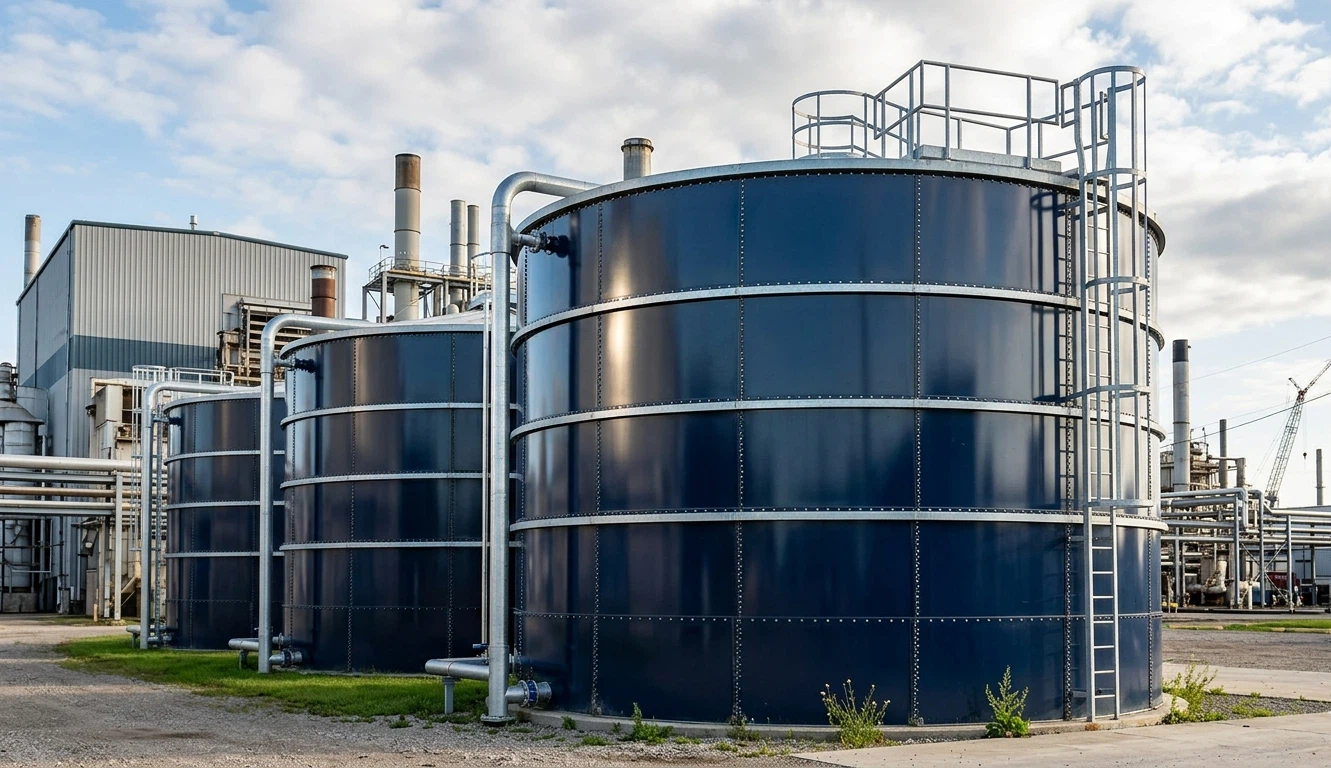
Tank foundation settlement is one of the most important checks during the first fill of a steel water tank. A tank may look stable when empty, but once water load increases, weak spots in the foundation, base frame, or support system can appear quickly.
This guide explains what to inspect before filling, how to monitor settlement at each water level, when to pause filling, and how a proper base and support rod system helps reduce deformation, leakage, and commissioning delays.
Оглавление
Why First Fill Reveals Tank Foundation Settlement
First fill is not just a water test. It is the first time the tank, base, support rods, and Concrete pad experience real operating load together.
Before filling, small uneven areas may not be visible. After the water level rises, the tank weight increases rapidly. Any weak compaction, poor leveling, void under the pad, or local support gap can start showing as movement.
AWWA D100 is widely used for welded carbon steel water storage tanks and covers minimum requirements for design, construction, inspection, and testing of new welded steel water tanks. That matters because inspection and testing are not separate from tank reliability; they are part of the system.
Tank foundation settlement becomes especially critical in modular steel water tanks because loads are transferred through panels, base members, bolts, seals, and support rods. Uneven support can create stress concentration long before obvious leakage appears.
What Settlement Can Do to a Steel Water Tank
Tank foundation settlement does not only affect the ground. It changes the way the tank carries load.
The most common consequences include:
- Tank base out of level
- Uneven panel stress
- Seal compression differences
- Local leakage risk
- Support rod tension imbalance
- Joint distortion
- Long-term fatigue around connection areas
A technical paper on hydrostatic tes,t results for steel tanks explains that tank settlement monitoring can involve geodetic surveys and horizontal inclinometer measurement, with settlement checks performed before moving to the next stage of testing.
That staged approach is important. If the tank continues filling while settlement is still changing, the final problem may be harder and more expensive to correct.
Concrete Pad Checks Before Filling Starts
A Concrete pad can provide a stable and level base, but it should never be treated as “automatically acceptable” just because it has been poured.
Before filling, check:
1.Surface level:The pad should be even enough to keep the tank base fully supported.
2.Cracks:Hairline shrinkage cracks may not be serious, but wider cracks, edge cracks, or active movement
3.Drainage:Water should not collect under or around the base.
4.Edge support:The pad edge should not be broken, soft, or unsupported.
5.Contact condition:The tank base should sit firmly without visible gaps or rocking.
6.Anchor or support layout:Any support rods, base rails, or fixing points should align with the design.
Tank foundation settlement is often blamed on the pad, but the real cause may be below it: weak subgrade, poor compaction, uneven bedding, or water softening the soil.
Monitoring Settlement During Commissioning of Steel Tanks
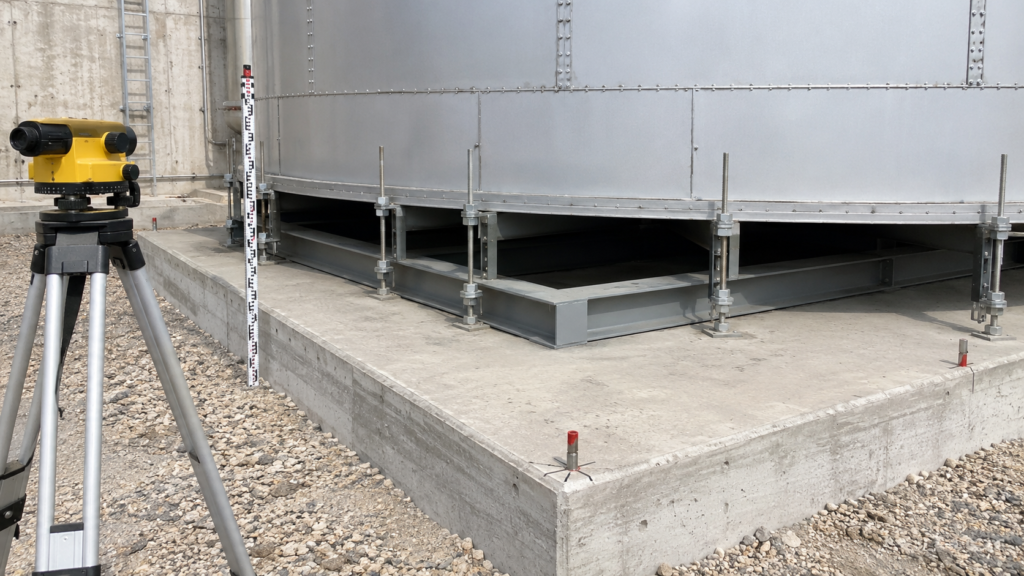
Monitoring settlement during commissioning of steel tanks should be planned before water enters the tank. Once filling starts, the team should already know where to measure, how often to record, and when to stop.
A practical monitoring plan includes:
- Fixed reference points outside the tank foundation
- Measurement marks around the tank perimeter
- Baseline readings before filling
- Water level records at each inspection point
- Visual inspection of base, panels, seals, and rods
- Final settlement readings after the full test level is reached
For smaller steel water tanks, the tools may be simpler, but the logic is the same. Tank foundation settlement must be measured, not guessed.
What to Check at 25%, 50%, 75%, and 100% Fill Levels
A staged fill plan makes settlement easier to detect before it becomes structural damage.
At 25% fill:
- Confirm the base is still level.
- Check for local pad movement.
- Look for gaps under base supports.
- Inspect early seal compression.
At 50% fill:
- Compare settlement readings with baseline.
- Check support rod tension visually.
- Inspect panel alignment.
- Look for water around the base.
At 75% fill:
- Review whether movement is slowing or increasing.
- Check for joint distortion.
- Inspect the Concrete pad edge.
- Confirm there is no progressive leaning.
At 100% fill:
- Record final settlement readings.
- Inspect all visible joints and seals.
- Confirm base alignment.
- Keep the tank under observation if required by the project specification.
Tank foundation settlement is not automatically dangerous if it is small and uniform. The real concern is uneven or progressive movement.
When Filling Should Be Paused
The filling process should be paused if the monitoring team sees signs that settlement is uneven, fast, or affecting the tank structure.
Stop and review if you notice:
- One side settling faster than the other
- Sudden level change between readings
- Concrete pad cracking or edge failure
- Visible tank leaning
- Panel buckling or joint distortion
- Leakage near the base
- Abnormal support rod tension
- Unusual sound during filling
API 650 hydrostatic testing discussions often emphasize that hydrotesting is not only about leakage; it also allows settlement behavior to be observed under water load.
For water tanks, the same principle applies. First fill is the safest time to find problems because the tank has not yet entered normal service.
How Base Frames and Support Rods Reduce Risk
A Concrete pad is important, but it is only one part of the support system. For sectional or modular steel tanks, load distribution also depends on the tank base, internal or external support members, and rod arrangement.
A properly designed water tank base and support rods system helps distribute loads, maintain alignment, and reduce deformation risk during first fill and long-term operation.
This is where Tank foundation settlement becomes a system issue, not only a civil works issue. If the base frame is uneven or support rods are not correctly arranged, the tank may respond poorly even on a good pad.
For project teams, that means the commissioning inspection should include:
- Base rail contact
- Support rod alignment
- Rod tightness
- Panel verticality
- Joint compression
- Corner stability
- Pad-to-base contact
Tank foundation settlement is easier to manage when the tank support system is designed to keep load paths clear and balanced.
Заключение
Tank foundation settlement is best controlled before the tank is handed over, not after leakage or deformation appears. First fill gives engineers and installers a valuable chance to see how the Concrete pad, base frame, support rods, and tank body behave under real water load.
A good commissioning plan does not need to be complicated. It needs clear reference points, staged filling, careful records, and the discipline to pause when readings or visual signs suggest a problem.
For steel water tanks, stable support starts below the tank but does not end there. The base system, support rods, installation quality, and settlement monitoring all work together. If Tank foundation settlement is checked properly during first fill, the tank has a much stronger chance of entering service level, stable, and ready for long-term use.
Часто задаваемые вопросы
What is tank foundation settlement?
Tank foundation settlement is the downward or uneven movement of the tank foundation under load, especially as water is added during filling.
Why is first fill important?
First fill applies real operating load to the tank for the first time. It can reveal foundation, Concrete pad, base, or support problems that were not visible when empty.
How do you monitor settlement during commissioning?
Use fixed reference points, record baseline levels, fill in stages, and check settlement readings at 25%, 50%, 75%, and 100% water levels.
Can a Concrete pad prevent all settlement problems?
No. A Concrete pad helps, but soil condition, leveling, base frame contact, drainage, and support rod arrangement also affect performance.
When should filling be stopped?
Stop filling if settlement is uneven, progressive, or combined with cracking, leakage, tank leaning, panel distortion, or abnormal support rod tension.
How do support rods help a steel water tank?
Support rods help maintain alignment, control panel movement, and improve structural stability during filling and long-term service.