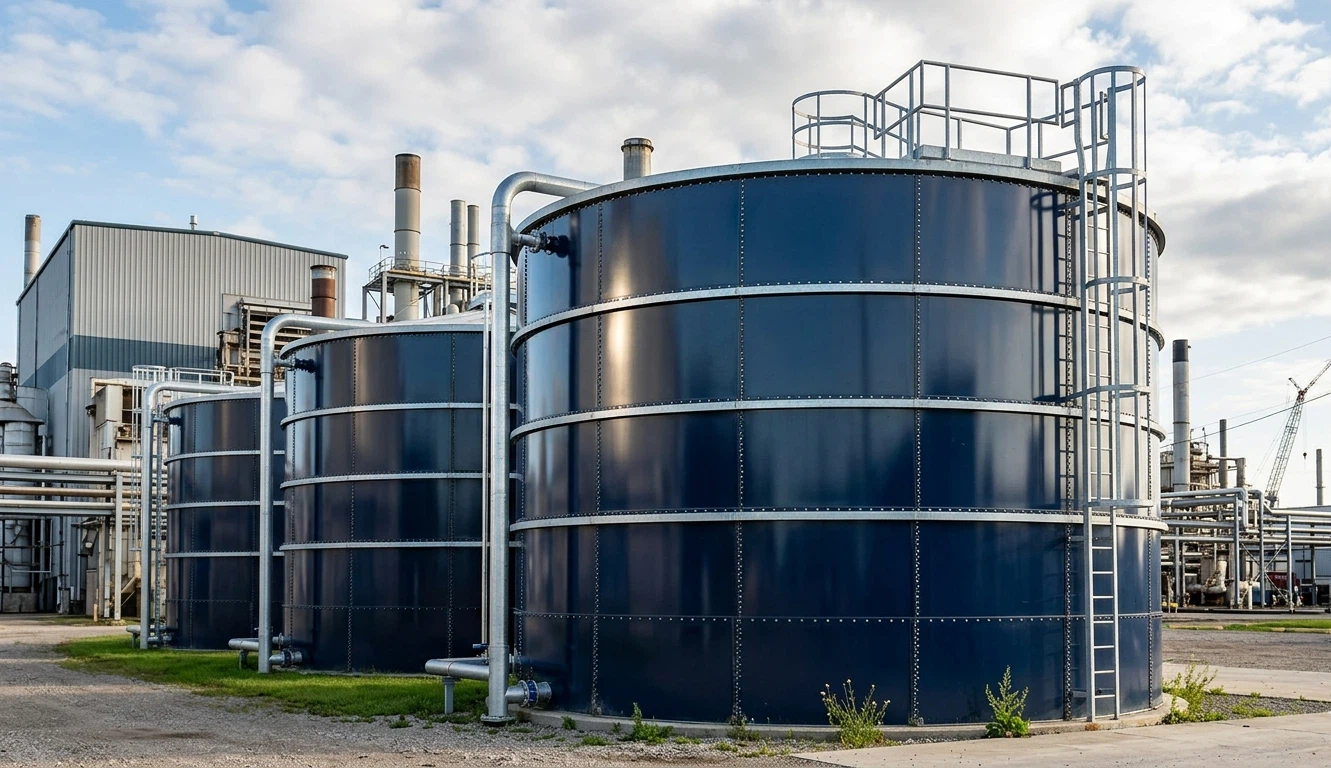
In seismic-prone regions—from the fault lines of California to the heavy tectonic activity in Southeast Asia—an промышленный резервуар для воды is more than just a storage vessel; it is a critical lifeline. Whether it provides fire protection for a manufacturing plant or potable water for a municipality, its structural integrity during a tremor is non-negotiable. Achieving this level of reliability requires a rigorous approach to seismic water tank design, ensuring that every component, from the roof rafters to the foundation bolts, can withstand intense lateral and vertical accelerations.
For engineers and project managers, the benchmark for safety has shifted. The introduction of the latest building codes has made compliance a complex but essential task. Designing for resilience means moving beyond “standard” builds and embracing site-specific engineering that accounts for soil conditions, liquid dynamics, and the specific mechanical properties of the tank structure.
Оглавление
How ASCE 7-22 Redefines Liquid Storage Safety
The primary authority governing structural loads in the United States and many international markets is the American Society of Civil Engineers. Their latest publication, ASCE 7-22 (Minimum Design Loads and Associated Criteria for Buildings and Other Structures), introduces significant updates to how we calculate seismic forces.
In the realm of seismic water tank design, ASCE 7-22 mandates a more granular analysis of ground motion data. Unlike previous iterations, the new standard utilizes multi-period design spectra, which provides a more accurate representation of how a structure will behave across different earthquake frequencies. For a liquid-filled tank, this is crucial because the “sloshing” of the water creates complex forces that vary significantly depending on the vibration period.
Failure to adhere to these updated standards doesn’t just result in legal non-compliance; it places the entire facility at risk of catastrophic failure during an SDC (Seismic Design Category) D, E, or F event. You can review the core updates to these load requirements directly through the ASCE 7-22 digital platform.
Preventing Structural Failure: The “Elephant’s Foot” Phenomenon
One of the most common and devastating failures in large-scale storage is known as “elephant’s foot buckling.” This occurs when the bottom shell of the tank collapses under the extreme vertical compressive loads generated by the tilting of the tank during an earthquake.
In a professional seismic water tank design, engineers must calculate the hydrodynamic pressure of the contained liquid. When the ground shakes, the water inside doesn’t move as a solid mass. Instead, it exerts “impulsive” force (the water moving in sync with the tank) and “convective” force (the sloshing wave action). The combination of these forces creates a massive overturning moment.
Without a reinforced base and proper shell thickness, the steel near the floor buckles outward, resembling the foot of an elephant. Preventing this requires a deep understanding of the seismic design requirements for bolted steel tanks, which often involve thickening the starter rings (the bottom-most panels) and utilizing high-tensile strength hardware to maintain structural geometry under stress.
Seismic Design Requirements for Bolted Steel Tanks
When comparing storage options, All Bolted Tanks offer unique advantages in high-risk zones. Unlike field-welded tanks, which are rigid and susceptible to heat-affected zone (HAZ) fractures, bolted tanks are composed of precision-engineered panels joined by high-strength bolts and flexible gaskets.
The seismic design requirements for bolted steel tanks focus heavily on the ductility of the connection points. In a major seismic event, the ability of a structure to undergo minor, controlled displacement without snapping is a lifesaver. The mechanical joints in a bolted system provide a degree of “give” that can dissipate energy more effectively than a brittle weld.
Furthermore, standards like AWWA D103-22 (Factory-Coated Bolted Carbon Steel Tanks) work in tandem with ASCE 7-22 to dictate specific bolt-hole tolerances and gasket compressions that ensure the tank remains leak-proof even after significant swaying. These requirements are detailed in the American Water Works Association bookstore.
The Focus on the Tank Base and Anchorage
If you are designing for a high-risk zone, the most important part of your seismic water tank design isn’t the tank itself—it’s the connection to the earth. The “Focus on Base” philosophy is what separates a standard water vessel from a seismic-rated industrial asset.
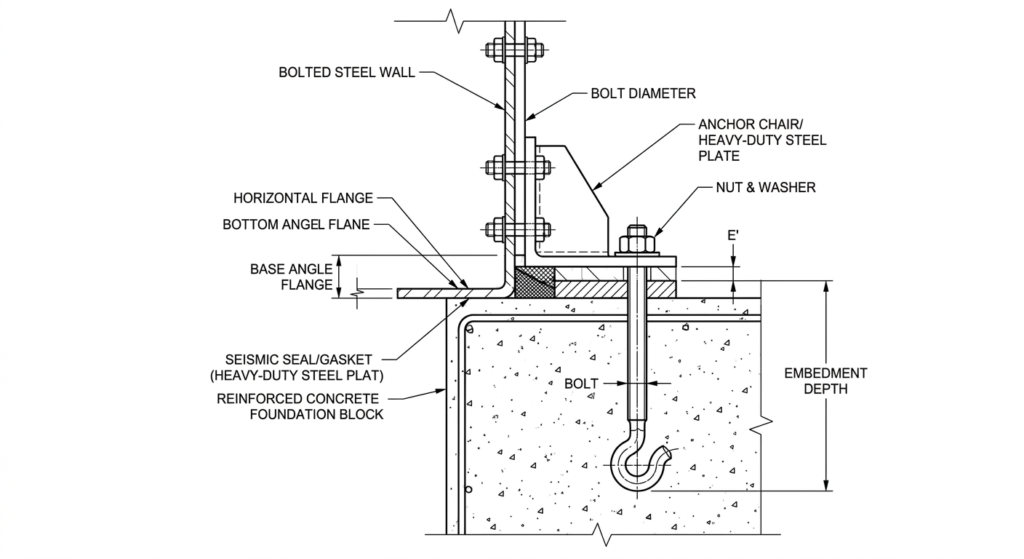
For All Bolted Tanks, the anchorage system must be engineered to resist both “shear” (the force trying to slide the tank off its pad) and “uplift” (the force trying to tip the tank over). This is achieved through:
1.Heavy-Duty Anchor Chairs: These are welded or bolted to the starter ring to distribute the uplift force into the anchor bolts.
2.Cast-in-Place Anchor Bolts: Typically much longer and thicker than standard bolts, designed to reach deep into the reinforced concrete foundation.
3.High-Strength Base Flanges: A thickened bottom angle that prevents the floor-to-wall joint from tearing during lateral acceleration.
Zhengling’s engineering approach prioritizes these base components, ensuring that the seismic water tank design accounts for the specific soil friction and “site class” of your project location.
Hydrodynamic Loads and the Sloshing Effect
A common mistake in basic seismic water tank design is treating the water as a static weight. In reality, the “sloshing” wave (convective load) can be powerful enough to blow out the tank roof or damage internal rafters.
Under ASCE 7-22, designers must calculate the “freeboard”—the empty space between the top of the water and the roof. If the freeboard is too low, the seismic wave will hit the roof with thousands of pounds of force. In high-risk zones, we often increase the height of the tank or reinforce the roof structure to act as a secondary diaphragm, stabilizing the top of the shell against the moving water mass.
Understanding these fluid dynamics is a core part of the seismic design requirements for bolted steel tanks. Every Zhengling tank intended for seismic zones undergoes simulation to ensure the roof and top shell rings can handle these internal “tsunami” forces.
Why Ductility in All Bolted Tanks Matters
In the world of structural engineering, “stronger” isn’t always “better.” A structure that is too stiff will snap under the immense energy of an earthquake. This is where All Bolted Tanks shine.
The modular nature of the panels and the use of specialized gaskets allow for microscopic movements between the sheets. This inherent ductility is a major factor in seismic water tank design. Instead of the stress concentrating at a single welded point, it is distributed across hundreds of high-strength bolts.
For high-magnitude zones, we utilize specific bolt patterns and thicknesses that align with the ASCE 7-22 “Response Modification Coefficient” (R-Value). This coefficient allows engineers to account for the tank’s ability to absorb energy, often resulting in a more efficient and cost-effective design than a traditional welded alternative.
Professional Compliance for Industrial Applications
When procuring a tank for an industrial site, you must ensure that the manufacturer provides a stamped calculation package. This package should prove that the seismic water tank design meets the local building code and the specific seismic parameters (Ss and S1 values) provided by the USGS or relevant national geological authority.
Using All Bolted Tanks for these applications allows for faster installation without sacrificing this technical rigor. Since the components are factory-fabricated, the tolerances are much tighter than what can be achieved with field-welding in wind or rain. This precision is vital for ensuring that every bolt hole aligns perfectly to maintain the structural integrity required for seismic design requirements for bolted steel tanks.
Часто задаваемые вопросы
How does ASCE 7-22 change the cost of my tank?
The updated ASCE 7-22 standards may require thicker steel or more robust anchorage in certain regions compared to older codes. While this can increase material costs, it significantly reduces the risk of total loss during an earthquake.
Can any bolted tank be used in a seismic zone?
No. A standard tank must be specifically engineered. The seismic water tank design must be adjusted based on the specific “Seismic Design Category” of your site.
What is the most common failure point in a water tank during an earthquake?
The base. Specifically, anchor bolt failure or buckling of the bottom shell (elephant’s foot) are the primary causes of tank collapse.
Does a bolted tank leak after an earthquake?
If designed according to AWWA D103 and ASCE 7-22, the gaskets are engineered to maintain a seal even under structural stress. Zhengling tanks use high-performance EPDM or Viton gaskets to ensure long-term flexibility.