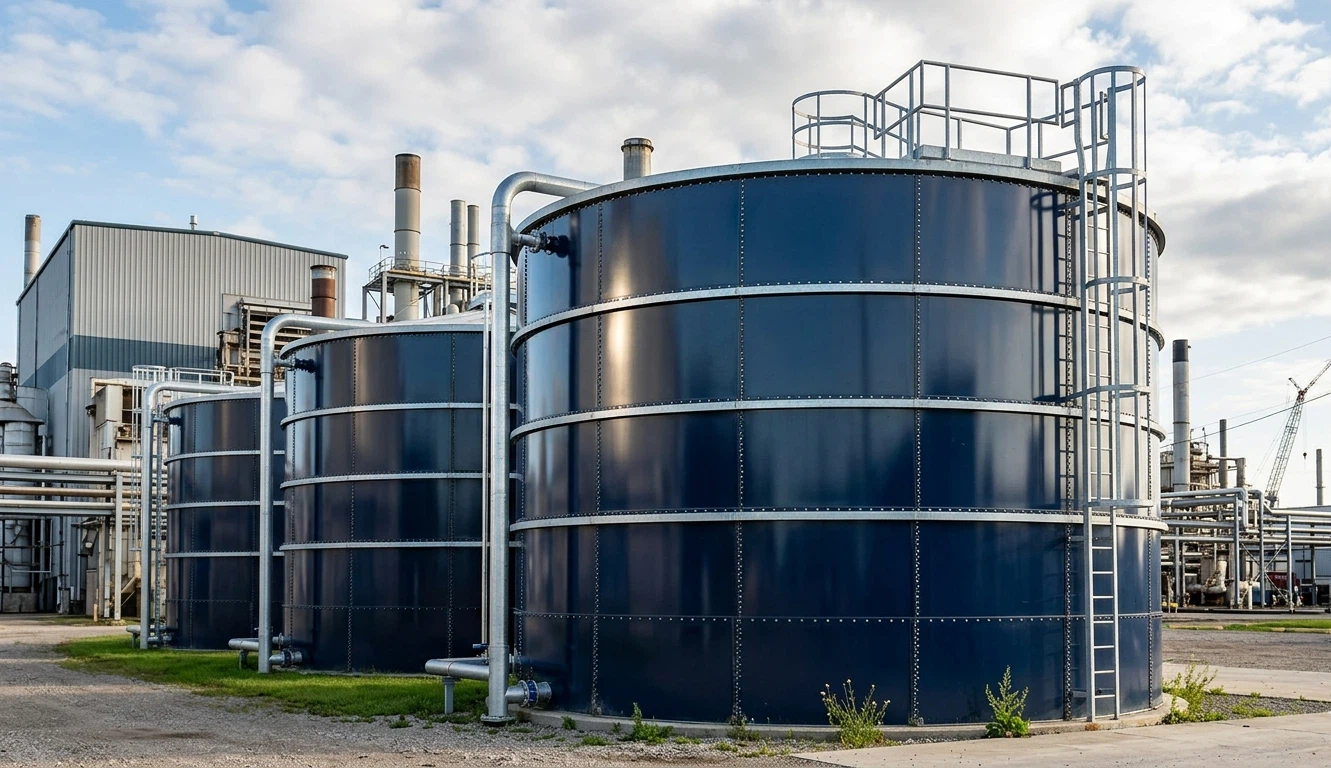
In the world of industrial liquid storage, managing the hydrostatic pressure of thousands of gallons of water is only half the engineering battle. The other half is ensuring that the personnel who inspect, maintain, and repair these massive structures can do so without risking their lives.
For facility managers and procurement officers, treating access systems as an afterthought is a dangerous gamble. A poorly designed platform is a structural liability that can trigger severe federal penalties and catastrophic workplace accidents. Achieving OSHA water tank safety requires a meticulous approach to structural engineering, moving far beyond simply bolting a ladder to a steel wall.
Whether you are upgrading an existing facility or commissioning a new build, sourcing reliable B2B water tank access solutions is a critical phase of project management. This guide breaks down the essential federal regulations and structural requirements you must meet to protect your personnel and your infrastructure.
Оглавление
The Hidden Costs of Non-Compliance in Elevated Storage
The Occupational Safety and Health Administration does not treat elevated workspaces lightly. Fall-related incidents remain the most frequently cited violation across the industrial sector.
When an inspector arrives at your site, their primary focus will be on the integrity of your elevated surfaces. If an access platform flexes under weight, lacks proper toe boards, or utilizes inferior fasteners, the resulting fines can easily exceed the cost of the platform itself. Moreover, non-compliance leads to operational downtime. If a tank is deemed unsafe to access, routine maintenance stops, leading to contaminated water supplies or undetected leaks.
Integrating robust Fall protection for industrial tanks is the only way to insulate your facility from these liabilities. True OSHA water tank safety demands that the platform system is engineered as a primary structural component, capable of withstanding maximum live loads and severe environmental stressors.
According to the official OSHA Walking-Working Surfaces Standard (1910.28), employers are legally obligated to ensure that any employee exposed to a fall hazard of four feet or more is protected by a certified guardrail or fall arrest system.
Explore our full range of Основание резервуара для воды и опорные стержни designed for extreme load conditions.
Designing OSHA Compliant Access for Large Industrial Tanks
Building an access system requires complex load calculations. Designing OSHA compliant access for large industrial tanks is not a one-size-fits-all process. Engineers must account for the specific geometry of the tank, the regional climate, and the frequency of access required.
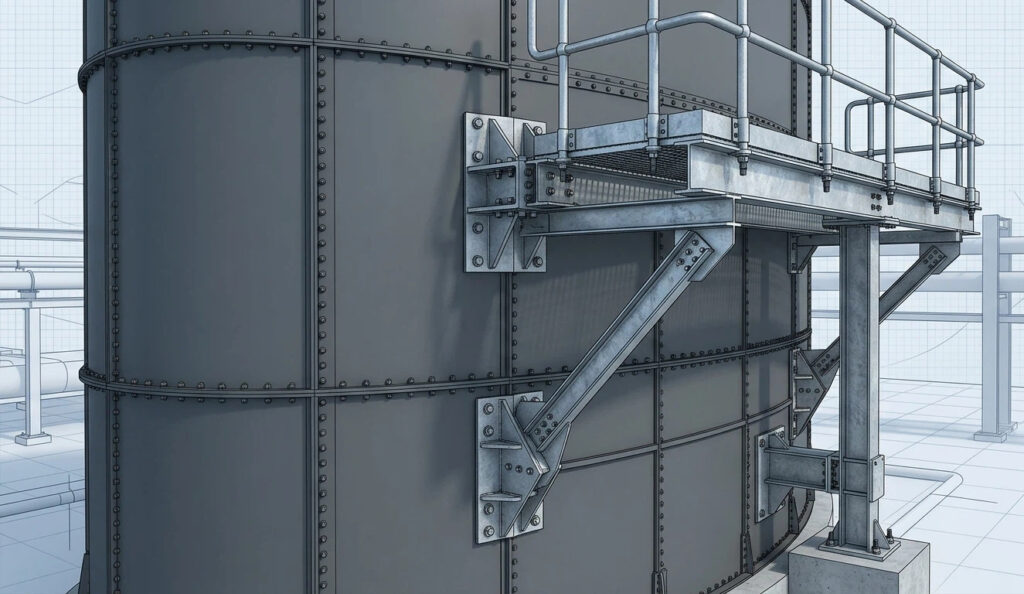
One of the greatest challenges is wind load. An external platform acts like a massive sail. In severe weather, the wind exerts tremendous lateral force against the platform, which is then transferred directly to the tank’s shell. Understanding and mitigating these environmental pressures is critical.
Therefore, integrating aerodynamic considerations is a foundational step in maintaining OSHA water tank safety over the lifespan of the equipment.
The Critical Engineering Behind Tank Walkways
The surface material of your access system dictates its effectiveness. In liquid storage environments, moisture, algae, and chemical condensation are constant threats. Standard flat steel or diamond-plate surfaces quickly become slick, turning routine inspections into high-risk operations.
This is why high-traction Tank walkways are non-negotiable. Industrial standards dictate the use of serrated bar grating. This open-grid design allows water, snow, and debris to pass straight through the walking surface. It ensures that the worker’s boots maintain a high friction coefficient against the steel, regardless of the weather conditions.
Furthermore, OSHA mandates specific dimensions for these walkways to ensure safe passage. The minimum clear width for a standard industrial catwalk is 22 inches, though 36 inches is highly recommended for pathways where personnel must carry tools or replacement parts. Ensuring your Tank walkways meet these dimensional and traction requirements is a core pillar of OSHA water tank safety.
Why Support Rods Dictate OSHA Water Tank Safety
A common and dangerous misconception is that safety platforms are entirely independent of the tank’s internal structure. In reality, you cannot have a safe external platform without a rigid internal foundation.
When a maintenance crew steps onto an external walkway, their combined weight pulls downward and outward on the tank’s wall panels. If the tank shell is not internally braced, this eccentric load can cause the metal panels to buckle or deform.
To prevent structural failure, the internal framework must counteract the external weight. Utilizing heavy-duty Основание резервуара для воды и опорные стержни provides the necessary tension inside the tank. These rods act as a structural skeleton, tying the opposing walls together and transferring the load down to the concrete foundation.
If you ignore the internal bracing, the most expensive guardrails in the world will not save the structure from warping. Therefore, specifying high-quality internal supports is an absolute necessity for achieving true OSHA water tank safety.
Material Selection for Galvanized Steel Tank Platforms
Corrosion is the silent enemy of industrial safety. A platform that passes inspection on day one can become a death trap three years later if the materials are not suited for the environment.
For the vast majority of exterior liquid storage applications, Galvanized steel tank platforms are the industry standard. Hot-dip galvanization creates a metallurgical bond between the steel and the zinc coating, providing decades of protection against rust.
Unlike standard paint, which can chip and allow moisture to penetrate the steel underneath, a galvanized coating acts as a sacrificial anode. Even if the platform is scratched by heavy tools, the surrounding zinc will corrode before the underlying steel is compromised.
For authoritative data on the load-bearing longevity of these materials, the American Institute of Steel Construction (AISC) provides extensive documentation on how galvanization protects structural integrity in highly corrosive industrial zones. Incorporating these materials ensures your OSHA water tank safety standards remain intact for the long haul.
Proactive Maintenance to Ensure Ongoing OSHA Water Tank Safety
Even the most robustly engineered systems require proactive oversight. Industrial vibrations from nearby machinery, thermal expansion from temperature fluctuations, and extreme weather events all take a toll on fasteners and structural joints.
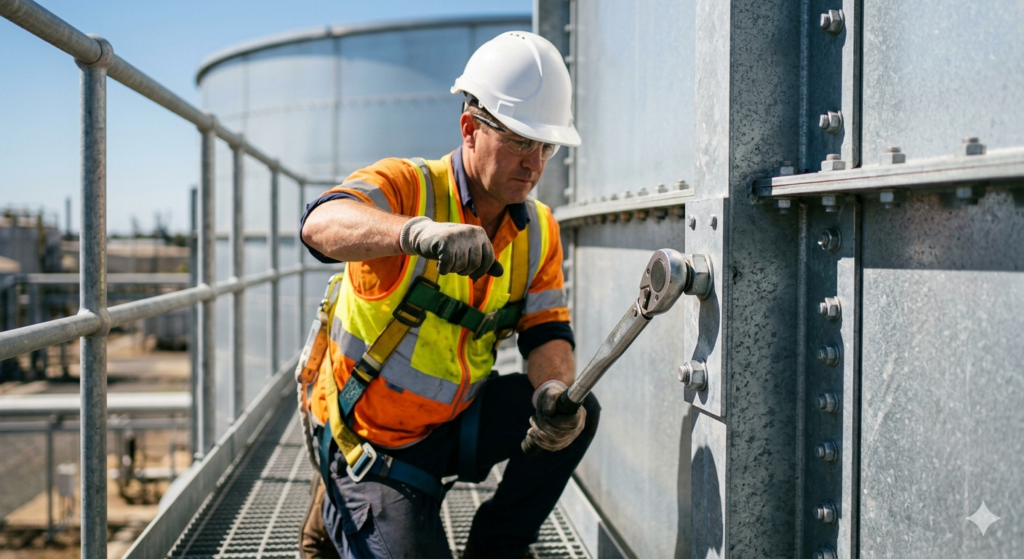
Implementing a strict maintenance schedule is critical. Facility managers should mandate visual inspections of the platform system every quarter.
Key inspection points include:
- Fastener Torque: Checking all structural bolts connecting the platform to the tank shell to ensure they have not vibrated loose.
- Weld Integrity: Inspecting the joints on guardrails and ladder cages for hairline fractures.
- Gate Springs: Ensuring that the self-closing safety gates at the top of ladder access points snap shut automatically and securely.
Documenting these routine checks is vital. In the event of a federal audit, having a paper trail of your maintenance schedule proves your ongoing commitment to OSHA water tank safety.
Часто задаваемые вопросы
What is the minimum load capacity for an industrial platform?
Under federal regulations, the walking-working surface must support at least four times the intended maximum load. For standard access areas, engineering calculations typically use a minimum concentrated live load of 250 pounds to ensure OSHA water tank safety.
Are safety cages still required for fixed ladders?
Recent regulatory updates have phased out the use of cages for new fixed ladders over 24 feet, replacing them with personal fall arrest systems or ladder safety systems. However, existing cages may remain under specific legacy conditions.
Can I retrofit a safety platform onto an older storage tank?
Yes, retrofitting is common. However, you must first have a structural engineer verify that the existing tank panels and internal rods can handle the additional dead load of the steel. Failing to reinforce the base before adding a walkway will compromise OSHA water tank safety.
How high must the guardrails be on the walkway?
Top rails must be 42 inches (plus or minus 3 inches) above the walking surface. Additionally, a mid-rail must be installed halfway between the top rail and the surface, and toe boards must be at least 3.5 inches high to prevent dropped tools. Strict adherence to these dimensions guarantees your OSHA water tank safety compliance.