Most industrial water storage problems are not caused by the tank itself. They begin long before installation—when a fully welded tank cannot fit through a factory entrance, exceeds transportation limits, or leaves no practical way to expand capacity years later.
A modular industrial water tank solves these challenges by changing how the tank is delivered, assembled, maintained, and upgraded. Instead of transporting one oversized structure, the system arrives as individual panels that are assembled on site. This approach reduces transportation constraints, makes installation possible in confined locations, and allows future expansion without replacing the entire tank.
If you’re comparing a sectional water tank, evaluating a bolted water tank, or planning modular water storage for a new industrial facility, this guide explains where modular designs create measurable engineering advantages—and where they may not be the best choice.
Оглавление
Why Do Traditional Industrial Water Tanks Become a Problem Before Installation?
Many project delays occur before the first drop of water enters the tank.
Large welded tanks often require oversized transportation permits, specialized lifting equipment, and unobstructed installation routes. These requirements can become significant obstacles when a project involves urban construction, factory retrofits, or facilities with restricted access.
For example, a manufacturing plant may have sufficient storage space inside the building, but the entrance doors or internal corridors are too narrow to move a one-piece tank into position. In these situations, redesigning the building is usually far more expensive than selecting a different tank system.
Согласно U.S. Federal Highway Administration, oversized loads frequently require route planning, permit approval, and transportation restrictions depending on dimensions and weight.
These logistical considerations are often overlooked during early project planning but can significantly affect schedules and installation costs.
Another common issue appears years after commissioning.
Industrial facilities rarely maintain exactly the same production capacity throughout their lifecycle. When water demand increases, traditional welded tanks usually require complete replacement because their dimensions cannot be modified economically.
That is where a modular industrial water tank offers a completely different design philosophy.
Can Transportation Determine Whether a Tank Design Is Practical?
Absolutely.
Transportation limitations are often the first engineering constraint—not tank capacity.
Instead of shipping a completed vessel, a sectional water tank is transported as standardized panels, internal reinforcements, fasteners, and sealing materials. Every component fits inside conventional shipping containers or standard freight vehicles.
This creates several practical advantages:
- Lower transportation costs
- Fewer oversized freight permits
- Easier international shipping
- Simplified customs handling
- Reduced risk of transportation damage
For overseas EPC projects, these benefits become even more valuable because logistics frequently account for a considerable percentage of total project costs.
Modern modular construction principles have become increasingly common across industrial infrastructure because transporting standardized components is generally more flexible than transporting completed structures.
The National Institute of Building Sciences discusses similar modular construction concepts in its guidance on industrial building systems:
Although water tanks differ from modular buildings, the engineering philosophy is remarkably similar—manufacture under controlled conditions, transport efficiently, and assemble where needed.
What Makes a Modular Industrial Water Tank Different from a Welded Tank?
The biggest difference is not the material.
It is the installation method.
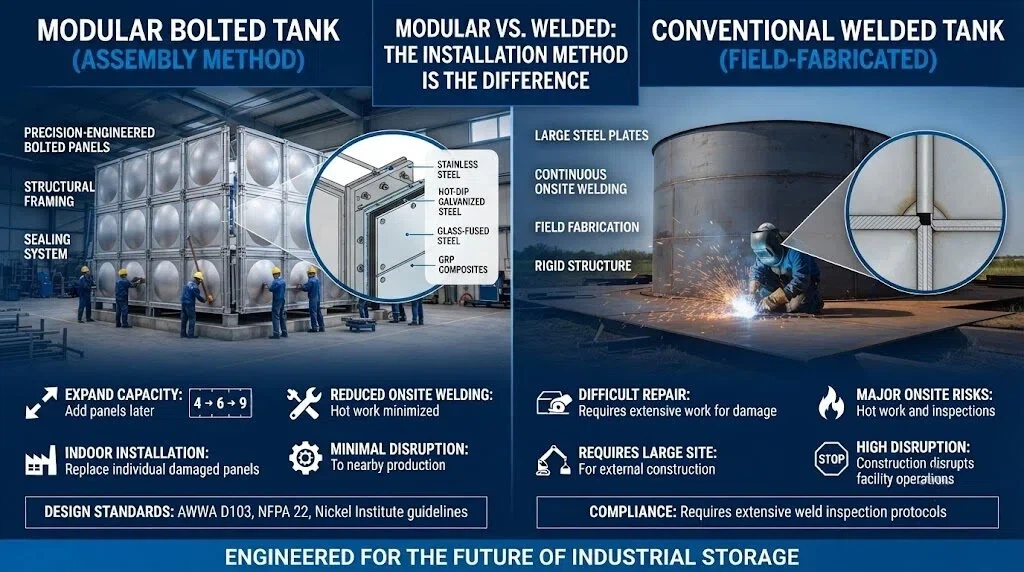
A modular industrial water tank is manufactured as precision-engineered panels that are bolted together on site using structural framing and sealing systems. Depending on project requirements, the panels may be made from stainless steel, hot-dip galvanized steel, glass-fused steel, or GRP composites.
This modular approach provides flexibility that a conventional welded tank cannot easily achieve.
A typical bolted water tank allows engineers to:
- Increase storage capacity by adding panels later
- Replace individual damaged panels instead of replacing the entire tank
- Install tanks inside existing buildings
- Reduce onsite welding
- Minimize disruption to nearby production equipment
The design principles behind sectional storage systems are also recognized in international water storage standards.
In addition to the AWWA D103 standard, NFPA 22 (Standard for Water Tanks for Private Fire Protection) serves as a core benchmark for steel tank design, providing robust engineering guidance on structural integrity, seismic performance, construction quality control, and rigorous inspection protocols for both potable and industrial water storage systems.
Similarly, stainless steel fabrication practices commonly follow recommendations developed by the Nickel Institute, particularly regarding corrosion resistance, fabrication methods, and long-term maintenance.
Is Modular Water Storage Only Suitable for New Projects?
Not at all.
In many cases, modular water storage provides greater value during renovation projects than new construction.
Consider an operating pharmaceutical plant.
Stopping production for several weeks to replace a welded tank can be extremely expensive. A modular system allows components to enter the facility through existing access points, reducing demolition work and minimizing disruption.
The same advantage applies to:
- Food processing plants
- Больницы
- Commercial buildings
- Mining facilities
- Municipal pumping stations
- Water treatment plants
Whenever installation space is limited, a sectional tank for limited access sites becomes a practical engineering solution rather than simply an alternative product.
Why Are Engineers Specifying Modular Industrial Water Tank Systems More Frequently?
The answer is rarely “because they’re modular.”
It is because project constraints have changed.
Industrial facilities are becoming denser, land costs continue to rise, and retrofit projects now represent a larger share of industrial construction than greenfield developments.
A modular industrial water tank aligns well with these realities because it gives engineers more flexibility without fundamentally changing storage performance.
Instead of designing the building around the tank, engineers can design the tank around the building.
That shift may seem subtle, but it often determines whether a project proceeds on schedule or requires costly structural modifications.
A recent discussion by the engineering community on Engineering Stack Exchange highlights how installation constraints and maintenance accessibility frequently influence equipment selection as much as structural calculations themselves.
As more industrial projects prioritize lifecycle adaptability over one-time installation, modular tank systems continue gaining acceptance across manufacturing, infrastructure, and utility sectors.
How Does a Modular Industrial Water Tank Compare with a Traditional Welded Tank?
Choosing between a welded tank and a modular industrial water tank is rarely about which design is “better.” The right choice depends on transportation, installation conditions, future expansion plans, and maintenance strategy.
For projects built on open sites with no expected capacity changes, a welded tank may still be appropriate.
However, when access is limited or operational flexibility matters, modular construction usually provides more practical options throughout the tank’s service life.
Before comparing specifications, ask one simple question:
“Will this tank still meet the site’s needs ten years from now?”
If the answer is uncertain, modular construction deserves serious consideration.
| Comparison Item | Traditional Welded Tank | Modular Industrial Water Tank |
|---|---|---|
| Transportation | Oversized shipment may require permits | Standard container or truck transport |
| Site Access | Limited by tank dimensions | Individual panels fit through restricted access |
| Установка | Heavy crane and more welding | On-site panel assembly with bolted connections |
| Future Expansion | Usually requires replacement | Capacity can be increased by adding panels |
| Обслуживание | Repairs may affect the entire structure | Individual panels can be replaced |
| Downtime | Often longer | Localized repairs reduce shutdown time |
| Suitable for Retrofit Projects | Ограниченный | Отличный |
| Lifecycle Flexibility | Ниже | Выше |
The comparison also explains why many engineering consultants recommend evaluating lifecycle costs instead of focusing only on the initial purchase price.
“For industrial assets, rigorous evaluation requires more than upfront capital expenditure; it demands an analysis of maintenance and operational lifespans. As detailed in the standard industry definitions of Life-cycle cost analysis, factoring in replacement and future modifications ensures better long-term investment decisions.”
Where Does a Modular Water Tank for Industrial Projects Create the Greatest Value?
Not every facility benefits equally from modular construction.
The biggest advantages appear where transportation, installation, and future changes are difficult to predict.
Manufacturing Plants
Factories frequently expand production lines long before they relocate.
Instead of replacing an entire storage system, a modular industrial water tank can often be enlarged by adding additional panels, reducing capital expenditure and minimizing production interruptions.
This flexibility is especially valuable for facilities planning phased expansion.
Food and Beverage Processing
Food manufacturers place significant emphasis on hygiene, maintenance accessibility, and inspection.
A stainless steel sectional water tank allows damaged panels to be replaced individually instead of dismantling the complete structure.
Facilities following sanitary design practices should also consider internationally recognized guidance such as the EHEDG (European Hygienic Engineering & Design Group) recommendations on hygienic equipment design.
Water Treatment Facilities
Municipal and industrial treatment plants often operate continuously.
Any shutdown affects daily operations.
Because a bolted water tank can isolate maintenance to specific sections, repair work is generally less disruptive than replacing or rewelding an entire tank.
This becomes particularly important where uninterrupted water supply is required.
Commercial Buildings and Hospitals
Buildings in city centers rarely provide unrestricted equipment access.
Roof openings, elevators, mechanical rooms, and narrow corridors frequently determine the maximum component size that can enter the building.
A sectional tank for limited access sites allows installation without major structural demolition.
For retrofit projects, this advantage often outweighs small differences in procurement cost.
Mining and Remote Industrial Sites
Remote construction projects introduce another challenge—logistics.
Oversized fabricated tanks can require specialized transportation over difficult terrain, increasing both cost and project risk.
Transporting modular components instead reduces dependence on exceptional-load transportation and allows staged delivery according to construction progress.
How Should You Plan a Sectional Tank for Limited Access Sites?
A restricted installation site does not automatically require a smaller tank.
Instead, it requires better planning.Before selecting a modular industrial water tank, engineers should evaluate several practical conditions that directly influence installation efficiency.
1.Measure the Smallest Access Point
Do not measure only the equipment room.
Check:
- Factory doors
- Service corridors
- Stairwells
- Roof openings
- Elevator dimensions
- Crane operating radius
The smallest access point determines the maximum panel size.
2.Leave Space for Future Expansion
Many owners calculate today’s water demand but ignore future production increases.
If expansion is likely within five to ten years, reserve enough surrounding space for additional panel rows.
Planning ahead costs very little during initial construction but can prevent expensive redesign later.
This is one of the strongest reasons engineers recommend modular water tank for industrial projects rather than fixed welded designs.
3.Consider Maintenance Access from Day One
Maintenance personnel need space to inspect bolts, replace panels, and access internal components.
A tank installed tightly against surrounding walls may reduce future serviceability even if installation is successful.
The Occupational Safety and Health Administration (OSHA) provides guidance on maintaining safe access for inspection and maintenance activities around industrial equipment.
Good engineering considers not only installation day but every inspection that follows.
4.Confirm Leak Prevention Details Before Procurement
Panel quality alone does not determine sealing performance.
Engineers should review:
- Gasket material compatibility
- Bolt tightening sequence
- Joint alignment
- Structural support spacing
- Hydrostatic testing procedure
Ignoring these details increases the likelihood of leakage after commissioning.
For a deeper discussion, see our guide.
What Mistakes Increase the Lifetime Cost of Modular Tanks?
Most long-term expenses are created during specification—not during operation.
Common examples include:
- Selecting panel materials without considering local water chemistry.
- Ignoring future expansion requirements.
- Underestimating transportation restrictions.
- Omitting maintenance clearance around the tank.
- Choosing capacity based only on current production.
Each of these decisions may appear minor during procurement but can significantly increase modification costs later.
A well-designed modular industrial water tank should support operational changes rather than become an obstacle to them.
Final Thoughts
Selecting a modular industrial water tank is rarely about following industry trends. It is about reducing project constraints before they become expensive problems.
When transportation routes are restricted, installation space is limited, or production capacity is expected to grow, modular construction provides flexibility that conventional welded systems cannot easily match.
For engineering teams, the best decision is usually the one that remains practical throughout the tank’s entire service life—not simply the one with the lowest initial quotation.
By evaluating access conditions, lifecycle costs, maintenance strategy, and future expansion during the design stage, buyers can choose a storage solution that supports long-term operations instead of limiting them.
Часто задаваемые вопросы
What is a modular industrial water tank?
A modular industrial water tank is a water storage system assembled from factory-manufactured panels that are bolted together on site. This design simplifies transportation, installation, maintenance, and future expansion.
Is a sectional water tank stronger than a welded tank?
Both systems can provide excellent structural performance when designed according to recognized engineering standards. The main difference is installation flexibility and expandability rather than strength alone.
Can a modular industrial water tank be expanded later?
Yes. One of the biggest advantages of modular construction is that additional panel sections can often be added without replacing the original tank, provided expansion space has been reserved.
How long does installation usually take?
Installation time depends on capacity and site conditions, but modular systems generally require less on-site construction than field-welded tanks because most manufacturing is completed before delivery.
What materials are commonly used?
Common choices include stainless steel, hot-dip galvanized steel, GRP, and glass-fused-to-steel panels. The selection depends on water quality, operating environment, and maintenance expectations.
Do bolted water tanks leak more easily?
No. Leakage is usually related to improper gasket installation, bolt tightening sequence, or poor assembly rather than the bolted design itself.