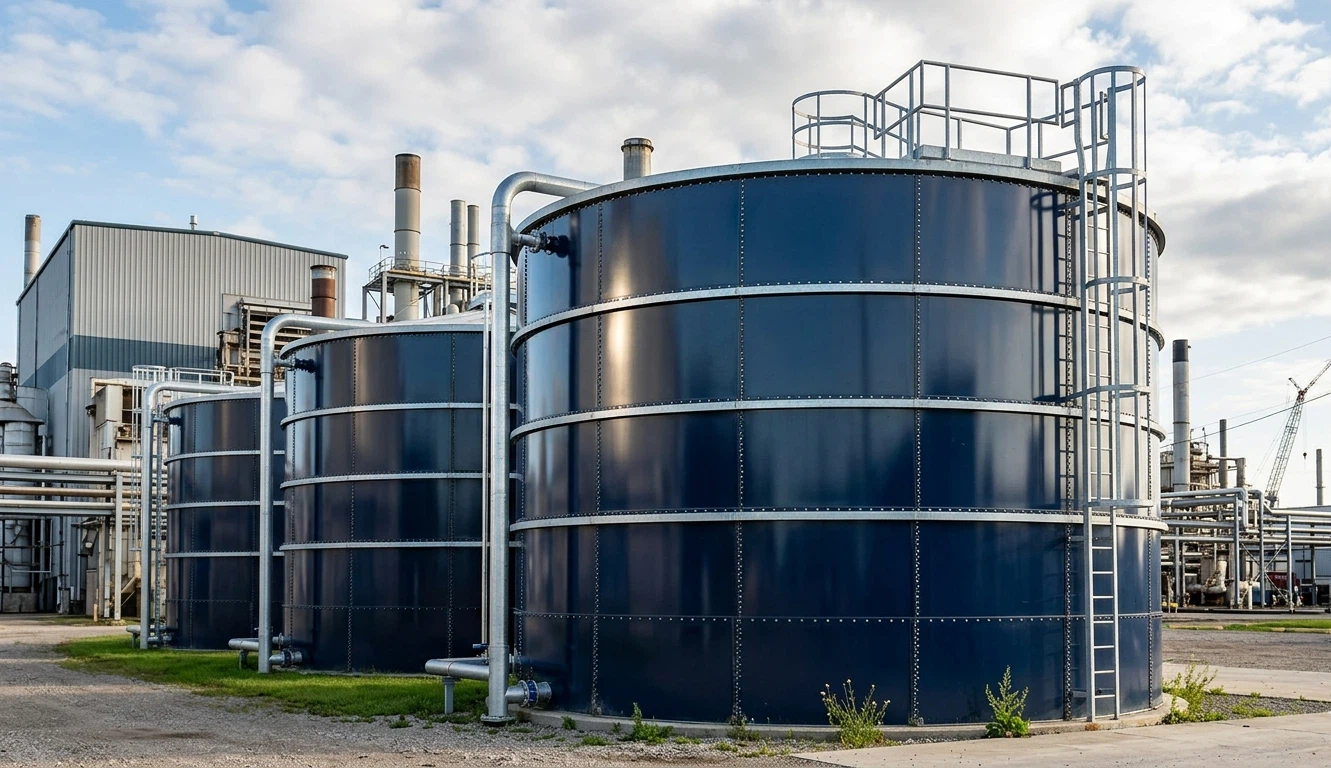
Global climate patterns are shifting, and with them, the baseline for industrial infrastructure safety has moved. For project managers and structural engineers, “standard” is no longer enough when a site is located in a typhoon corridor or an arctic plateau. A specialized extreme weather tank isn’t just a storage vessel; it is a critical fail-safe designed to protect a community’s water supply or an industrial facility’s fire suppression system when the environment turns hostile.
Whether you are dealing with the corrosive salt spray of a coastal hurricane zone or the crushing weight of a five-foot snowpack, the storage solution must be calculated for the absolute worst-case scenario. This is where the intersection of material science and advanced structural engineering becomes the difference between a long-lasting asset and a catastrophic site failure.
Оглавление
Beyond the Gusts: Structural Integrity in High-Wind Environments
When we discuss wind load design, we aren’t just talking about the tank standing upright. We are talking about the “ovalling” effect—where high-velocity winds create a pressure differential that can cause a tank to buckle inward on the windward side or burst on the leeward side.
For an extreme weather tank, engineering starts with the ASCE 7-22 (Minimum Design Loads and Associated Criteria for Buildings and Other Structures). This standard provides the map for calculated risk, dictating how a structure must respond to three-second peak gusts. In high-wind zones, the thickness of the upper shell rings is often increased, and top wind girders are reinforced to maintain the tank’s circular geometry under duress. You can find the full technical breakdown of these standards at the ASCE Library.

The Physics of Engineering Bolted Steel Tanks for Hurricane Zones
Hurricane-force winds bring two distinct challenges: sustained high pressure and flying debris. Engineering bolted steel tanks for hurricane zones requires a departure from traditional light-gauge construction. These tanks utilize high-tensile strength steel plates that are factory-punched and coated, ensuring that every bolt hole is a point of strength rather than a point of failure.
In these regions, the extreme weather tank must be anchored using specialized heavy-duty bolt assemblies embedded deep into a reinforced concrete foundation. The goal is to ensure the tank stays put even when the surrounding soil becomes saturated. Furthermore, the modular nature of a bolted extreme weather tank allows for easier inspection and replacement of individual panels if they are struck by high-velocity debris during a storm—a feat that is nearly impossible with welded alternatives without extensive downtime.
While wind is a lateral force, snow is a vertical one—and it is relentless. A standard tank roof might be rated for 20-30 lbs per square foot (psf), but an extreme weather tank destined for a northern climate might need to support 100 psf or more.
The engineering behind an extreme weather tank in these conditions focuses on the roof pitch and internal support structures. According to AWWA D103 (Factory-Coated Bolted Carbon Steel Tanks for Water Storage), roof designs must account for “unbalanced snow loads,” where wind causes snow to drift on one side of the roof, creating uneven stress. You can review the AWWA standards for bolted tanks at the American Water Works Association.
By using a self-supporting dome or a heavily columned cone roof, an extreme weather tank can shed load effectively while maintaining its internal liners or enamel coatings.
Galvanized vs. Эмаль: Choosing the Right Shield for the Storm
Material choice is the first line of defense against atmospheric corrosion, which is often accelerated in extreme weather.
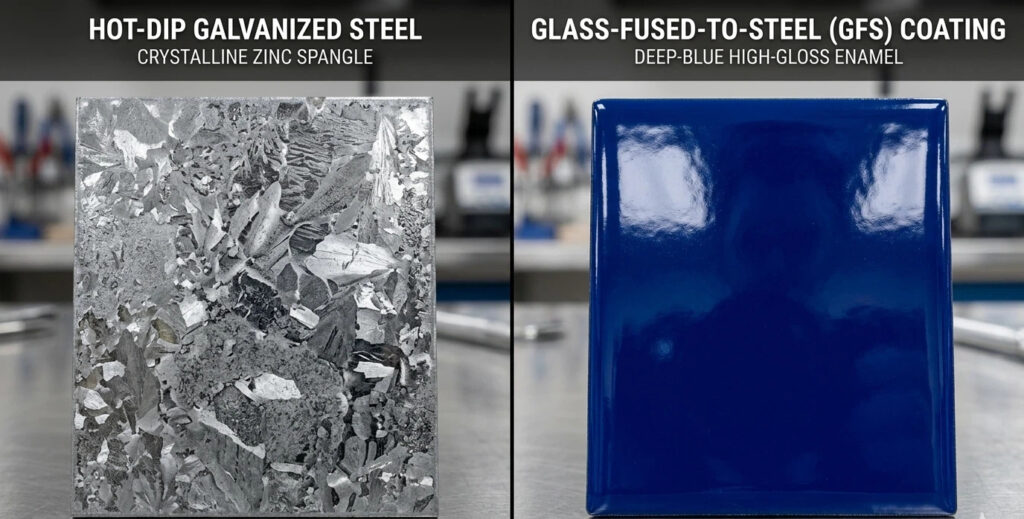
1.Galvanized Steel: This is the workhorse of the industry. Hot-dip galvanizing provides a sacrificial zinc layer that protects the steel. In an extreme weather tank, galvanization is ideal for inland regions where heavy snow and wind are the primary concerns.
2.Enamel (Glass-Fused-to-Steel): This is the premium choice for coastal hurricane zones. The enamel coating is chemically bonded to the steel at temperatures above 800°C. The result is a surface that is harder than the steel itself, resistant to salt spray, UV radiation, and abrasive wind-blown sand.
Selecting an enamel-coated extreme weather tank ensures that the structural integrity isn’t compromised by rust over a 30-to-50-year lifespan.
The Role of Modular Construction in Disaster Recovery
One of the most overlooked benefits of engineering bolted steel tanks for hurricane zones is the speed of deployment. When a natural disaster strikes, the need for potable water is immediate. Because an extreme weather tank is pre-manufactured and shipped in compact crates, it can be assembled on-site with minimal heavy equipment.
This modularity doesn’t just help in the initial setup; it’s a longevity feature. If a 150 MPH gust carries a piece of heavy equipment into the side of the tank, a bolted extreme weather tank can be repaired by replacing only the damaged panels. In contrast, a welded tank would require a full structural audit and potentially a complete replacement.
Final Thoughts
An extreme weather tank is more than a budget line item; it is structural insurance. By prioritizing wind load design and insisting on engineering bolted steel tanks for hurricane zones, you are protecting the most valuable resource on your site. As we see more “once-in-a-century” storms occurring every few years, the definition of a “standard” tank is evolving. Don’t let your infrastructure be the weak link in the next storm.
Часто задаваемые вопросы
What is the maximum wind speed an extreme weather tank can handle?
Most are engineered to 150-165 MPH as standard, but they can be custom-designed for 200+ MPH zones using thicker steel and additional wind girders.
How does snow load affect the tank’s foundation?
Snow load adds significant “dead weight.” The foundation must be calculated not just for the weight of the water, but for the added vertical pressure of the snowpack to prevent settling or cracking.
Why is enamel better than paint in hurricane zones?
Paint can chip or peel when struck by wind-blown debris, leading to rapid corrosion. Enamel is a physical bond that doesn’t “peel,” making it much more durable in abrasive coastal environments.
Can a bolted tank really be as strong as a welded one?
Yes. In many cases, it is superior because the factory-applied coatings are more uniform, and the lap-joint design provides redundant strength that handles the vibration of high winds better than rigid welds.
How often should an extreme weather tank be inspected?
In high-stress zones, a visual exterior inspection should be done annually, with a comprehensive internal and structural audit every 3 to 5 years.