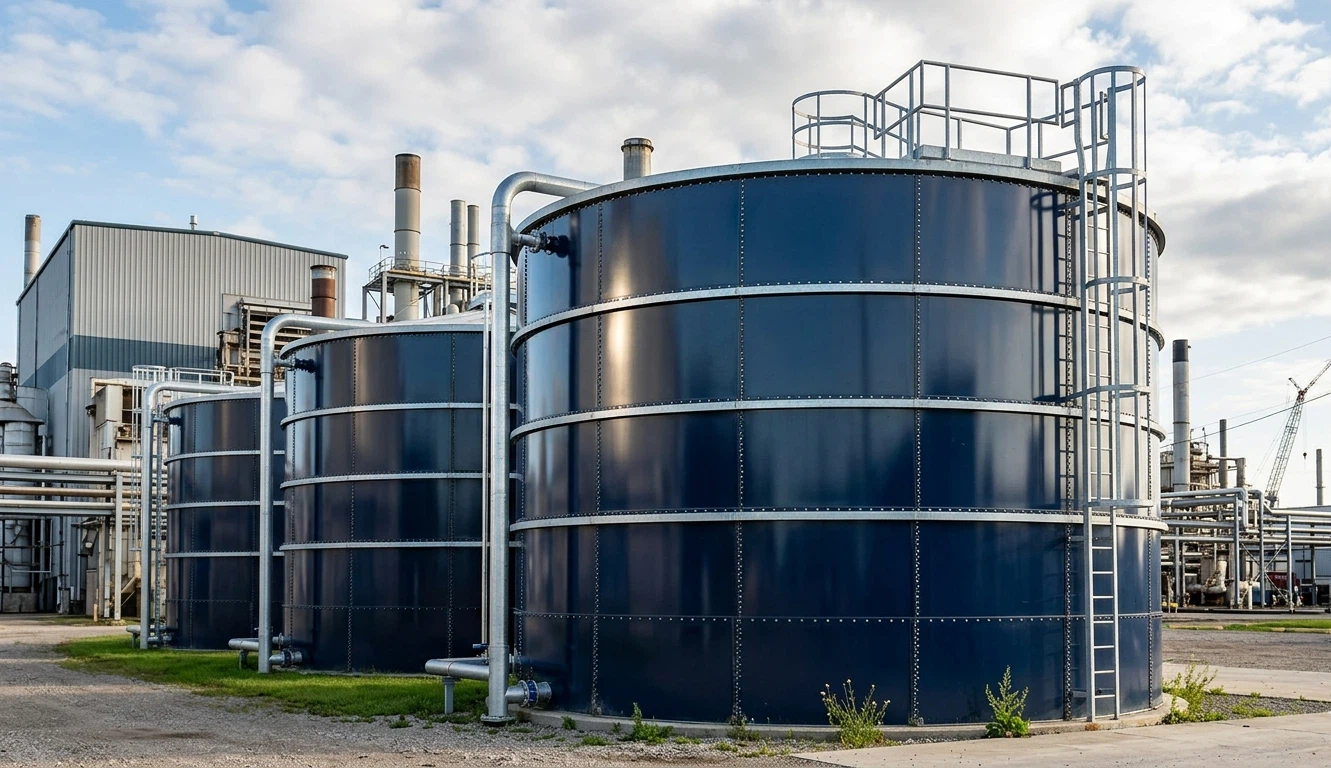
Emergency Backup Water is not only a disaster-preparedness topic. For factories, industrial parks, food processing plants, electronics workshops, textile facilities, and general manufacturing sites, a municipal water interruption can quickly become a production problem.
This guide explains how factories can size Emergency Backup Water, build a practical Contingency Plan, and choose a backup water tank system that supports continuity when normal municipal supply is interrupted.
Оглавление
Why Emergency Backup Water Matters When Municipal Supply Stops
A factory uses water in more ways than many managers realize. Water may support cooling systems, washing, rinsing, cleaning, boiler feed, employee sanitation, product processing, landscape or dust control, and basic facility operation. When municipal supply stops, the impact is not always immediate, but it can spread quickly.
Emergency Backup Water helps facilities maintain critical functions instead of shutting down all operations at once. It does not mean the factory must run at full normal capacity during an outage. The purpose is to protect essential operations, prevent avoidable downtime, and give managers time to respond.
The U.S. EPA’s emergency drinking water planning guide discusses backup supply options during water outages and notes that some businesses and institutions develop alternative sources specifically for backup supply. This supports the basic idea that emergency water supply should be planned before an interruption happens.
For factories, Emergency Backup Water is part of operational resilience. It should be connected with production planning, facility maintenance, EHS management, and risk control.
What a Factory Water Contingency Plan Should Include
A water Contingency Plan should be practical enough for operators to use during a real interruption. A document that only lists “use backup water” is not enough.
A useful factory water Contingency Plan should include:
1.Critical water use points
2.Normal daily water demand
3.Reduced emergency operating demand
4.Required backup duration
5.Water quality requirements
6.Backup water tank capacity
7.Pump and pipe connection plan
8.Emergency valve switching procedure
9.Water level monitoring
10.Cleaning and maintenance schedule
11.Staff roles during outage
12.Refill and recovery plan
WaterISAC’s business continuity planning guidance explains that a business continuity plan helps keep the “heart pumping,” while emergency response focuses on immediate incident control. For factory water planning, that distinction is useful: the Contingency Plan should keep essential operations moving while the supply problem is being solved.
Sizing Emergency Water Storage for Factory Continuity
Sizing Emergency Water Storage for factory continuity starts with one question: how much water is truly critical during an outage?
Do not begin with the largest tank you can buy. Begin with the minimum operating demand you must protect.
Required Backup Water Volume = Critical Daily Water Demand × Required Backup Days × Safety Factor
For example:
Critical demand: 20 m³/day
Backup duration: 2 days
Safety factor: 20%
20 × 2 × 1.2 = 48 m³
In this case, the factory should consider at least 48 m³ of Emergency Backup Water capacity for critical operations.
The safety factor matters because real outages rarely follow a perfect plan. Water demand may rise, refill may be delayed, or part of the stored water may be reserved for hygiene or safety needs.
CDC guidance for household emergency water storage recommends at least one gallon per person per day for three days, and more where needed. While factories must calculate industrial water demand separately, the same principle applies: emergency water planning should be based on defined demand and duration, not guesswork.
How Much Emergency Backup Water Does a Factory Really Need?
The answer depends on what the factory must keep running.
A food plant may need water for cleaning, sanitation, and process control. An electronics facility may need water for controlled production environments. A textile plant may need water for washing, dyeing, or finishing. A general manufacturing plant may need water for cooling, bathrooms, equipment washing, and fire-related support systems.
Factory managers should separate water use into three levels:
- Must-run water: essential production, safety, sanitation, and equipment protection
- Can-reduce water: cleaning, non-critical washing, partial process operation
- Can-stop water: landscape use, non-essential washdown, non-critical support activities
Emergency Backup Water should first protect the must-run category. A factory does not always need to store enough water for normal operation. It needs enough to avoid uncontrolled shutdown, unsafe conditions, or expensive process interruption.
Which Water Uses Should Be Prioritized During an Outage?
During a municipal water interruption, the factory should not treat all demand equally.
Priority usually starts with human health and safety. Then it moves to equipment protection, critical process needs, cooling or circulation systems, and minimum sanitation. Fire protection water may be governed by separate codes, tanks, or system requirements, so it should be reviewed with local authorities and fire protection engineers rather than mixed casually into general production storage.
WHO technical guidance on emergency water needs explains that water requirements vary according to climate, health conditions, and use type. Although the document focuses on emergency populations, it reinforces the planning concept that water demand should be categorized rather than estimated as one generic number.
For factories, this means Emergency Backup Water planning should identify exactly which departments receive water first and which activities stop immediately.
Galvanized vs Enamel Water Tank for Emergency Backup Water
Tank material should match the water quality requirement, installation environment, budget, and expected storage duration.
А оцинкованный резервуар для воды is often selected for cost-effective industrial water storage. It is suitable for many factory sites that need modular capacity, practical installation, and reliable backup water volume for non-sensitive or general industrial use.
Ан enamel water tank is usually considered when stronger corrosion resistance and cleaner long-term storage conditions are important. For projects with higher water quality expectations, longer storage cycles, or stricter internal surface requirements, enamel panels can provide a more protected tank option.
Neither option is automatically “better” for every project. For Emergency Backup Water, the right choice depends on stored water use, water chemistry, site exposure, cleaning plan, maintenance expectation, and budget.
Tank Location, Pumps, and Access Affect Reliability
A backup water tank is only useful if water can move where it is needed.
Buyers should review:
- Distance from critical water use points
- Foundation requirements
- Pump selection
- Pipe diameter and pressure demand
- Emergency valve switching
- Overflow and drainage
- Access for inspection
- Cleaning space
- Freeze or heat protection
- Refill access by tanker or municipal line
CDC’s emergency water planning guide for healthcare facilities recommends identifying nearby storage tanks during planning for water supply interruptions. Although factories are different from hospitals, the planning lesson is useful: water storage location and access should be mapped before an outage, not during one.
A good Emergency Backup Water system is not only a tank. It includes connection points, pumping, monitoring, inspection, and operating procedures.
Common Mistakes in Emergency Backup Water Planning
Factories often make the same mistakes when planning emergency water storage.
The first mistake is using total daily water consumption without separating critical demand. This can lead to oversized systems that cost too much or undersized systems that fail when needed.
The second mistake is ignoring water quality. Water for equipment cooling, employee sanitation, process cleaning, or product contact may require different storage and treatment considerations.
The third mistake is forgetting pumps and controls. A tank with no reliable delivery system does not protect continuity.
The fourth mistake is failing to maintain stored water. Emergency Backup Water should be inspected, cleaned, circulated, or refreshed according to the facility’s water quality needs.
The fifth mistake is never testing the Contingency Plan. Staff should know how to switch valves, monitor water levels, and reduce non-critical water demand.
What Buyers Should Check Before Choosing a Backup Water Tank
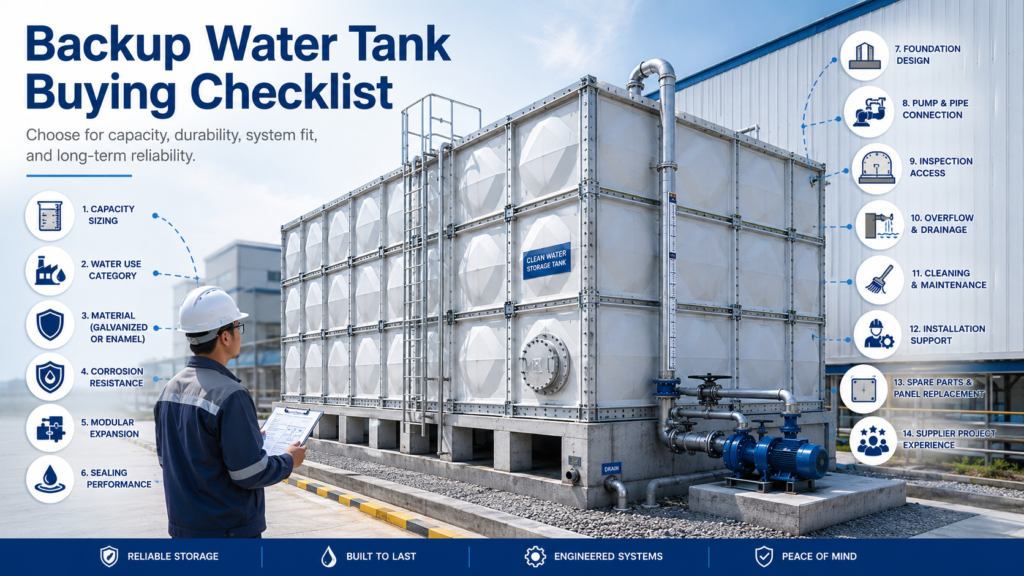
Before choosing an industrial water storage tank, buyers should confirm both capacity and system fit.
Key checks include:
1.Required tank capacity
2.Water use category
3.Galvanized or enamel tank material
4.Corrosion resistance
5.Modular expansion options
6.Sealing performance
7.Foundation design
8.Pump and pipe connection
9.Inspection access
10.Overflow and drainage design
11.Cleaning method
12.Installation support
13.Spare parts and panel replacement
14.Supplier project experience
For Emergency Backup Water, the lowest tank price is not always the lowest-risk choice. A better decision considers lifecycle maintenance, site conditions, and continuity value.
Future Trend
Factory water resilience is becoming more important as supply chains become less tolerant of downtime. Extreme weather, aging infrastructure, construction damage, drought pressure, and local supply interruptions can all affect municipal water reliability.
Future Emergency Backup Water systems will likely include more monitoring and control features: level sensors, automatic refill alarms, pump status feedback, remote alerts, and maintenance records.
Заключение
Emergency Backup Water should be sized with a clear business purpose: keeping essential factory operations stable when municipal supply is interrupted. The right plan starts with critical water demand, backup duration, safety factor, water quality requirements, and a realistic Contingency Plan.
For factories, the decision is not only about buying a tank. It is about building an Emergency Backup Water system that includes storage, pumps, access, monitoring, maintenance, and operating procedures. Whether the project uses a galvanized water tank, an enamel water tank, or a combined storage approach, the goal is the same: protect continuity before a water outage becomes a production shutdown.
Часто задаваемые вопросы
What is Emergency Backup Water for factories?
Emergency Backup Water is stored water used to support essential factory operations during municipal water interruptions, supply failures, or planned outage events.
How do you calculate emergency water storage capacity?
Calculate critical daily water demand, multiply it by required backup days, and add a safety factor for uncertainty.
Should a factory store enough water for full normal production?
Not always. Many factories size emergency storage for critical operations first, then decide whether partial production or full production continuity is necessary.
What should be included in a water Contingency Plan?
It should include critical water uses, backup duration, tank capacity, water quality requirements, pumps, valve switching, inspection, maintenance, and staff responsibilities.
Is a galvanized water tank suitable for Emergency Backup Water?
Yes, a galvanized water tank can be suitable for many industrial backup water storage projects, especially where cost-effective modular capacity is important.
When should buyers choose an enamel water tank?
An enamel water tank is useful when stronger corrosion resistance, cleaner long-term storage, or higher water quality expectations are required.