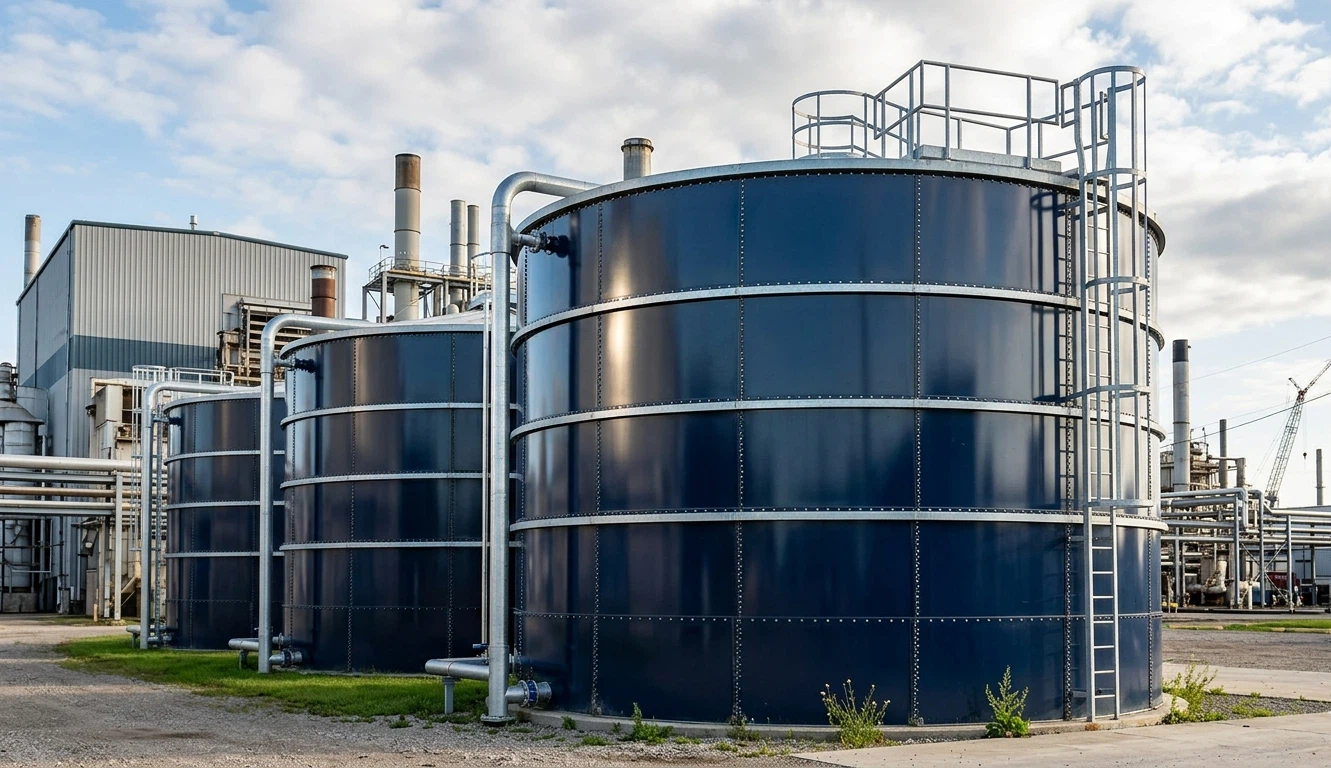
Industrial water management is undergoing a massive regulatory shift. Heavy industries—ranging from coal chemical plants to lithium mining and semiconductor manufacturing—are facing strict mandates to implement Zero Liquid Discharge (ZLD) systems. The goal is complete water circularity.
However, engineers and EPC contractors know that designing a ZLD facility looks much easier on a P&ID schematic than it does in physical reality. While the thermal evaporators and crystallizers receive the majority of the capital expenditure and engineering focus, the most common point of critical failure lies elsewhere. It lies in the containment hardware.
Specifically, the system is only as resilient as its Brine Storage Tanks. When handling highly concentrated, aggressive chemical slurries, choosing the wrong containment material inevitably leads to structural degradation, catastrophic leaks, and unplanned facility downtime.
Оглавление
The Hardware Killer: High-Salinity Wastewater
To understand why standard containment fails, we must examine the chemical profile of the liquid. The ZLD process relies on reverse osmosis (RO) and thermal evaporation to strip pure water from the effluent. What remains is high-salinity wastewater.
This concentrated brine is a metallurgical nightmare. It typically contains massive concentrations of chlorides, sulfates, and heavy metals. Furthermore, the pH levels can swing aggressively from highly acidic (pH 2) to highly alkaline (pH 14) depending on the upstream process variations.
When engineers specify standard carbon steel or even 304/316L stainless steel for their Brine Storage Tanks, they run into an electrochemical wall. Chlorides are notorious for penetrating the passive oxide layer of stainless steel. This initiates localized “pitting corrosion” and crevice corrosion. Once a pit forms, the localized acid concentration inside the pit accelerates the corrosion rate exponentially, eventually boring right through the steel plate.
Epoxy-coated carbon steel is another common, yet flawed, alternative. The high temperature of the brine, combined with its chemical aggressiveness, often causes standard epoxy linings to blister and delaminate. When the coating fails, the underlying carbon steel is exposed and rapidly eaten away.
Reference: For authoritative data on chloride-induced pitting corrosion in industrial alloys, refer to the technical guidelines published by AMPP – The Association for Materials Protection and Performance.
The Solution: The Enamel (GFS) Water Tank
Addressing this severe corrosion requires a fundamental shift in material science. For modern ZLD infrastructure, the industry standard has shifted toward the Enamel (GFS) Water Tank.
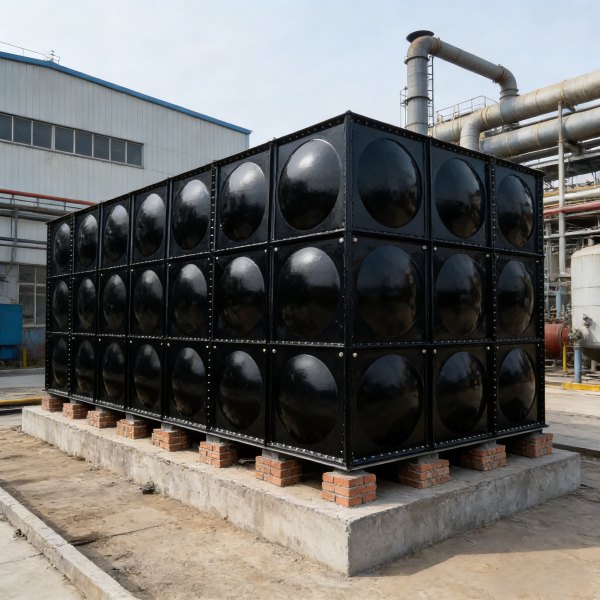
GFS stands for Glass-Fused-to-Steel. This is not a simple paint or spray-on epoxy. It is an advanced metallurgical process. During manufacturing, a specialized enamel powder is applied to high-strength titanium alloy steel plates. These plates are then fired in a high-temperature furnace at over 800°C (1470°F).
At this extreme heat, the glass powder melts and actually fuses with the steel at a molecular level. The resulting surface possesses the structural strength of steel but the absolute chemical inertness of glass.
Because glass does not react with chlorides, sulfates, or extreme pH variations, a GFS-coated unit is arguably the best tank coating for high chloride brine. By specifying this technology, facility managers completely bypass the pitting and delamination issues that plague traditional Brine Storage Tanks.
Strategic Integration of ZLD Water Tanks
In a closed-loop water treatment facility, ZLD Water Tanks serve multiple critical functions. They are not simply passive holding vessels; they are active components that buffer the entire chemical and thermal process.
1.Equalization and RO Reject Storage
Before entering the brine concentrator, the RO reject water must be equalized. The flow rate and chemical composition fluctuate constantly. Heavy-duty Brine Storage Tanks are required here to hold the corrosive feed, allowing the downstream thermal evaporators to operate at a steady, optimized baseline.
2.Crystallizer Feed Buffering
The most aggressive fluid in the entire plant is the pre-crystallization slurry. It is hot, dense, and chemically volatile. Using an Enamel (GFS) Water Tank at this stage ensures that the extreme chloride levels do not eat through the containment walls while the slurry awaits final crystallization and solid waste separation.
3.High-Purity Distillate Storage
ZLD systems don’t just process waste; they generate ultra-pure water for reuse in cooling towers or boilers. GFS technology is equally suited for storing this distillate, ensuring no metallic leaching contaminates the high-purity water before it returns to the manufacturing loop.
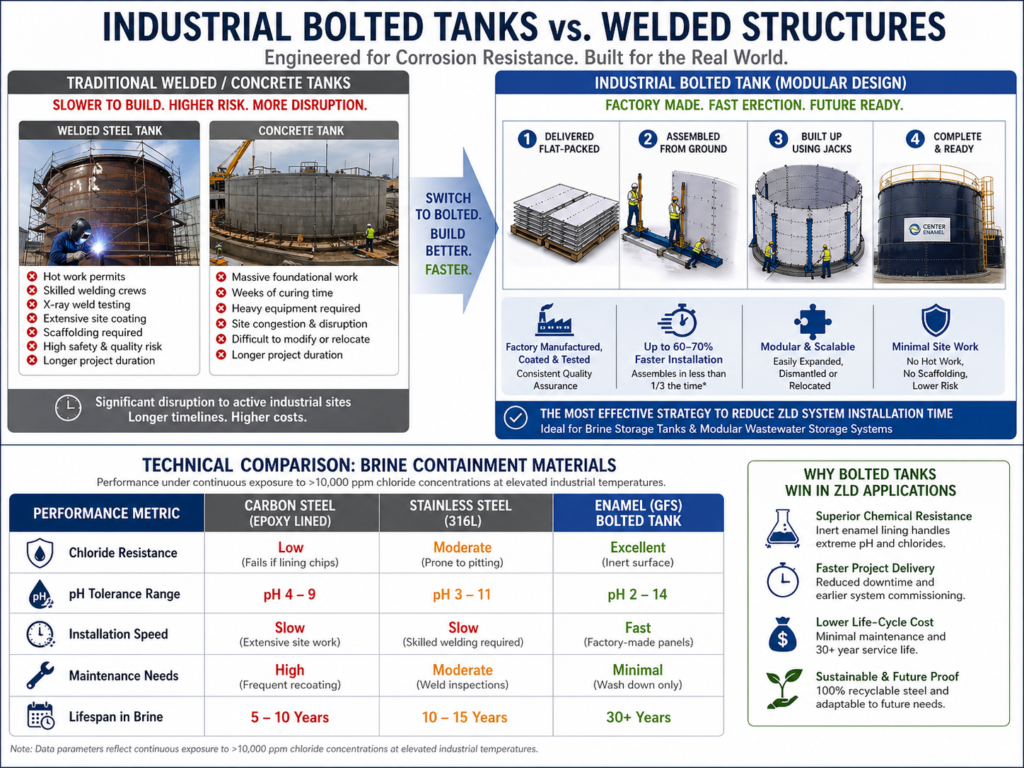
Industrial Bolted Tanks vs. Welded Structures
Beyond chemical resistance, EPC contractors face severe logistical constraints. Retrofitting an existing chemical plant with a new ZLD system means working within tight spatial footprints and strict project deadlines.
This is where the physical construction of the vessel matters. When analyzing Bolted vs Welded tanks for chemical storage, the bolted modular design offers a massive competitive edge.
Traditional welded tanks require hot work permits, specialized welding crews, x-ray weld testing, and extensive on-site coating applications. Concrete tanks require massive foundational work and weeks of curing time. Both methods cause significant disruption to an active industrial site.
Conversely, Industrial Bolted Tanks are manufactured, coated, and quality-tested entirely in the factory. They arrive at the project site as a flat-packed kit of standardized panels. Erection is achieved using specialized jacks, allowing crews to build the tank from the ground up without scaffolding.
If you are asking how to reduce ZLD system installation time, switching to a bolted architecture is the most effective strategy. A team can often assemble high-capacity Brine Storage Tanks in less than a third of the time it takes to construct a welded or concrete equivalent. Furthermore, this modular wastewater storage design allows the tank to be easily expanded, dismantled, or relocated if the facility’s capacity needs change in the future.
Technical Comparison: Brine Containment Materials
To quantify the engineering advantages, the following table breaks down the core differences between primary material choices for highly corrosive industrial storage.
| Performance Metric | Carbon Steel (Epoxy Lined) | Stainless Steel (316L) | Enamel (GFS) Bolted Tank |
| Chloride Resistance | Low (Fails if lining chips) | Moderate (Prone to pitting) | Excellent (Inert surface) |
| pH Tolerance Range | pH 4 – 9 | pH 3 – 11 | pH 2 – 14 |
| Скорость установки | Slow (Extensive site work) | Slow (Skilled welding required) | Fast (Factory-made panels) |
| Потребности в техническом обслуживании | High (Frequent recoating) | Moderate (Weld inspections) | Minimal (Wash down only) |
| Lifespan in Brine | 5 – 10 Years | 10 – 15 Years | Более 30 лет |
Note: Data parameters reflect continuous exposure to >10,000 ppm chloride concentrations at elevated industrial temperatures.
Thermal Stability and High-Grade Sealing
Storing high-salinity wastewater involves handling fluids at elevated temperatures. Heat accelerates corrosion. The thermal expansion coefficient of standard coatings often differs from the underlying steel, causing micro-cracking during temperature fluctuations.
Because the glass and steel in an Enamel (GFS) Water Tank are fused, they act as a single composite material. They expand and contract together, ensuring the inert barrier remains uncompromised even when receiving hot fluids direct from the evaporator loop.
Additionally, the integrity of Brine Storage Tanks relies heavily on the panel joints. High-grade Industrial Bolted Tanks utilize specialized EPDM (Ethylene Propylene Diene Monomer) or polyurethane sealants between every panel. These sealants are specifically engineered to withstand acidic and alkaline chemical attacks.
When specified correctly, these tanks meet and exceed strict international engineering standards, including AWWA D103-09 (American Water Works Association) for bolted steel tanks, ensuring complete regulatory compliance for heavy industrial applications.
Total Cost of Ownership (TCO) and ROI
Procurement departments often focus exclusively on the initial capital expenditure (CAPEX). While a bare carbon steel tank may carry a lower initial price tag, the glass-fused-to-steel tank cost is significantly lower when evaluated over a 20-to-30-year operational lifecycle.
If standard Brine Storage Tanks fail after five years due to chloride pitting, the plant faces massive costs. The tank must be drained, the aggressive chemicals must be temporarily rerouted or disposed of off-site at a premium, and the tank must be physically rebuilt or relined. The cost of just three days of facility downtime easily dwarfs the initial savings of a cheaper tank.
Investing in an Enamel (GFS) Water Tank eliminates this cycle of failure and repair. The virtually maintenance-free nature of the GFS coating provides true “Uptime Insurance.” By protecting the facility against unplanned outages, high-performance Brine Storage Tanks deliver a rapid Return on Investment (ROI), transforming a mandatory environmental compliance expense into a reliable, long-term infrastructural asset.
Заключение
The transition to Zero Liquid Discharge is non-negotiable for the future of heavy industry. However, achieving sustainable water circularity requires uncompromising hardware. The extreme conditions of high-salinity wastewater demand materials that do not degrade under pressure.
By integrating Enamel (GFS) technology into your system design, you eliminate the threat of pitting corrosion and coating delamination. Opting for Industrial Bolted Tanks drastically reduces site disruption and installation timelines. Ultimately, engineering your facility with premium Brine Storage Tanks is the most effective way to guarantee the long-term operational success and profitability of your entire ZLD infrastructure.
Часто задаваемые вопросы
Are bolted tanks structurally safe for storing heavy brine liquids?
Yes. High-salinity wastewater has a higher specific gravity than fresh water. Bolted Brine Storage Tanks are specifically engineered with thicker lower-ring steel plates and reinforced hardware to handle the increased hydrostatic pressure safely.
How do you fix a leak in a bolted tank?
Unlike welded tanks that require draining, grinding, and hot-welding to repair, a bolted tank joint can usually be remediated simply by re-torquing the specific bolts or locally replacing the sealant mastic, drastically reducing maintenance downtime.
What is the maximum temperature GFS tanks can handle?
Standard GFS Brine Storage Tanks comfortably handle continuous liquid temperatures up to 60°C (140°F). For specialized high-temperature processes, high-grade enamel formulations and specialized sealants can be specified to handle up to 90°C (194°F).
Can an existing bolted tank be expanded?
Yes. One of the primary benefits of this modular architecture is that Brine Storage Tanks can often be expanded by jacking up the existing structure and adding new rings of steel panels at the base, provided the original foundation was sized for future expansion.