Industrial water tank leakage prevention is rarely about fixing a visible crack. In most real projects, leaks begin much earlier—during panel selection, tank sealing design, bolt tightening, and installation tolerance control on bolted water tank systems.
Table of Contents
Why water tank leakage usually starts before commissioning
Most leakage cases are not “random defects.” They are cumulative engineering errors.
A key failure pattern is described in hydraulic containment research from the U.S. Environmental Protection Agency, which notes that structural joints and seal interfaces are primary risk zones in modular containment systems EPA Water Storage Infrastructure Overview.
In industrial projects, leakage typically comes from four early-stage decisions:
- panel thickness mismatch under hydrostatic load
- incorrect gasket compression design
- inconsistent bolt torque distribution
- foundation unevenness affecting alignment
- Even a small deviation in installation geometry can trigger long-term seepage paths.
In bolted water tank systems, sealing failure usually comes from:
Tank sealing is often treated as a “component,” but in practice it behaves like a system.
In bolted water tank systems, sealing failure usually comes from:
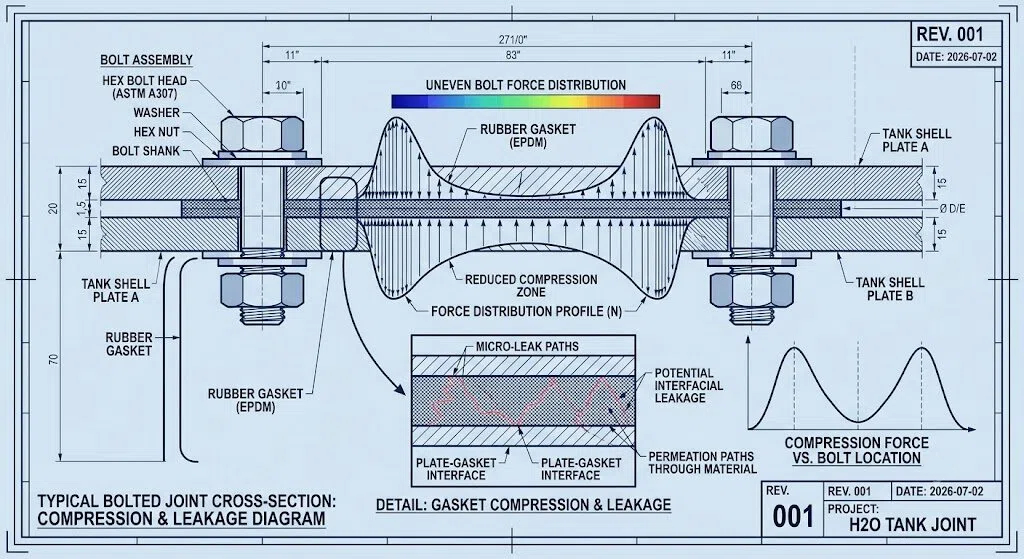
- uneven gasket compression across panel joints
- over-compression during bolt tightening
- chemical aging in stored water conditions
- temperature cycling causing micro-gap formation
Why bolted water tank systems leak more at joints, not panels
In most industrial systems, the tank panels themselves are not the weak point. The joint system is.
Bolted assemblies introduce multiple interfaces:
- steel-to-steel contact surfaces
- gasket-to-metal compression zones
- bolt preload transfer paths
In real field installation, leakage often comes from:
- torque applied without sequence control
- missing cross-pattern tightening
- reuse of bolts without preload calibration
- panel misalignment during assembly
This is why bolted water tank leakage prevention depends more on installation discipline than material choice.
What installation errors are actually causing leakage?
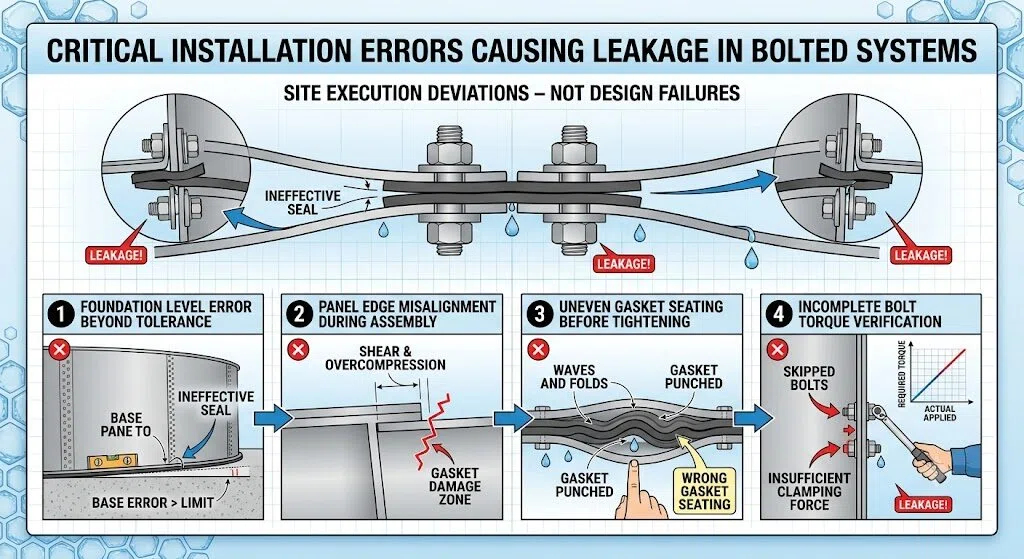
Most leakage problems are not design failures—they are site execution issues.
Typical installation deviations include:
- foundation level error beyond tolerance
- panel edge misalignment during assembly
- uneven gasket seating before tightening
- incomplete bolt torque verification
Why leakage often appears months after installation
A common misunderstanding is that leakage is an installation defect only. In reality, many failures appear later.
The main long-term mechanisms include:
- gasket compression set over time
- bolt preload relaxation under vibration
- thermal expansion and contraction cycles
- corrosion at joint interfaces
Wikipedia’s overview of bolted joint mechanics explains how preload loss directly affects joint integrity under dynamic loading conditions Bolted Joint Mechanics.
This explains why a tank that passes initial testing may still develop seepage after several operational cycles.
How inspection before commissioning actually prevents downtime
Pre-commissioning testing is not a formality. It is the last engineering control point.
Standard inspection sequence includes:
- water filling test (24–48 hours hold)
- joint visual inspection under load
- bolt torque re-check after initial settlement
- gasket compression verification at key zones
What actually prevents industrial water tank leakage in real projects?
There is no single fix. Leakage prevention is a system-level control.
Effective engineering practice combines:
- controlled panel manufacturing tolerance
- correct tank sealing material selection
- calibrated bolt torque sequence
- strict installation leveling control
- verified pressure testing before operation
A technical overview of industrial water storage systems from USGS water infrastructure research also highlights that structural reliability depends on integrated design and field execution consistency USGS Water Infrastructure Systems.
In real procurement decisions, water tank leakage is less about product specification and more about how well these five systems are controlled together.
Technical note
In real engineering projects, industrial water tank leakage prevention is never about one material or one component. It is about how tank sealing, structural alignment, and bolted water tank installation control work together under real load conditions.
When these systems are not aligned, leakage is not an accident—it is the expected outcome.And in most cases, it starts long before the tank is ever filled.
FAQ
Why does a new bolted water tank leak after installation?
Most cases come from uneven bolt torque or gasket compression imbalance during assembly.
Is tank sealing failure more common than panel failure?
Yes. Most leakage starts at sealing interfaces, not steel panels.
Can bolt tightening really affect leakage?
Yes. Uneven torque creates stress concentration and micro-gaps in joints.
How long before leakage problems usually appear?
Immediately after filling or after 3–12 months of operation due to preload relaxation.
What is the most critical inspection step?
Water filling test combined with torque re-check after initial settlement.