Coastal infrastructure projects are among the most demanding engineering environments on the planet. For project managers and facility engineers, the challenge of coastal water storage goes far beyond simple containment. The constant exposure to airborne chlorides, high humidity, and fluctuating temperatures creates a “perfect storm” for rapid material degradation.
In regions where seawater is a constant neighbor, traditional steel tanks often succumb to structural failure within just a few years. Understanding how to mitigate these risks requires a deep dive into material science and a shift toward advanced protective technologies designed specifically for high-salinity zones.
Table of Contents
Why Coastal Water Storage Fails
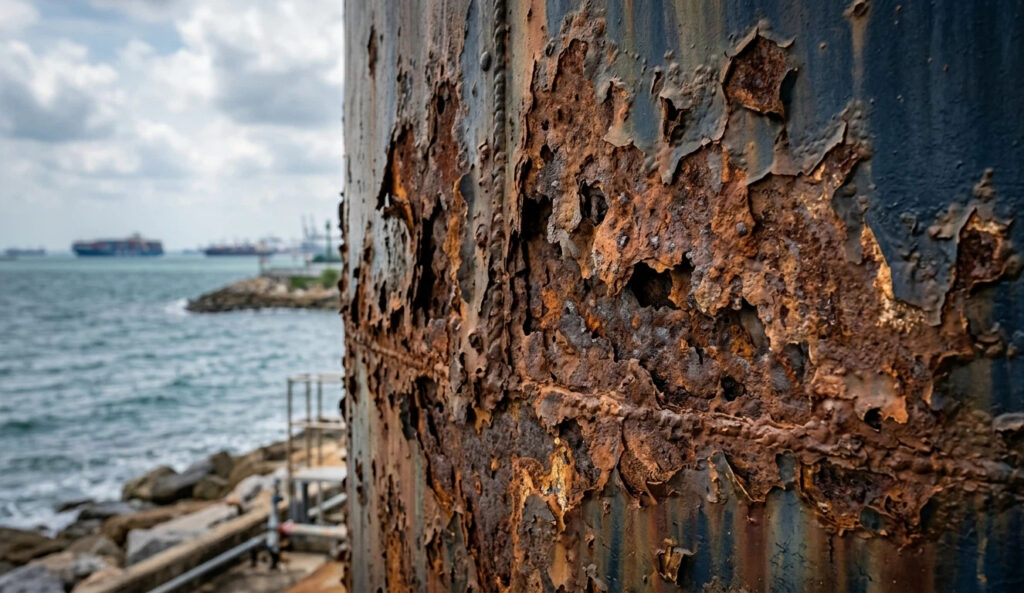
The failure of coastal water storage systems is rarely a sudden event. Instead, it is a relentless electrochemical process. Coastal air is saturated with chloride ions (Cl-), which are uniquely aggressive. Unlike many other ions, chlorides are small enough to penetrate the microscopic pores of standard industrial coatings.
Once these ions reach the carbon steel substrate, they act as a catalyst for “pitting corrosion.” This localized attack creates small, deep holes in the metal that can lead to catastrophic leaks while the rest of the tank surface appears relatively intact. For any engineer managing coastal water storage, recognizing this invisible threat is the first step toward long-term asset protection.
The ISO 12944 Standard for Marine Infrastructure
To quantify the threat, international engineers rely on the ISO 12944 standard. This framework classifies environmental corrosivity, with C5-M Corrosion representing the “Very High (Marine)” category. This designation applies to buildings and industrial structures in coastal and offshore areas with high salinity.
In a C5-M Corrosion environment, the rate of thickness loss for unprotected carbon steel is staggering. According to ISO standards, a steel surface can lose over 200 micrometers of thickness in its first year of exposure alone. Navigating these requirements is essential for ensuring that coastal water storage solutions meet the necessary legal and safety benchmarks for industrial use.
The Failure Analysis of Conventional Coatings in High-Salinity Zones
Historically, the go-to method for protecting industrial tanks in high-salinity environments was the application of multi-layer organic coatings, such as epoxies or polyurethanes. However, the coastal sun and salt create a hostile synergy. UV radiation breaks down the polymer chains of organic coatings (a process known as “chalking”), which eventually allows moisture and salts to seep through.
Furthermore, these coatings are susceptible to “osmotic blistering.” When salt is trapped beneath a coating during a maintenance repaint, it draws moisture through the film, creating high-pressure blisters that eventually burst and expose the raw steel. For large-scale coastal water storage, the recurring costs of sandblasting and repainting these systems every 3 to 5 years often negate any initial savings.
Protecting Industrial Tanks in High-Salinity Environments: A Material Science Approach
True resilience in protecting industrial tanks in high-salinity environments requires moving away from barriers that “degrade” toward barriers that are “inert.” Inorganic materials, such as specialized glass or ceramics, do not react with chloride ions. They provide a permanent physical shield that does not suffer from UV degradation or osmotic failure.
When designing systems for coastal water storage, engineers are increasingly prioritizing composite materials that combine the structural strength of steel with the chemical resistance of inorganic coatings. By eliminating the possibility of “under-film” corrosion, facility owners can extend the service life of their assets from 10 years to over 30 years in even the harshest shoreline conditions.

The Role of Glass-Fused-to-Steel in Saline Regions
The pinnacle of modern tank engineering for coastal water storage is Glass-Fused-to-Steel (GFS) technology. By fusing premium borosilicate glass to steel at temperatures exceeding 800°C, a molecular bond is created. This resulting surface is as hard as steel but as chemically resistant as glass.
Because the surface is non-porous, chloride ions have nowhere to lodge. For those tasked with protecting industrial tanks in high-salinity environments, specifying an enamel water tank is the most effective way to neutralize the C5-M Corrosion threat. Unlike field-applied paints, this factory-applied finish is uniform and tested to withstand the extreme abrasion of wind-blown sand and salt spray common in port cities and island utilities.
Hurricane Resilience and Structural Integrity for Shoreline Infrastructure
Beyond the chemical threat of C5-M Corrosion, coastal regions are frequently prone to extreme weather events. A coastal water storage system must be engineered to withstand high wind loads and potential debris impact during hurricanes or typhoons.
Bolted tank designs are particularly advantageous here. The modular nature of these tanks allows for precise engineering of the steel shell thickness to meet localized wind load requirements (often exceeding 150 mph in coastal zones). Furthermore, the use of marine-grade sealants and encapsulated bolt heads ensures that the joints—often the weakest point in a tank—remain as protected as the main panels.
The Economic Case: Total Cost of Ownership in Coastal Zones
When evaluating coastal water storage options, looking at the initial purchase price is a common mistake. In a high-salinity environment, the “Total Cost of Ownership” (TCO) is dominated by maintenance and downtime. A carbon steel tank that requires repainting every five years will eventually cost three times more than an advanced enamel water tank over a 25-year period.
By investing in superior technology for protecting industrial tanks in high-salinity environments today, infrastructure owners eliminate the future liabilities of structural repair and environmental contamination. In the world of coastal water storage, the cheapest option is almost always the one that never needs to be repainted.
Final Thoughts
Building for the coast requires a departure from “standard” industrial practices. As the demand for coastal water storage grows—driven by global trade and seawater desalination—the industry must adopt more rigorous standards. By focusing on the science of C5-M Corrosion and implementing strategies for protecting industrial tanks in high-salinity environments, we can build infrastructure that doesn’t just survive the ocean but thrives alongside it.
FAQ
Why is C5-M Corrosion so much more aggressive than C4?
C5-M environments involve high condensation and a high percentage of chloride time-of-wetness. This leads to continuous electrochemical activity, whereas C4 (industrial) areas may have periods of dryness that slow the corrosion down.
Can I use stainless steel for coastal water storage?
While some grades (like 316L) offer better resistance, they are still prone to “crevice corrosion” in high-salinity zones. For many projects, Glass-Fused-to-Steel is a more cost-effective and reliable alternative to expensive specialty alloys.
How often should a coastal tank be inspected?
For coastal water storage, we recommend an external visual inspection every year and a detailed structural audit every 5 years, focusing on the sealants and bolt integrity.
Does high salinity affect the foundation of the tank?
Yes. Salt can also attack the concrete foundation (sulfate/chloride attack). It is vital to use high-quality, dense concrete with appropriate cover for the reinforcement bars when building for