Cathodic protection tank systems are the definitive line of defense against the thermodynamic inevitability of corrosion. For asset managers and municipal engineers, the goal is rarely just “maintenance”; it is the extension of infrastructure life into the half-century mark. While a standard steel tank might face structural compromise within 20 to 25 years due to localized pitting, a well-engineered electrochemical defense can push that horizon well beyond 30 years.
Corrosion is an electrical process. Therefore, the solution must be electrical. By understanding the interaction between the steel shell and its environment, we can transition from reactive repairs to proactive asset longevity.
Table of Contents
What is cathodic protection for tanks?
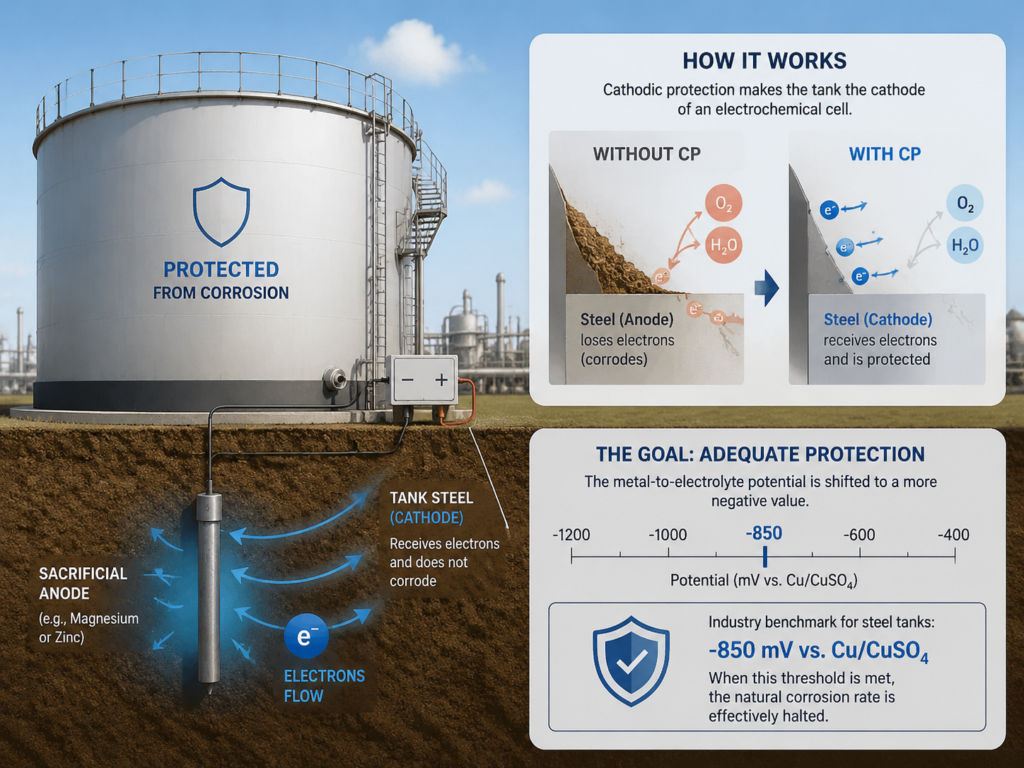
At its core, cathodic protection (CP) is a technique used to control the corrosion of a metal surface by making it the cathode of an electrochemical cell. In the context of a cathodic protection tank setup, we are essentially “tricking” the environment. Instead of the tank’s steel shell surrendering electrons to oxygen and water (the process of oxidation), we provide an alternative source of electrons.
According to the AMPP (formerly NACE) SP0169 standard, corrosion control is achieved when the metal-to-electrolyte potential is shifted to a more negative value. For steel tanks, the industry benchmark is typically reaching a polarized potential of -850 mV relative to a copper/copper sulfate reference electrode. When this threshold is met, the natural corrosion rate is effectively halted.
How does Cathodic Protection work?
To understand how a cathodic protection tank functions, one must visualize the tank as a giant battery. Corrosion occurs where current leaves the metal (the anode) and enters the electrolyte (water or soil). Cathodic protection reverses this. We force current to enter the metal surface from an external source.
This is achieved through two primary methods:
1.Galvanic Protection: Utilizing sacrificial anodes made of more active metals like magnesium or zinc.
2.Impressed Current: Using an external DC power source to drive protective current through relatively inert anodes.
By flooding the steel surface with electrons, we create a “passivation” layer. This layer prevents the iron atoms in the steel from ionizing and dissolving into the water, which is the root cause of structural thinning and leaks.
Why use cathodic protection technology?
The decision to implement a cathodic protection tank strategy is often a financial one as much as it is an engineering one. Without it, the “cost of neglect” compounds over time.
Preventing Pitting Corrosion
Unlike uniform corrosion, which thins a plate evenly, pitting is a localized attack that can create a “pinhole” leak in a 1/4-inch steel plate in just a few years. CP is particularly effective at neutralizing these high-intensity local cells that coatings alone cannot stop.
Complementing Coating Systems
No coating is perfect. Even the highest quality Glass-Fused-to-Steel or epoxy linings will have “holidays”—microscopic gaps or scratches caused during installation. As noted in the AWWA D103-19 standard for Bolted Carbon Steel Tanks, cathodic protection acts as the secondary “safety net,” protecting the steel specifically at these holiday locations where corrosion would otherwise concentrate.
Regulatory and Safety Compliance
For many industrial and municipal sectors, protecting the structural integrity of a tank is a legal requirement. A catastrophic failure doesn’t just result in lost revenue; it can lead to environmental contamination and significant liability. Utilizing a cathodic protection tank system ensures the asset remains compliant with modern safety protocols for decades.
The Benefits of cathodic protection for bolted steel tanks
Bolted steel tanks offer incredible modularity and speed of installation, but they present unique challenges for corrosion control. The benefits of cathodic protection for bolted steel tanks are found in how the technology addresses the mechanical joints and hardware.
Hardware Longevity
In a bolted configuration, the bolts, nuts, and gaskets are potential sites for crevice corrosion. While the panels are often coated, the edges and fasteners are vulnerable. A cathodic protection tank system ensures that the protective current migrates into these tight spaces, protecting the structural fasteners that hold the entire assembly together.
Edge Protection
The “cut edges” of steel panels are historically the first place where rust appears. Because cathodic protection works through the electrolyte (the liquid inside), it provides constant coverage to every square millimeter of submerged metal, regardless of the complexity of the tank’s geometry. This is one of the primary benefits of cathodic protection for bolted steel tanks, as it negates the need for frequent, expensive recoating of panel edges.

Types of Tank Cathodic Protection
Choosing the right system for your cathodic protection tank depends on the water chemistry (resistivity), the tank size, and the availability of power.
1.Galvanic Systems (Sacrificial Anodes)
This is the “set it and forget it” approach. Sacrificial anodes, usually made of magnesium, are suspended inside the tank. Because magnesium has a higher negative potential than steel, it corrodes “sacrificially.”
- Pros: No external power required, low maintenance, easy to install.
- Cons: Anodes must be replaced every 3–5 years depending on consumption.
2.Impressed Current Cathodic Protection (ICCP)
For massive industrial tanks or high-resistivity water, sacrificial anodes may not provide enough current. ICCP uses a rectifier to convert AC power to DC, which is then fed into permanent anodes (often made of mixed metal oxides).
- Pros: Fully adjustable current, can protect much larger surfaces, anodes can last 20+ years.
- Cons: Requires a constant power source and more sophisticated monitoring.
Cathodic protection tank Application Areas
The versatility of the cathodic protection tank makes it a staple across various global industries where water storage is critical.
- Municipal Potable Water: Ensuring the “30+ year life” of community water towers and ground storage tanks.
- Fire Protection: Protecting the firewater tanks that sit stagnant for years but must be structurally sound in an emergency.
- Wastewater Treatment: Combating the aggressive, low-resistivity environment of effluent and sewage storage.
- Industrial Process Water: Where high-temperature or chemical-heavy water would otherwise accelerate the corrosion of the steel shell.
Monitoring for Long-Term ROI
A cathodic protection tank is not a “magic wand”; it requires periodic verification. Industry standards, such as NACE SP0388, recommend annual “Tank-to-Water” potential surveys. These tests ensure that the system is providing the correct current density to keep the steel in a passive state. If the potential drops, it is a signal that the sacrificial anodes are depleted or the ICCP rectifier needs adjustment.
Conclusion
The transition from a standard utility vessel to a long-term asset depends entirely on how you manage the invisible forces of chemistry. Implementing a cathodic protection tank system is the most cost-effective method to ensure that your infrastructure does not succumb to premature failure.
By leveraging the benefits of cathodic protection for bolted steel tanks, engineers can confidently design for the future, knowing that the structural core of their asset is electrochemically shielded. In an era where sustainability and fiscal responsibility are paramount, extending the life of your storage infrastructure starts with a robust cathodic protection tank strategy.
FAQ
.
How does cathodic protection work?
It works by making the tank’s steel shell the “cathode” in an electrochemical circuit. By introducing a more active metal (anode) or an external power source, current is forced onto the steel surface, preventing iron atoms from oxidizing and rusting.
What is the purpose of ICCP?
The purpose of Impressed Current Cathodic Protection (ICCP) is to provide a higher and more controllable amount of protective current than sacrificial anodes can offer. It is ideal for large tanks or environments where the water is highly resistive to electrical flow.
Do fiberglass tanks need to have cathodic protection?
No. Fiberglass (FRP) is a non-conductive material and does not corrode electrochemically. However, any internal metallic components, such as ladders, pipes, or bolted baffles inside the FRP tank, may still require localized protection.