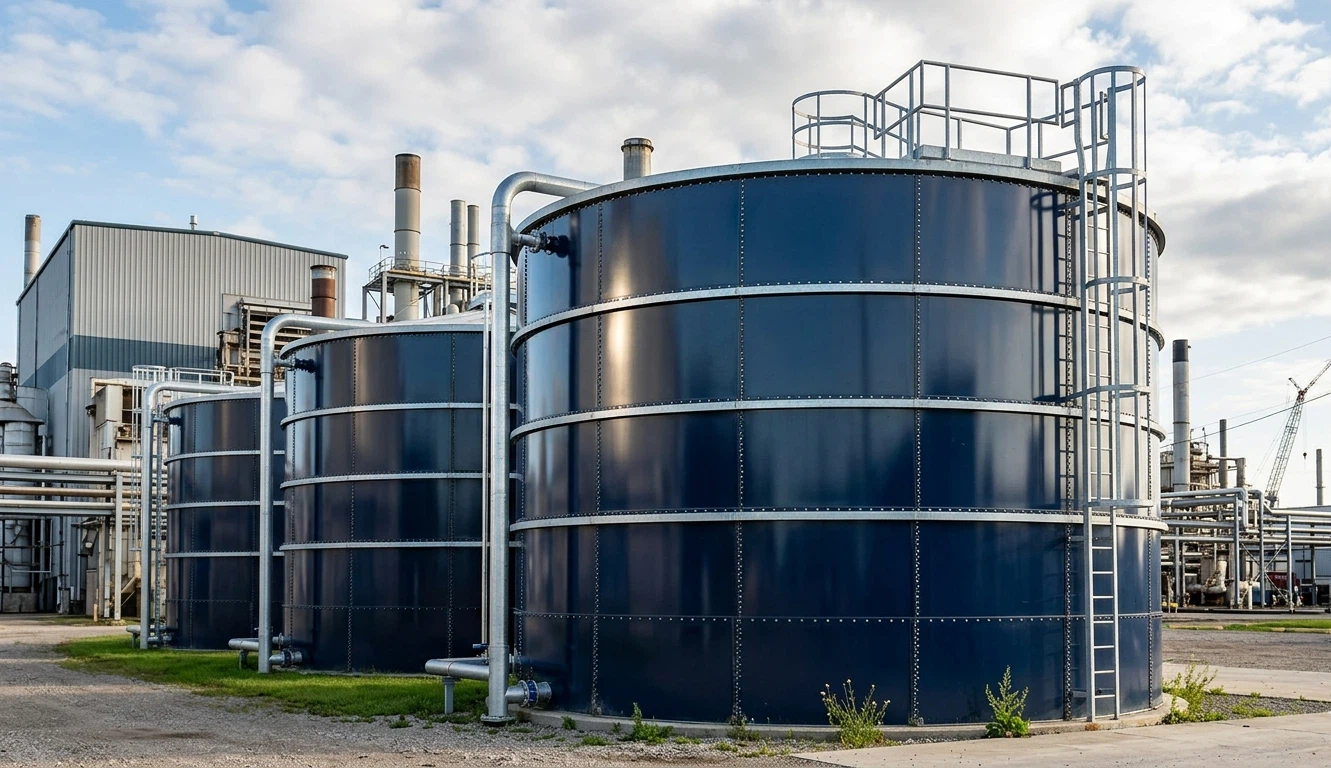
In the landscape of high-purity water systems, the storage phase is often the most overlooked vulnerability. Engineers spend millions on sophisticated membrane filtration and electrodeionization (EDI) stacks, only to see their water quality degrade inside the final container. Storing ultrapure water in a standard RO water storage tank without considering the material-liquid interface is a recipe for catastrophic conductivity spikes.
High-purity water—specifically Reverse Osmosis (RO) and Deionized (DI) water—is fundamentally aggressive. Often referred to as “hungry water,” it lacks dissolved minerals and ions. To reach chemical equilibrium, this water will actively “pull” ions from any material it touches. If you are managing an RO water storage tank, understanding the mechanism of ion leaching is not just a maintenance task; it is a requirement for process integrity.
جدول المحتويات
Why Material Selection Matters
Pure water acts as a powerful solvent. When stored, the water seeks to satisfy its ionic hunger by leaching metallic or organic components from the tank walls. In a typical RO water storage tank, this leaching can involve iron, chromium, or nickel from lower-grade steels, or silica from glass-based coatings.
The choice of the best tank linings for reverse osmosis water storage depends entirely on your target resistivity. For general industrial applications, an electrical conductivity of 1–10 μS/cm might be acceptable. However, in semiconductor or pharmaceutical sectors, water must reach 18.2 MΩ·cm. In these environments, even a trace amount of leaching from a DI water tank can render a batch of product useless.
Evaluating Material Solutions: Enamel vs. Stainless Steel
To prevent ion leaching, engineers generally gravitate toward two specialized solutions: Glass-Fused-to-Steel (Enamel) and Stainless Steel (316L). Each offers a distinct metallurgical strategy for maintaining water purity.
Enamel (Glass-Fused-to-Steel) Water Tanks
An Enamel water tank utilizes the chemical inertness of glass. By fusing a specialized glasscoating to a carbon steel substrate at temperatures exceeding 800°C, the manufacturercreates a molecular bond. This glass surface is non-porous and chemically passive, making itan excellent RO water storage tank option for large-scale municipal or industrial storage.Because glass does not contain metallic ions that can be easily stripped by RO water, itprovides a stable environment for long-term storage.
Stainless Steel Water Tanks (316L)

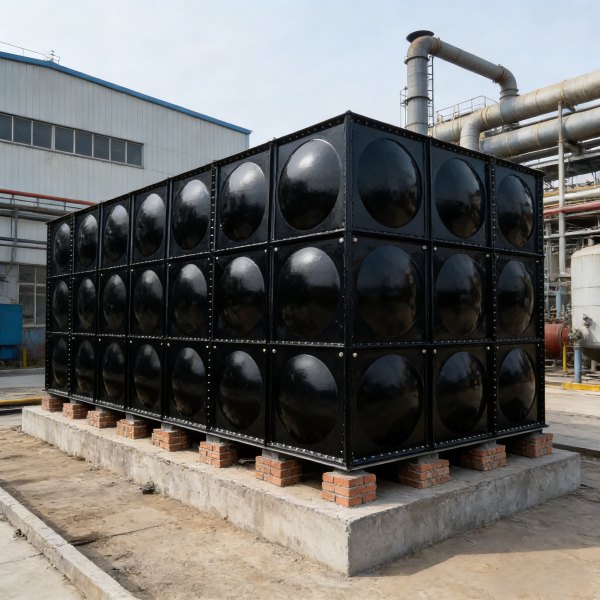
For the most stringent high-purity requirements, a Stainless Steel water tank—specifically constructed from 316L—is the gold standard. The “L” stands for low carbon, which improves corrosion resistance after welding. However, the steel itself is not enough; it must undergo a passivation process. Passivation removes free iron from the surface and enhances the protective chromium-oxide layer. This ensures that the DI water tank remains passive and does not introduce heavy metals into the ultrapure stream.
Technical Comparison: Ion Stability and Maintenance
| ميزة | Enamel (Glass-Fused-to-Steel) | Stainless Steel (316L Passivated) |
| Ion Leaching Risk | Extremely Low (Inert Glass) | Very Low (Dependent on Passivation) |
| Surface Finish (Ra) | Moderate (≈ 0.5-1.0 m) | Very Smooth (< 0.4 pm with EP) |
| Thermal Shock | Sensitive to rapid temp changes | Highly Resilient |
| CIP Compatibility | Good (Chemical) | Excellent (Chemical & Heat) |
| Best Application | Large Industrial/Municipal RO | Pharmaceutical/Semiconductor DI |
Technical Reference: NACE International – Corrosion and Purity Standards
The Role of Manufacturing Quality
A high-performance RO water storage tank is only as good as its weakest weld. In the world of high-purity water, “dead legs” and rough seams are the primary breeding grounds for biofilm and ion accumulation. This is where manufacturing precision becomes a critical safety factor.
Utilizing Large panel cutting technology during the fabrication stage ensures that every plate of a Stainless Steel water tank fits with microscopic precision. When you reduce the gap between panels through Large panel cutting, the subsequent welding process requires less heat and filler material. This results in a smoother interior weld bead, which is essential for a DI water tank to prevent microbial growth and facilitate effective cleaning.
Furthermore, the structural integrity provided by precise Large panel cutting allows for larger diameter tanks with fewer vertical seams. Fewer seams mean fewer potential failure points where ion leaching could occur due to localized corrosion (pitting).
Regulatory Compliance and Official Standards
When specifying an RO water storage tank, you must adhere to international safety and purity standards. These are not merely suggestions; they are legal requirements in many jurisdictions.
- NSF/ANSI 61: This is the primary standard for all materials that come into contact with drinking water. Whether you choose the best tank linings for reverse osmosis water storage or a raw material, it must be NSF certified to ensure it does not leach toxic chemicals.
- FDA 21 CFR 177: For food and beverage or pharmaceutical applications, the RO water storage tank lining must comply with FDA regulations regarding “indirect food additives.” Both specialized enamel and passivated stainless steel meet these requirements.
- ASME BPE: For the biopharmaceutical industry, the surface roughness (Ra) and weldquality of a DI water tank are strictly governed by the Bioprocessing Equipment (BPE)standards.
Best Practices for Maintaining Water Resistivity
Even the most expensive RO water storage tank can fail if the operational protocols are neglected. To maintain the integrity of your stored water, consider the following engineering steps:
- Vent Filtration: As water is drawn from the RO water storage tank,air enters. This aircontains CO2, which dissolves into the water and forms carbonic acid, lowering the pHand increasing conductivity. Always install a CO2 scrubber on the vent.
- Vent Filtration: As water is drawn from the RO water storage tank,air enters. This aircontains CO2, which dissolves into the water and forms carbonic acid, lowering the pHand increasing conductivity. Always install a CO2 scrubber on the vent.
- UV Sterilization: Place UV lamps in the circulation loop to kill any bacteria that might have survived the initial treatment and are attempting to colonize the surface of the RO water storage tank.
خاتمة
Selecting an RO water storage tank is a balancing act between initial capital expenditure and long-term water quality stability. For massive industrial volumes, the best tank linings for reverse osmosis water storage often involve Enamel/Glass-Fused-to-Steel due to its massive chemical resistance. However, for specialized lab or medical grade water, the passivated Stainless Steel water tank remains the undisputed leader.
التعليمات
How often should I re-passivate a Stainless Steel DI water tank?
Generally, passivation should be audited annually. If you notice a steady drop in resistivity that cannot be explained by your RO membranes, it may be time to chemically re-passivate the interior surfaces.
Is a plastic liner better than an Enamel water tank for RO water?
While some plastic liners are inert, they are prone to “off-gassing” organic compounds (TOCs). For large-scale applications, the structural stability of an RO water storage tank with an enamel or stainless finish is superior.
Can Large panel cutting really improve my water quality?
Yes. Precision Large panel cutting results in tighter tolerances. This means smaller, smoother weld seams, which directly reduces the risk of “crevice corrosion”—a major source of ion leaching.