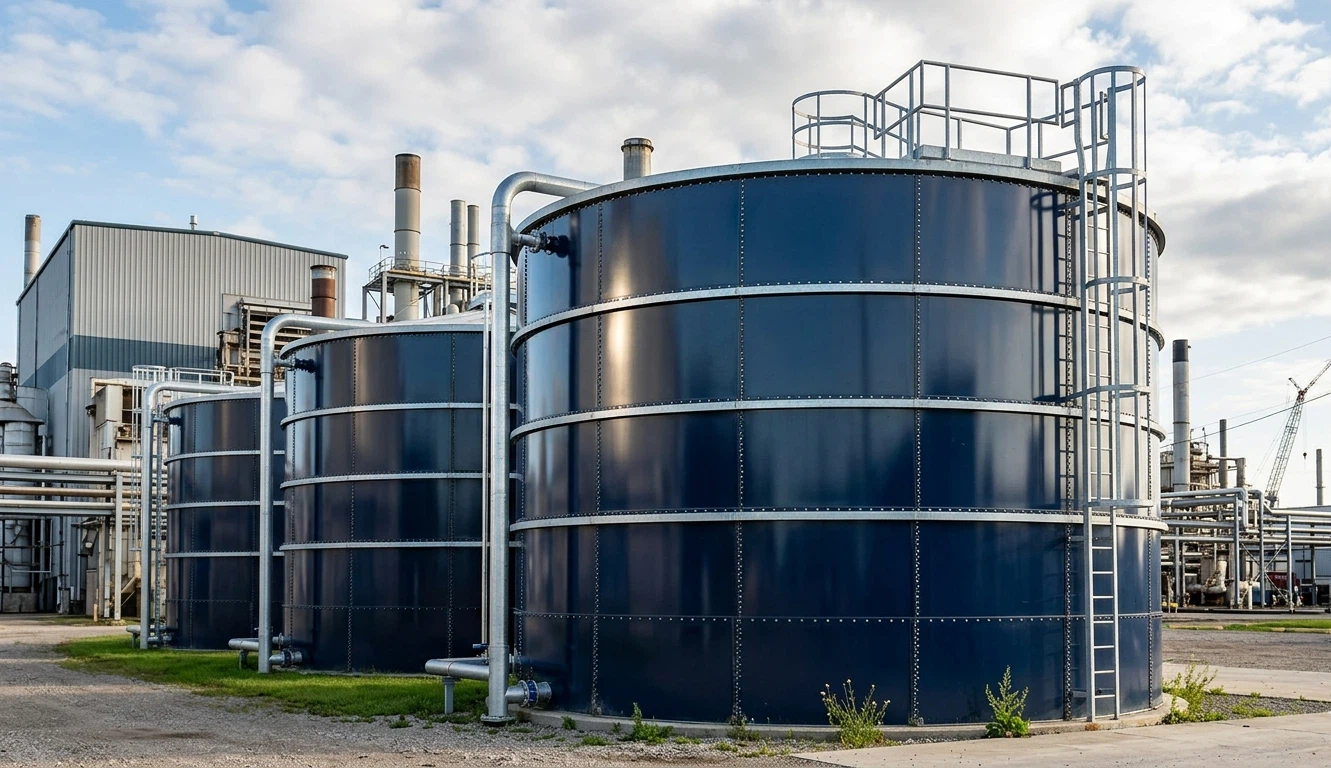
In pharmaceutical manufacturing, water is not merely a utility; it is a critical raw material. Whether you are producing high-purity solvents or cleaning high-stakes process equipment, the integrity of your Pharma water storage system determines the safety of your final product.
Storing Purified Water (PW) or Water for Injection (WFI) is a battle against time and microbiology. The moment water enters a storage vessel, it is at risk of recontamination. To prevent this, engineers must look beyond simple containment and focus on a USP grade tank design that prioritizes sterility, self-draining capabilities, and precise surface finishes.
جدول المحتويات
USP <1231> and Storage Logic
The United States Pharmacopeia (USP) chapter <1231> provides the blueprint for water system design. It explicitly states that Pharma water storage must prevent the proliferation of microorganisms while maintaining the chemical purity of the water.
A compliant system is not just about the water itself; it is about the “wetted surfaces.” Any stagnation in the tank becomes a breeding ground for bacteria. Therefore, a self-draining sanitary water tank design is a non-negotiable requirement. The tank floor must be sloped toward a central outlet, ensuring that during a CIP (Clean-in-Place) cycle, no residual liquid remains to harbor contaminants.
Material Science: 316L Stainless Steel vs. المينا
When sourcing sanitary stainless steel tanks for pharmaceutical water, the industry standard is 316L. The “L” stands for low carbon, which is crucial for preventing “carbide precipitation” during welding. If the carbon is too high, the weld zones become susceptible to corrosion—a disaster for water purity.
However, in specific high-purity or corrosive chemical environments, enamel-lined (glass-lined) tanks are gaining traction. While 316L is the workhorse, a 316L stainless steel pharma tank offers the best balance of durability and ease of electropolishing. Electropolishing removes the “peaks and valleys” on the metal surface, creating a microscopic smoothness that makes it nearly impossible for bacteria to cling.
The War on Biofilm: Surface Finish Requirements
The single greatest threat to Pharma water storage is the development of biofilm. Biofilms are complex communities of bacteria that secrete a protective slime, making them resistant to standard sanitization.
To combat this, the surface finish requirements for USP purified water tanks are extremelystrict. We typically specify a roughness average (Ra) of less than 20pin (0.5pum). This level ofsmoothness is achieved through mechanical grinding followed by chemical electropolishing.Without this finish, even the most expensive USP grade tank will eventually fail a microbialaudit.
Biofilm prevention in water storage also relies on constant motion. Modern systems utilize “vortex breakers” and high-velocity spray balls to ensure that every square inch of the tank’s internal surface is constantly rinsed with ozonated or hot water.
Engineering for Compliance: ASME BPE Standards
Every high-quality Pharma water storage vessel should follow the ASME BPE (Bioprocessing Equipment) standard. An ASME BPE compliant tank features specific “Sanitary Trim” components:
- Tri-Clamp (TC) Connections: These allow for easy disassembly and cleaning without threads where bacteria can hide.
- Hydrophobic Vent Filters: These 0.22-micron filters allow the tank to “breathe” as water levels change without letting airborne microbes inside.
- Zero-Static Diaphragm Valves: Used for sampling and drainage to ensure no stagnant water is trapped in the valve body.
A dead leg minimized pharmaceutical water storage design is another ASME BPE hallmark.A “dead leg” is a section of piping where water can stagnate. The rule of thumb is the 2D rule-the length of any stagnant pipe branch should not exceed twice its diameter.
Technical Specifications Table
| Specification | 316L Stainless Steel Tank | Enamel / Glass-Lined Tank |
| الميزة الأساسية | High durability, Electropolishing capable | Superior chemical inertness |
| Surface Finish (Ra) | < 0.5um (Electropolished) | Smooth glass finish |
| Compliance | ASME BPE, USP <1231> | USP, FDA Grade |
| Sanitization | Steam (SIP) or Ozonated Water | Hot Water or Chemical |
| Biofilm Resistance | Excellent (with proper EP) | ممتاز |
The Importance of Passivation in Pharma Water Storage
Even the best sanitary stainless steel tanks for pharmaceutical water require periodic maintenance known as passivation. Over time, the protective chromium oxide layer on the steel can be compromised.
Passivation involves treating the 316L stainless steel pharma tank with a mild oxidant (like citric or nitric acid) to restore this protective layer. In a Pharma water storage environment, if you see “rouging”—a reddish-brown iron oxide tint—it means your passivation layer has failed, and your USP compliance is at risk.
System Integration: Beyond the Tank
A USP grade tank is only as good as the system surrounding it. Your Pharma water storage strategy must include:
1.Level Control: Using non-contact ultrasonic or pressure sensors to avoid probe contamination.
2.Temperature Management: Keeping the water at either > 80°C’ (hot storage) or <
20°C’ (cold storage) to inhibit growth.
3.Continuous Circulation: Ensuring the water in the storage loop is moving at a turbulent
flow rate (Reynolds number > 4000).
When implementing a dead leg minimized pharmaceutical water storage design, every sensor port and manway must be scrutinized. If a sensor creates a pocket of still water, that becomes the weak link in your entire facility’s purity chain.
خاتمة
Selecting the right Pharma water storage solution is a decision that impacts the entire lifecycle of your facility. By insisting on an ASME BPE compliant tank with a self-draining sanitary water tank design, you reduce the risk of catastrophic microbial outbreaks and expensive production halts.
Whether you choose a high-polish 316L stainless steel pharma tank or a specialized enamel vessel, the focus must remain on the microscopic details of the surface. In the world of USP standards, the difference between success and a regulatory warning letter is often measured in microns.
التعليمات
Why is 316L preferred over 304 stainless steel?
16L contains molybdenum, which provides significantly better resistance to pitting corrosion in high-purity water systems compared to 304.
How often should a USP grade tank be passivated?
Typically once a year, or whenever “rouging” is detected during internal inspections.
What is a “Dead Leg”?
It is a section of piping where water does not circulate. In Pharma water storage, these must be minimized to prevent bacterial colonies from forming.
Can I use a plastic tank for USP water?
While some fluoropolymers (like PVDF) are used, stainless steel remains the standard due to its ability to withstand steam sterilization (SIP).
What is the ideal surface roughness for a Pharma water storage tank?
Most industry experts and auditors look for an Ra of 0.5um (20uin) or better, achieved
through electropolishing.