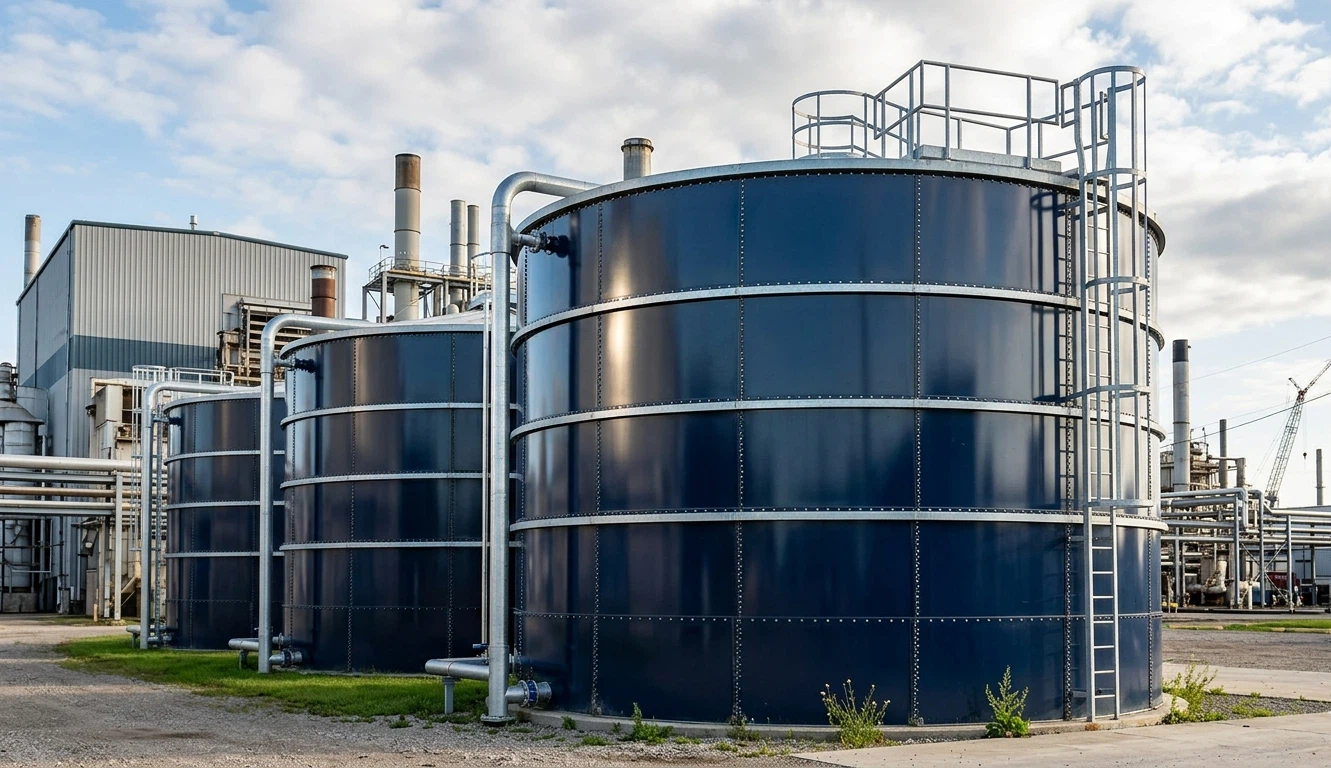
For potable water projects, the real question is not only whether the tank can store water. It is whether the water-contact materials—liners, coatings, gaskets, sealants, fittings, and internal surfaces—match the certification scope required by the project.
This guide explains what NSF/ANSI 61 actually means, how to verify tank compliance, and what to check when choosing enamel or stainless steel potable water tanks.
جدول المحتويات
لماذا NSF 61 Water Tank Searches Are Really About Potable Water Approval
NSF explains in its official article on NSF/ANSI 61 drinking water system components that the standard establishes minimum health-effects requirements for contaminants and impurities that may be indirectly imparted to drinking water from products, components, and materials used in drinking water systems.
That matters for municipal projects, factories, commercial buildings, farms, water treatment systems, and emergency potable water storage. For project buyers, an NSF 61 Water Tank requirement is usually a documentation and material-safety requirement, not just a tank-size requirement.
What NSF/ANSI/CAN 61 Actually Evaluates
NSF/ANSI/CAN 61 focuses on materials, components, products, and systems that contact drinking water. It is used to evaluate potential health effects from materials that may leach into potable water over time.
NSF’s official testing and certification page explains that NSF/ANSI/CAN 61 establishes criteria for evaluating the health effects of materials, components, products, and systems in contact with drinking water. Products can be tested and certified against the standard’s benchmarks.
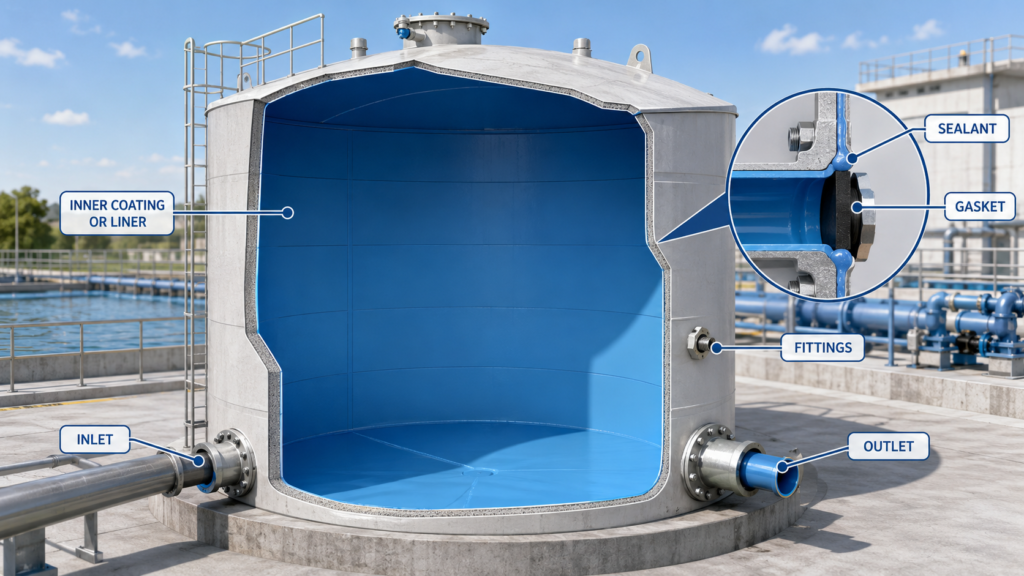
For a tank, this means buyers should look beyond the tank wall. The full wetted system may include:
- internal liner or enamel coating;
- stainless steel water-contact surface;
- gaskets and sealing strips;
- sealants and joint materials;
- nozzles, flanges, bolts, and fittings;
- internal accessories;
- ccess hatches and connections.
An NSF 61 Water Tank should be checked as a complete water-contact system. Calling a tank an NSF 61 Water Tank without explaining which parts are certified can create confusion during project approval.
NSF 61 vs NSF 372: What Tank Buyers Should Not Mix Up
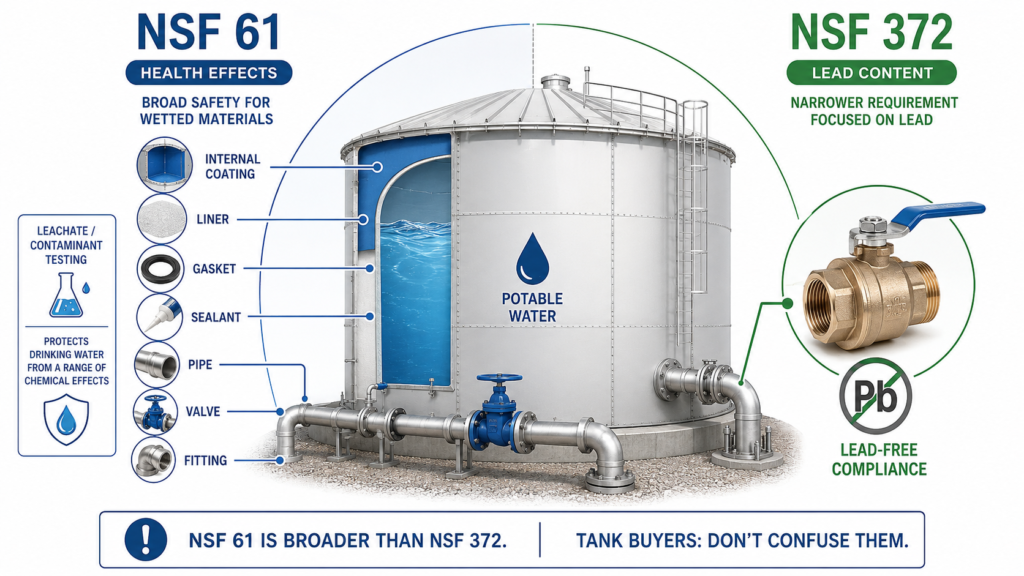
NSF 61 and NSF 372 are related in drinking water projects, but they are not the same.
NSF 61 focuses on health effects from materials in contact with drinking water. NSF 372 focuses on lead content requirements.
ANSI’s article on NSF/ANSI 61-2025 explains that NSF/ANSI/CAN 61 leachate testing evaluates products for contaminants of health-effects concern, not just lead. It also notes that the earlier Annex G lead-content procedure was moved into NSF/ANSI 372.
A separate industry explanation from Merit Brass on NSF 61 vs NSF 372 states that NSF/ANSI/CAN 372 addresses lead content only, while NSF/ANSI/CAN 61 addresses lead and other contaminants that may migrate into drinking water.
Before treating any product as an NSF 61 Water Tank solution, buyers should confirm whether the project asks for NSF/ANSI 61, NSF/ANSI 372, or both.
NSF 61 Is Only One Part of Water Tank Compliance
NSF 61 is critical for potable water contact safety, but it does not replace every construction, coating, fire protection, or industrial storage requirement. A water tank project may also involve AWWA D100, AWWA D103, NFPA 22, NSF 372, or API 650 depending on the application. For a broader comparison, read our guide to water tank safety standards before choosing a storage tank.
How to Ensure Industrial Tanks Meet NSF/ANSI 61
The long-tail question “How to ensure industrial tanks meet NSF/ANSI 61” is mainly about verification.
Do not rely only on phrases like “food grade,” “drinking water safe,” or “suitable for potable water.” Those terms may be useful, but they are not the same as a verified certification scope.
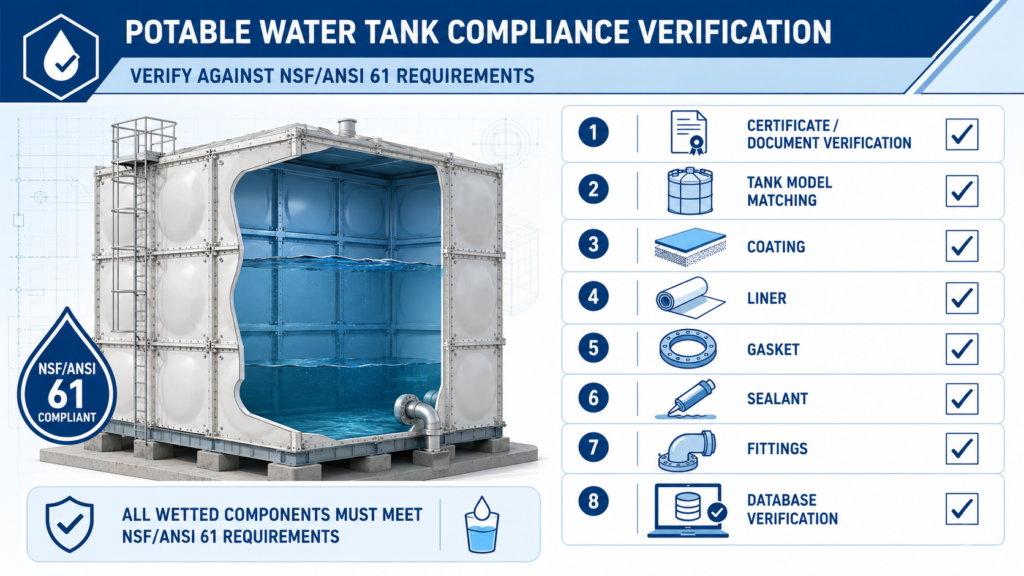
To verify an NSF 61 Water Tank for a project, follow this checklist:
1.Ask for the NSF/ANSI/CAN 61 certificate or test report.
2.Match the certificate to the manufacturer and tank model.
3.Confirm whether the certification covers the full tank, the lining, or only one component.
4.Check whether gasket, sealant, coating, liner, and fittings are included.
5.Confirm that the application is potable water storage, not process water.
6.Review local codes, tender documents, and engineering specifications.
7.Use NSF’s Certified Drinking Water System Components database when project verification is required.
An NSF 61 Water Tank should never be approved only because the material sounds safe. The certificate must match the actual water-contact design.
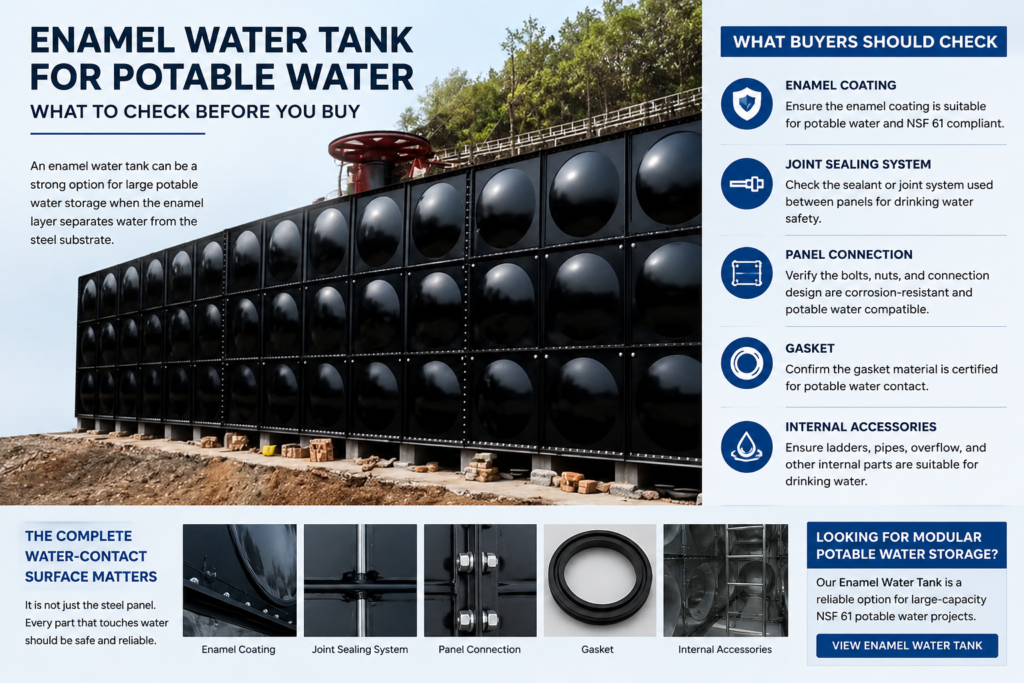
Enamel Water Tank for Potable Water: What to Check
An enamel water tank can be a strong option for large potable water storage when the enamel layer separates water from the steel substrate. This design helps improve corrosion resistance and makes modular tank construction practical.
But for an NSF 61 Water Tank project, enamel alone is not the whole answer.
Stainless Steel Potable Water Tank: What to Check
A stainless steel tank is often chosen for potable water because it is corrosion resistant, cleanable, and familiar to engineers. However, stainless steel does not automatically make a tank an NSF 61 Water Tank.
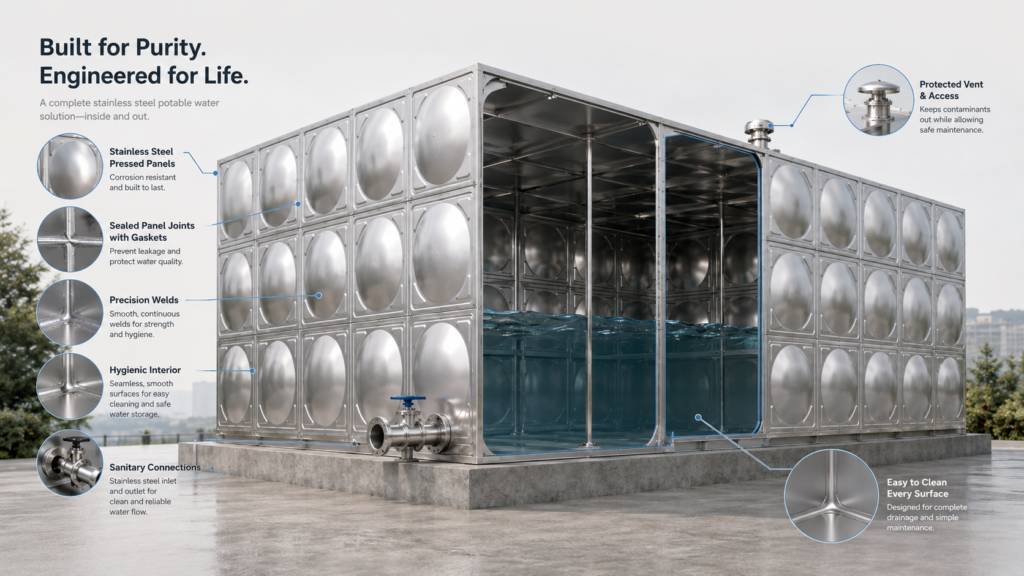
EPA’s drinking water distribution system tools and resources note that finished water storage facilities, such as tanks and reservoirs, can face sanitary risks including gaps, broken vent screens, sediment, and biofilm buildup. That is a reminder that tank material, access protection, inspection, and maintenance all affect water quality.
Common Mistakes When Buying Potable Water Tanks
An NSF 61 Water Tank purchase can go wrong when buyers focus only on the obvious details.
Avoid these mistakes:
- assuming “food grade” equals NSF/ANSI 61;
- checking the tank panel but ignoring the gasket;
- accepting a certificate that does not match the product model;
- assuming stainless steel automatically meets potable water certification;
- forgetting coatings, sealants, and internal fittings;
- using an industrial process water tank for drinking water storage;
- ignoring cleaning, vents, access hatches, and long-term inspection.
Water Quality Products has discussed finished water storage and quality concerns, including mixing, microbial growth, and water quality changes in storage systems. That makes the material and maintenance discussion even more important for a potable water storage tank.
Buyer Checklist Before Ordering an NSF Certified Water Tank
Before ordering an NSF certified water tank, ask the supplier direct questions.
- Is this tank designed for potable water?
- Which parts are certified or compliant with NSF/ANSI 61?
- Does the documentation cover the liner, coating, gasket, sealant, and fittings?
- Can the certificate be matched to the exact model?
- Has the tank design been used in drinking water storage projects?
- What cleaning and maintenance procedures are recommended?
- Can the supplier support project documents for approval?
For an NSF 61 Water Tank, the safest supplier is not the one with the shortest answer. It is the one that can explain the certification scope clearly.
Enamel vs Stainless Steel: Which Tank Fits the Project?
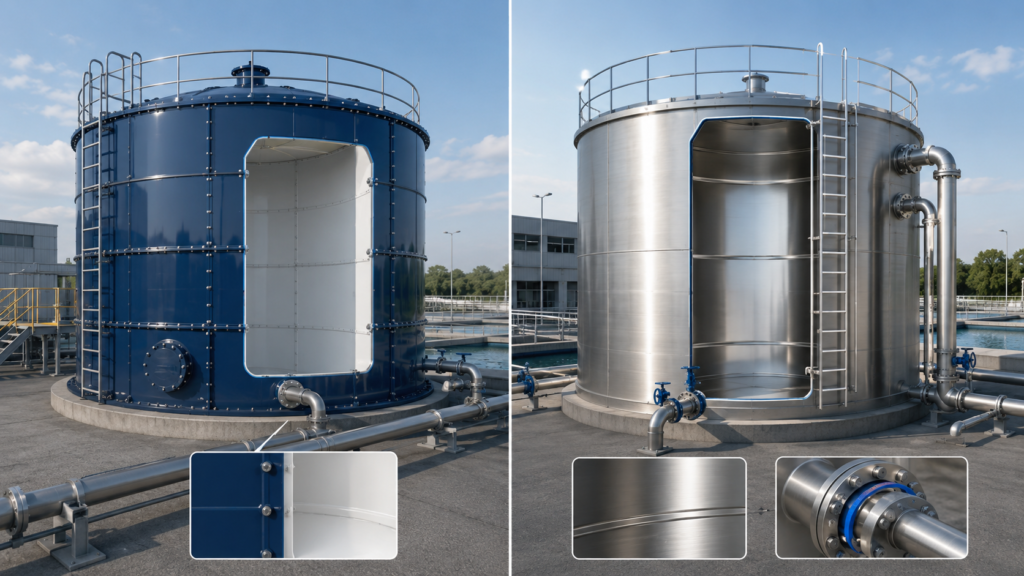
Choose an enamel water tank when the project needs modular capacity, corrosion protection, and practical installation for large-volume potable water storage.
Choose a stainless steel potable water tank when the project emphasizes clean internal surfaces, corrosion resistance, and easier visual inspection.
Both options can be suitable, but both must be checked against the same rule: every water-contact material should match the potable water requirement.
An NSF 61 Water Tank should be selected by certification scope, internal material system, and project approval needs, not by material name alone.
خاتمة
For real projects, buyers should verify the complete water-contact system: coating, liner, stainless surface, gasket, sealant, fittings, documentation, and maintenance plan. Enamel and stainless steel tanks can both work for potable water storage, but only when the certification scope matches the actual tank design.
التعليمات
What is an NSF 61 Water Tank?
It is not a separate tank model. It usually means a water tank specified for NSF/ANSI/CAN 61 potable water requirements.
Is NSF 61 required for every potable water tank?
Not everywhere. But many municipal, commercial, and industrial potable water projects require NSF/ANSI 61 certification or compliance for approval.
Does stainless steel automatically meet NSF 61?
No. Buyers still need to check steel grade, welds, surface finish, gasket, fittings, and certification scope.
Can enamel water tanks be used for potable water?
Yes, if the enamel coating, sealing materials, internal fittings, and water-contact surfaces meet the project’s potable water requirements.
What is the difference between NSF 61 and NSF 372?
NSF 61 evaluates health effects from water-contact materials. NSF 372 focuses on lead content.
How can buyers verify NSF 61 certification?
Ask for certificates or test documents, match them to the product model, and check official certification databases when needed.