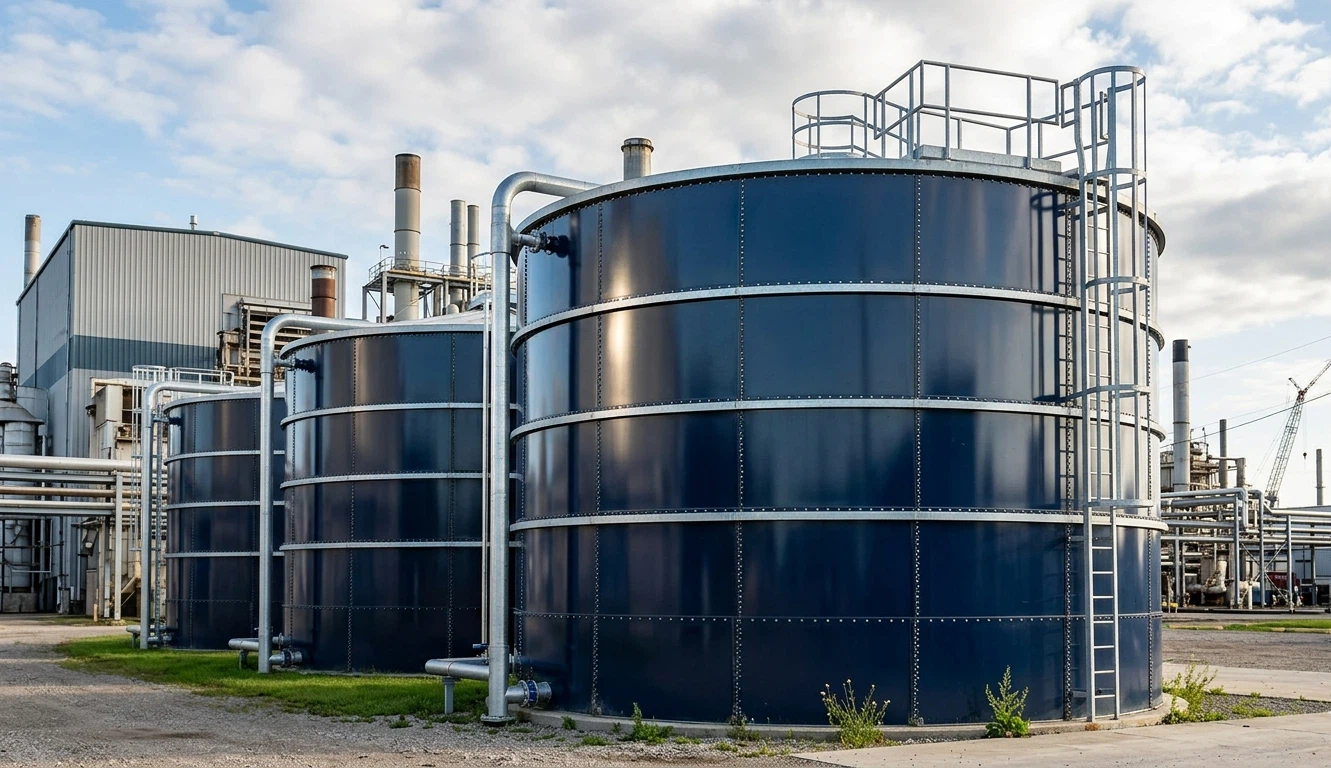
Selecting among industrial water tank manufacturers is not simply a matter of comparing tank materials, nominal capacity, or delivery schedules. For industrial projects, the tank becomes part of a larger operating system involving pumps, pipework, foundations, water quality, maintenance access, structural loads, and sometimes fire protection requirements.
A supplier may be able to manufacture a tank, but that does not automatically mean the supplier can deliver the right tank for your actual operating conditions.
For procurement managers, engineers, contractors, and facility owners, the better question is:
Can this manufacturer translate project requirements into a water storage system that will remain practical, maintainable, and reliable after installation?
This guide explains how to evaluate industrial water tank manufacturers before requesting a final technical proposal.
جدول المحتويات
Why Choosing the Right Industrial Water Tank Manufacturer Matters

Industrial tanks are rarely isolated pieces of equipment.
They may provide:
- Process water
- Cooling water
- Potable water
- Fire protection reserves
- Cleaning and washdown water
- Emergency backup water
- Rainwater storage
- Treated water storage
- HVAC system water
- Production buffer storage
A poor supplier selection can create problems that do not become obvious until installation begins.
For example, the tank capacity may be correct while the available installation footprint is not. The material may be corrosion resistant, but unsuitable for the stored water chemistry. The panels may be easy to transport, but the access openings may make future inspection difficult.
Reliable industrial water tank manufacturers therefore need to understand more than fabrication. They should be able to connect tank design with the real operating environment.
Before comparing suppliers, buyers can review the available industrial water tank product range to understand the differences between common tank structures and materials.
Start With the Application, Not the Tank Catalogue
One of the biggest procurement mistakes is sending suppliers only a required capacity.
A request such as:
“We need a 100 m³ industrial water tank.”
does not provide enough engineering information.
Two tanks with exactly the same storage capacity may require completely different materials, structures, fittings, foundations, and internal arrangements.
Before contacting industrial water tank manufacturers, define the following information.
Stored Water
Specify whether the tank will hold:
- Potable water
- Process water
- Cooling water
- Treated water
- Fire water
- Rainwater
- Wastewater
- Hot water
- Water containing chemicals
Water chemistry can directly affect material selection.
Operating Temperature
Normal-temperature water and high-temperature process water place different demands on materials, seals, coatings, and joints.
Required Capacity
Capacity should reflect actual water consumption, peak demand, refill rate, emergency reserve, and operational continuity rather than a simple estimate.
For projects still determining storage volume, our previous industrial water storage tank sizes and selection guide provides additional planning considerations.
Installation Environment
Tell the manufacturer whether the tank will be:
- Indoors
- Outdoors
- مترو الأنفاق
- On a rooftop
- Inside a plant room
- In a coastal area
- In a high-humidity environment
- In a seismic or high-wind region
These conditions affect structural and material decisions.
Which Tank Materials Should Industrial Water Tank Manufacturers Offer?
There is no single material that is automatically best for every project.
Experienced industrial water tank manufacturers should first understand the operating conditions and then recommend a suitable construction.
خزانات المياه المصنوعة من الفولاذ المقاوم للصدأ
Stainless steel is frequently considered where cleanliness, corrosion resistance, and maintainability are important.
Typical applications include:
- Food processing
- Beverage production
- المستشفيات
- Commercial buildings
- Potable water systems
- الإنتاج الصناعي
For projects with higher hygiene requirements, review the available stainless steel water tank solution.
A supplier should also clearly identify the stainless steel grade rather than simply describing the tank as “stainless.”
Galvanized Steel Water Tanks
Galvanized sectional tanks can be useful where structural strength, modular installation, and practical transportation are important.
Because standardized panels can be assembled on site, they can also be attractive for projects where transporting one large finished vessel would be difficult.
See the galvanized water tank configuration for an example of modular panel construction.
Fiberglass or GRP Water Tanks
GRP tanks are lightweight, corrosion resistant, and particularly suitable for modular installation.
They are commonly considered for:
- Building water supply
- Fire water
- Industrial circulating water
- المدارس
- المستشفيات
- Hotels
- Commercial facilities
More information is available on the fiberglass water tank product page.
The important point is not whether an industrial water tank manufacturer offers many materials. It is whether the supplier can explain why a particular material suits your application.
How to Check Engineering and Customization Capability

Customization should mean more than changing tank length, width, or height.
Professional industrial water tank manufacturers should be able to evaluate several engineering variables together.
Tank Geometry
A required capacity may be achieved using different dimensional combinations.
A wide, low tank may work well at one site, while another project may require a narrower and taller configuration because floor space is limited.
الدعم الهيكلي
Water is heavy, and increasing tank height increases hydrostatic loading on lower sections.
Tank panel thickness, reinforcement, tie rods, bases, and support arrangements therefore need to correspond to the actual configuration.
ال water tank base and support rod system illustrates why the supporting structure should be considered part of the overall tank design rather than an afterthought.
Connections and Openings
Ask the supplier to identify the location and size of:
- Inlet
- Outlet
- Drain
- Overflow
- Vent
- Manhole
- Level connection
- Pump connection
- Instrumentation connection
These details should be coordinated before production whenever possible.
Which Standards and Certifications Should Buyers Check?
Certificates should not be treated as decorative logos on a quotation.
Instead, buyers should ask three questions:
- Which standard applies to this specific tank?
- Which part of the project does it cover?
- Can the supplier provide supporting documentation?
The American Water Works Association publishes standards covering multiple water-storage tank types, including welded steel, bolted steel, fiberglass-reinforced plastic, coatings, and related systems. Buyers working on relevant projects can review the AWWA storage standards list.
For private fire-protection water storage, NFPA 22 addresses water tanks used for private fire protection. Exact requirements should always be confirmed against the project design, applicable edition, and local authority requirements. Review NFPA 22 information
Quality-management certification can provide another useful supplier-screening signal. ISO describes ISO 9001 as a framework for establishing and continually improving a quality management system. Buyers should verify certificate scope and validity rather than relying solely on an ISO logo shown in marketing material. Learn about ISO 9001 quality management
The key lesson is simple:
Ask industrial water tank manufacturers for evidence, not just claims.
How to Evaluate Factory Quality Control
A professional quotation tells you what the supplier intends to provide.
Quality-control records help tell you whether the factory can consistently provide it.
When evaluating industrial water tank manufacturers, ask how quality is controlled during the following stages.
| Production Stage | What Buyers Should Verify |
|---|---|
| Raw materials | Material grade, thickness and traceability |
| Forming | Panel dimensions and forming consistency |
| Welding or joining | Procedure, workmanship and joint quality |
| Surface treatment | Coating or corrosion-protection consistency |
| Components | Bolts, seals, supports and fittings |
| Assembly | Dimensional accuracy and connection positioning |
| Inspection | Leak, appearance and structural checks |
| Documentation | Drawings, material records and inspection reports |
For international procurement, documentation matters almost as much as the physical tank.
A factory should be able to clearly connect the purchased specification with the delivered components.
Why Maintainability Should Influence Supplier Selection
Many purchasing decisions focus heavily on initial specification and not enough on the next ten years of operation.
That is a mistake.
Water storage facilities eventually require inspection, cleaning, access, component replacement, and condition monitoring.
The U.S. Environmental Protection Agency notes that finished-water storage facilities can face risks associated with openings, sediment, biofilm, corrosion-related material, and structural conditions, making inspection and cleaning important elements of storage management. EPA finished-water storage resources
When comparing industrial water tank manufacturers, ask:
- Can personnel safely access the tank?
- Can sediment be drained effectively?
- Can seals or panels be replaced?
- Are internal components accessible?
- Is the tank easy to inspect?
- Can damaged sections be repaired without replacing the entire system?
A tank that is easy to manufacture but difficult to maintain may create unnecessary operational problems later.
Modular or One-Piece Tank: Which Is Better?
This is another common procurement question.
There is no universal answer.
خزانات معيارية
Modular construction is particularly useful when:
- Site access is restricted
- Large finished tanks cannot be transported
- The tank must be assembled inside a building
- Capacity needs to fit an unusual footprint
- Future component replacement is important
One-Piece Tanks
One-piece structures may simplify installation for suitable sizes and sites, but transportation dimensions and access can become limiting factors as capacity increases.
Experienced industrial water tank manufacturers should evaluate logistics before recommending a design.
This becomes particularly important in export projects where containers, unloading conditions, site access, lifting equipment, and local assembly capability must all be considered.
What Are the Red Flags When Choosing Industrial Water Tank Manufacturers?
Several warning signs should trigger additional investigation.
No Questions About the Application
A supplier immediately recommending a tank without asking about water type, capacity, installation environment, or operating conditions may be treating the project as a generic product sale.
Unclear Material Specification
“High-quality stainless steel” is not a complete material specification.
Ask for material grade and relevant technical documentation.
No Technical Drawings
For customized industrial systems, dimensional drawings are important for coordinating foundations, pipework, access, and surrounding equipment.
Certification Without Supporting Documents
A certification logo should never replace actual documentation.
No Discussion of Installation
Even high-quality components can perform poorly if the system is incorrectly installed.
No Maintenance Considerations
Manufacturers should understand that inspection, cleaning, access, drainage, and component replacement are part of tank lifecycle planning.
What Information Should You Send With an RFQ?

A detailed RFQ helps industrial water tank manufacturers prepare a more accurate technical proposal.
Provide as much of the following information as possible:
- Required capacity
- Stored liquid
- Water temperature
- Tank application
- Installation location
- Indoor or outdoor installation
- Available length, width, and height
- Required tank material
- Inlet diameter
- Outlet diameter
- Overflow diameter
- Drain requirements
- Manhole requirements
- Required accessories
- Foundation condition
- Project location
- Wind or seismic requirements where applicable
- Applicable standards
- Drawings or site plans
- Installation support requirements
Even when some information is unknown, sending a site drawing and explaining the operating objective can help the engineering team identify missing specifications.
For project-specific configuration assistance, use the contact and technical inquiry page and include your tank capacity, application, water type, installation dimensions, and destination.
التعليمات
How do I compare industrial water tank manufacturers?
Start by comparing technical capability rather than simply comparing tank capacity. Review material specifications, engineering support, structural design, quality control, documentation, customization, installation assistance, and after-sales support.
What should I ask an industrial water tank manufacturer before ordering?
Ask about material grade, tank dimensions, reinforcement, panel thickness, seals, fittings, drawings, applicable standards, production inspection, packing, installation requirements, and maintenance access.
Should I choose stainless steel or fiberglass?
The correct choice depends on water quality, temperature, hygiene requirements, corrosion environment, installation conditions, and project specifications. Stainless steel is often considered for hygiene-sensitive applications, while fiberglass offers advantages in corrosion resistance and modular handling.
Can industrial water tanks be customized?
Yes. Modular tank systems can often be configured around required capacity and available installation space. Connections, access openings, support arrangements, and other features may also be designed according to project requirements.
Why do industrial water tank manufacturers need site information?
Capacity alone does not define the final tank. Available space, foundation conditions, access limitations, piping, operating temperature, environment, and application can all affect the design.
What documentation should a manufacturer provide?
Depending on the project, documentation may include technical drawings, material information, component lists, inspection records, installation instructions, packing lists, and applicable certification documents.
خاتمة
Choosing between industrial water tank manufacturers should be treated as an engineering procurement decision rather than a simple product comparison.
The strongest supplier is not necessarily the one offering the largest catalogue. It is the manufacturer that asks the right questions, understands your operating conditions, explains material and structural choices clearly, provides usable technical documentation, and considers installation and maintenance before production begins.
Before sending an RFQ, define your water application, capacity, installation dimensions, material requirements, connections, and applicable standards. Then compare manufacturers using the same technical checklist.
Doing this early can prevent a common industrial procurement problem: purchasing a tank that meets the requested volume but does not fully meet the needs of the system around it.
For a project-specific tank configuration, submit your operating requirements through the technical inquiry page so the required capacity, material, dimensions, fittings, and installation conditions can be reviewed together.