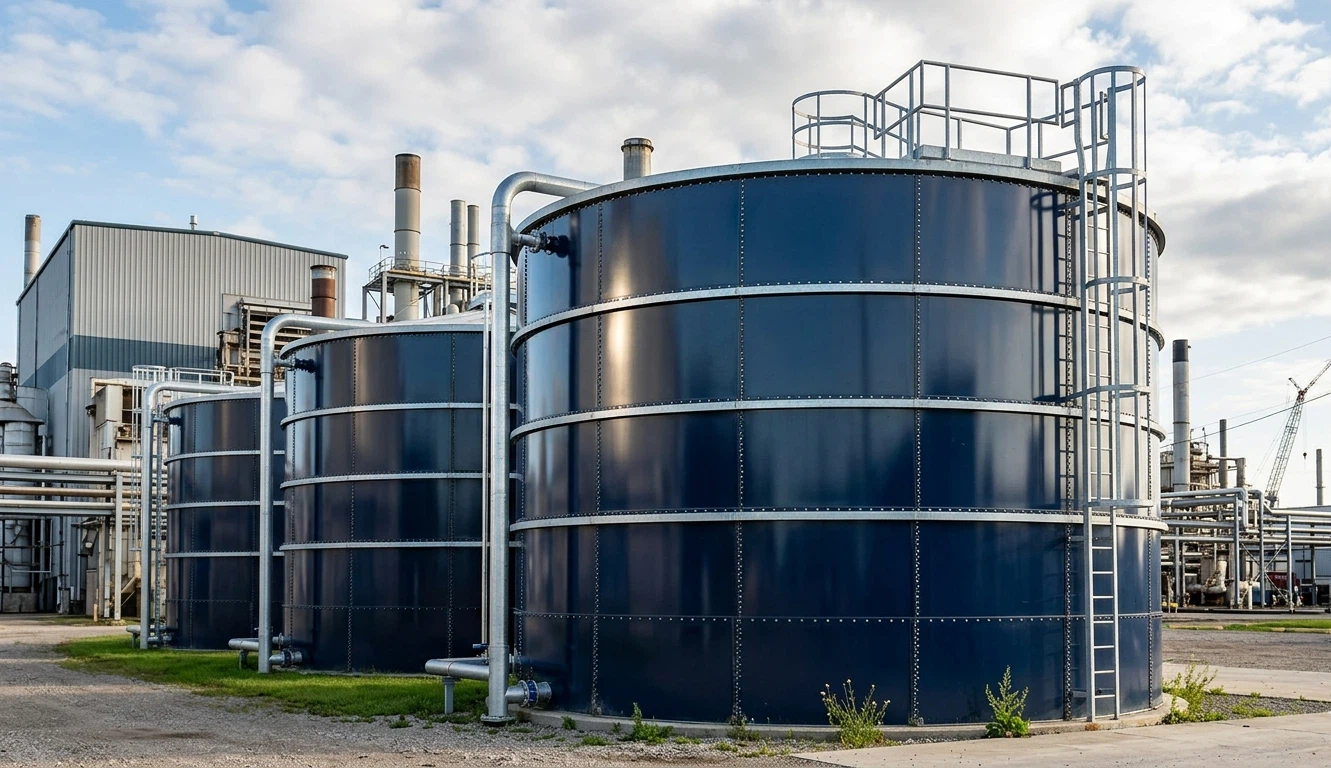
When was the last time your facility’s water storage was truly inspected? For many industrial sites, water tanks are “out of sight, out of mind” until a production line halts or a health inspector arrives. However, the industrial water tank cleaning frequency you maintain is not just a suggestion; it is a critical component of your site’s Water Safety Plan (WSP).
Neglecting this schedule leads to more than just dirty water. It invites the growth of biofilm, the accumulation of heavy sediments, and the proliferation of Legionella bacteria. But how do you determine the right interval? Is once a year enough, or are you sitting on a biological time bomb?
جدول المحتويات
What Dictates the Optimal Industrial Water Tank Cleaning Frequency?
The short answer is: it depends on your application. A tank providing water for a food processing plant requires a much higher industrial water tank cleaning frequency than a tank used solely for fire suppression.
Environmental factors also play a massive role. Is your tank located outdoors in direct sunlight? Is the water temperature consistently above 20°C? Warm, stagnant water is an incubator for microbial life. If your facility handles potable water or food-grade ingredients, your industrial water tank cleaning frequency should be at least semi-annual, supplemented by monthly temperature and chlorine residual monitoring.
Recommended Industrial Water Tank Cleaning & Inspection Frequency
| Industry / Application | Visual Inspection Frequency | Full Cleaning & Disinfection | Key Compliance Standard |
| Potable Water (Staff/Office) | Every 12 Months | If inspection fails or annually | WHO Guidelines / Local Health Code |
| Food & Beverage Production | Every 6 Months | Every 6 – 12 Months (Mandatory) | HACCP / GFSI Standards |
| Healthcare & Hospitals | Every 6 Months | Semi-annually (High Risk) | HTM 04-01 / CDC Guidelines |
| Cooling Tower Make-up | Quarterly | Every 6 Months | HSE HSG274 Part 1 |
| Process Water (Industrial) | Every 12 Months | Based on sediment/biofilm levels | ISO 14001 / Site WSP |
| Fire Suppression Tanks | Every 12 Months | Every 5 – 10 Years (Unless silted) | NFPA 25 |
The Biological Threat: Why Biofilm and Sediment Are Your Enemies
Have you ever noticed a slimy layer on the internal walls of a water vessel? That is biofilm—a complex colony of microorganisms that protects bacteria from disinfectants.
As sediment builds up at the bottom of the tank, it provides a “nutrient bed” for these colonies. Over time, these sediments can interfere with the industrial water tank cleaning frequency logic by depleting the residual chlorine meant to keep the water safe. If the sediment layer exceeds a few millimeters, your disinfection efforts are likely failing. This is why a physical inspection is often more valuable than a calendar-based guess.
Regulatory Requirements: What Does the Law Say About Intervals?
In most jurisdictions, the “law” is interpreted through established safety standards. In the United Kingdom and many international markets, the HSE HSG274 is the gold standard for controlling Legionella.
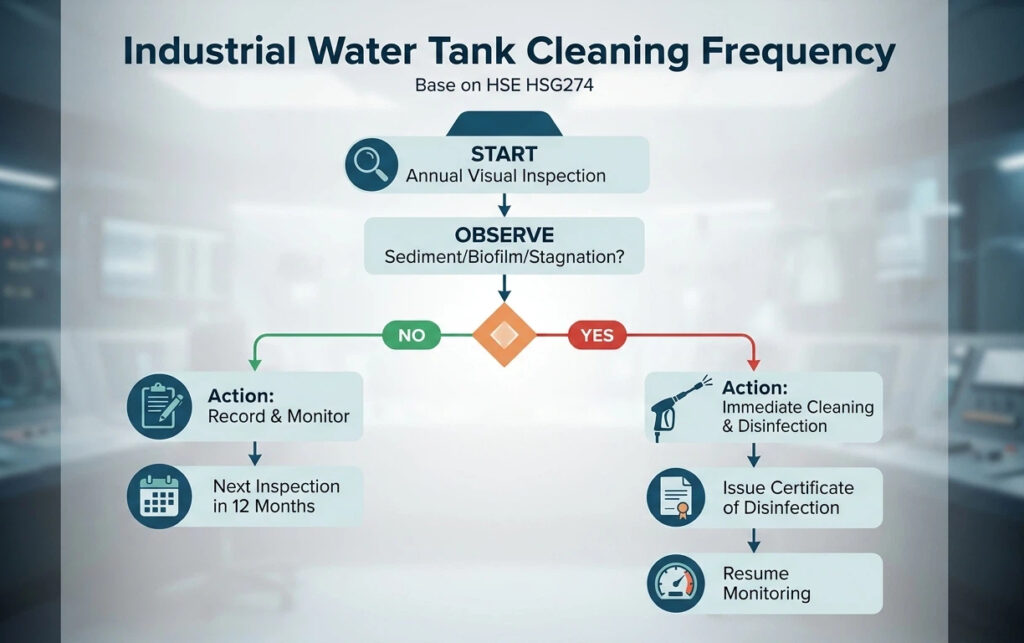
According to these guidelines, a visual inspection of the internal surfaces of the tank should occur at least annually. If the inspection reveals evidence of contamination, sediment, or biological growth, an immediate cleaning is mandatory. Therefore, while the industrial water tank cleaning frequency for a full scrub might be biennial for some, the inspection frequency is strictly annual.
Technical Reference: HSE HSG274 Part 2: The control of Legionella bacteria in hot and cold water systems
. (See Section: Monitoring and Inspection).
High-Risk Signs: When to Increase Your Cleaning Intervals
What if your scheduled date is months away, but the water quality is dropping? You need to recognize the early warning signs that your current industrial water tank cleaning frequency is insufficient.
- Turbidity Changes: Is the water suddenly cloudy? This usually indicates a breach in the filtration system or massive sediment disturbance.
- Persistent Odors: Does the water smell like sulfur or “earth”? This is a byproduct of anaerobic bacteria living in the sludge.
- Drop in Residual Chlorine: If you are dosing chlorine but the levels keep dropping, the organic matter in your tank is “consuming” the chemical.
- Positive Legionella Samples: If a lab test returns a count above 100 CFU/L, your industrial water tank cleaning frequency must be accelerated immediately.
Developing a Customized Maintenance Schedule for Your Site
The World Health Organization (WHO) emphasizes the “Water Safety Plan” approach. This means you should not blindly follow a generic industrial water tank cleaning frequency; you should assess your specific risks.
Start by mapping your system. How long does water stay in the tank? “Water age” is a major factor. If your turnover is slow, you are at higher risk. The WHO Guidelines for Drinking-water Quality suggest that localized risk assessments should dictate maintenance cycles, focusing on “critical control points.”
Can You Clean Industrial Tanks Yourself?
Many facilities ask if they can bypass professional services to save costs. While possible for small, accessible units, large industrial vessels require confined space entry permits, specialized PPE, and chemical neutralization protocols.
When you increase your industrial water tank cleaning frequency, you also increase the need for professional documentation. Most insurers and health inspectors require a “Certificate of Disinfection” issued by a certified contractor. DIY cleaning rarely meets the evidentiary requirements for high-risk industries like pharmaceuticals or hospitality.
Summary: Is Your Industrial Water Tank Cleaning Frequency Enough?
Maintaining the correct industrial water tank cleaning frequency is an investment in your facility’s operational uptime. A single Legionella outbreak can lead to site-wide shutdowns, massive legal liabilities, and irreparable brand damage.
By combining annual physical inspections with a robust testing regime, you ensure that your industrial water tank cleaning frequency is data-driven rather than speculative. Clean water isn’t just a utility; it’s a prerequisite for industrial excellence. If your tank hasn’t been opened in over 12 months, the time to act is now.
FAQ: Industrial Water Tank Maintenance
How often should industrial water tanks be cleaned by law?
While laws vary, the general standard (HSE/CDC) requires a visual inspection every 12 months. If sediment or slime is present, immediate cleaning and disinfection are legally required to prevent disease outbreaks.
What is the cost of neglecting the industrial water tank cleaning frequency?
Beyond health risks, neglect leads to pipe corrosion, pump failure due to sediment intake, and significantly higher energy costs for heating “dirty” water. It is far cheaper to clean than to replace specialized industrial plumbing.
Does a “clean” looking tank need disinfection?
Yes. Microscopic biofilm and Legionella are invisible to the naked eye. Even if the water appears clear, chemical disinfection should be part of your industrial water tank cleaning frequency strategy, especially if the system has been stagnant.
How long does a professional cleaning take?
professional team can usually complete the drain, scrub, and disinfection process within 6 to 8 hours, minimizing production downtime.