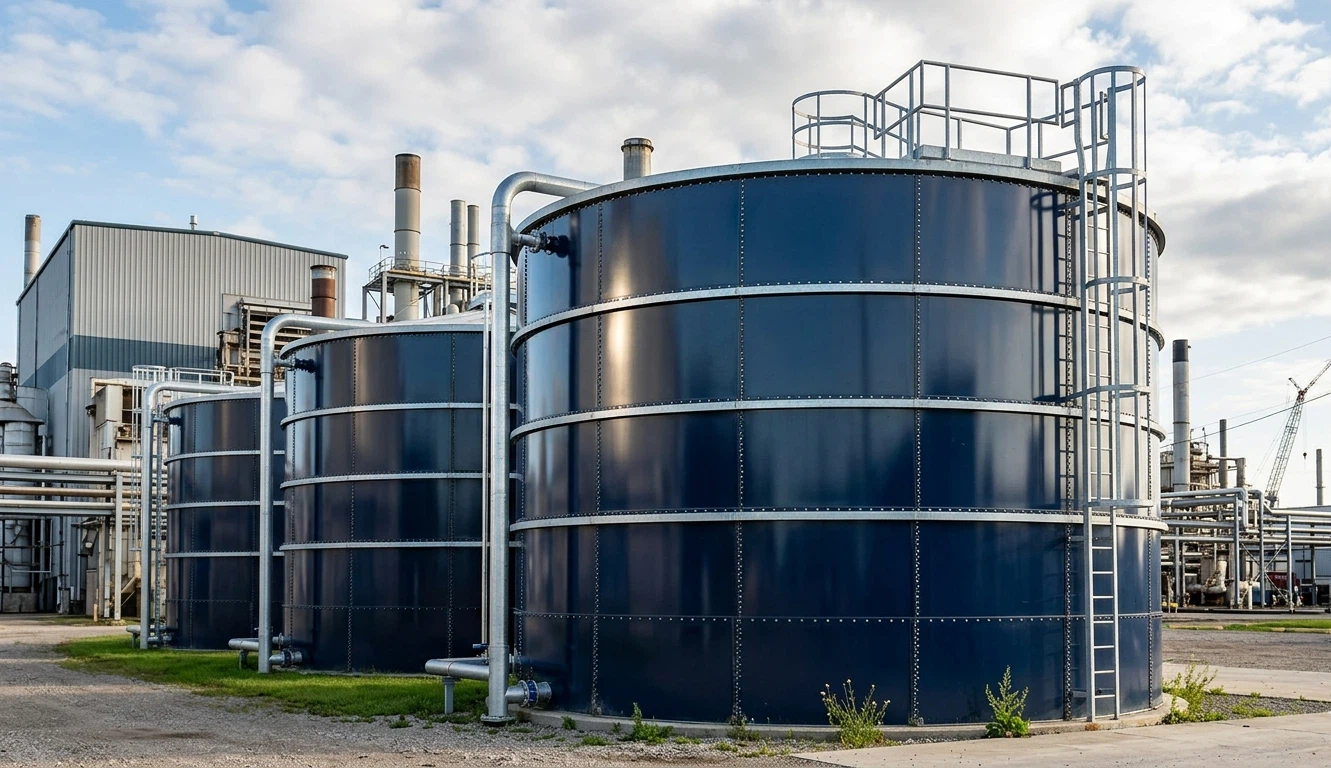
For a Tier III or Tier IV facility, a cooling interruption of even a few minutes can trigger a catastrophic cascading failure. While much of the industry focuses on the software layer of infrastructure management, the “physical layer”—specifically the Data center water storage system—remains the critical fail-safe for heat rejection.
As rack densities push past 50k W, the demand for instantaneous, redundant water supply isnon-negotiable. Whether it is for emergency makeup water or thermal buffering, the choice ofstorage material dictates the long-term maintenance costs and the overall reliability of thefacility.
جدول المحتويات
The Interface of Reliability: The Cooling Tower Tank
The most common application for water storage in these facilities is the Cooling tower tank. This tank acts as the primary buffer between the open cooling tower circuit and the secondary heat exchangers. In an open-loop system, water is constantly exposed to the atmosphere, introducing oxygen and environmental contaminants that accelerate corrosion.
Standard fiberglass (FRP) or concrete tanks often fall short in these high-stakes environments. FRP is prone to UV degradation and structural micro-cracking over time, while concrete can leach minerals into the water, altering the pH balance and fouling sensitive chiller components. A high-grade Stainless steel water tank eliminates these variables by providing a non-porous, chemically inert surface that resists both microbial growth and mineral buildup.
Preventing “Single Point of Failure” Corrosion
In a mission-critical environment, corrosion is more than just an aesthetic issue; it is a systemic risk. Using 316L stainless steel tanks for industrial cooling loops is the industry’s answer to aggressive water chemistry. Unlike 304-grade steel, the addition of molybdenum in 316L provides significantly higher resistance to chlorides and industrial chemical treatments used to prevent Legionella.
When you integrate Data center water storage into your primary cooling loop, you must account for the galvanic potential of the entire system. Stainless steel’s ability to remain passive in a wide range of water temperatures ensures that the tank does not become a sacrificial anode for the piping or the chillers. This material stability is what allows operators to maintain a “set and forget” mentality regarding their thermal storage.
Optimizing Energy with Thermal Energy Storage (TES)
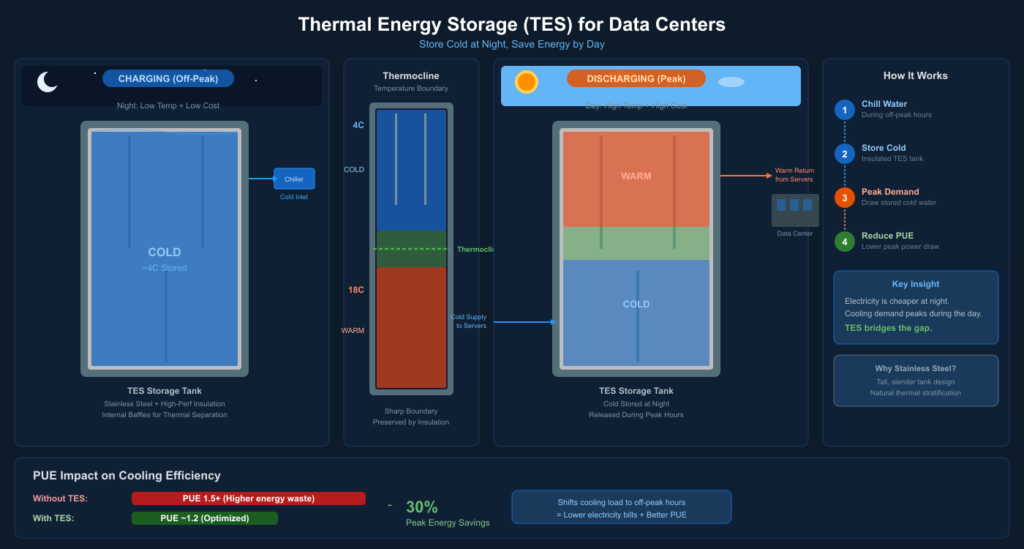
Efficiency in 2026 is measured by PUE (Power Usage Effectiveness). One of the most effective ways to drive this number down is through a Thermal energy storage (TES) tank for data centers. By chilling a massive volume of water during off-peak hours (when ambient temperatures and electricity rates are lower) and utilizing that “stored cold” during the heat of the day, facilities can significantly reduce their peak cooling load.
The mechanical design of a Data center water storage unit for TES applications requires precise internal baffling and high-performance insulation. The goal is to maintain a sharp thermocline—the boundary between the chilled water and the returning warm water. Stainless steel is the preferred material here because its structural integrity allows for the construction of tall, slender tanks that naturally facilitate thermal stratification.
Compliance and Safety: The Fire Protection Standard
Beyond cooling, these facilities have massive fire suppression requirements. It is a common architectural strategy to utilize NFPA 22 compliant water storage for fire protection that shares the footprint of the cooling makeup system. NFPA 22 is a rigorous standard that dictates everything from the welding quality of the tank to the specific types of anti-vortex plates used on the discharge pipes.
Technical Comparison: Industrial Water Storage Materials
The following table compares the physical properties of the most common materials used for Data center water storage in 2026.
| Property | 316L Stainless Steel | الألياف الزجاجية (FRP) | الخرسانة المسلحة |
| مقاومة التآكل | Excellent (Self-healing) | Good (but UV sensitive) | Poor (Requires lining) |
| عمر | 50+ years | 15 -20 years | أكثر من 30 عامًا |
| Microbial Control | Highest (Inert surface) | معتدل | Low (Porous) |
| Seismic Resilience | High (Ductile) | Low (Brittle) | Moderate (Heavy) |
| صيانة | الحد الأدنى | Periodic patching | High (Crack sealing) |
| الاستدامة | 100\text(%} Recyclable | Non-recyclable | Low recyclability |
Engineering for Continuous Operation
One of the biggest challenges in a 24/7 facility is maintenance. How do you clean or inspect a tank that is critical to the cooling loop? The answer lies in the engineering of the Data center water storage vessel itself. Modern designs incorporate a dual-compartment structure or a “by-pass manifold” system.
By using a modular Stainless steel water tank, operators can isolate one-half of the tank for cleaning while the other half continues to provide 100% of the required makeup water. Because stainless steel does not require the toxic epoxy linings found in concrete or carbon steel tanks, the cleaning process is faster and does not introduce volatile organic compounds (VOCs) into the cooling loop.
High-Density Cooling and Emergency Makeup
As we transition to liquid-to-chip cooling, the volume of water required for emergency backup has increased. If the municipal water supply fails, the Data center water storage must be able to provide hours of “bridge” cooling to allow for a graceful shutdown or to keep the facility running until the utility is restored.
When designing 316L stainless steel tanks for industrial cooling loops, engineers must calculate the “Dead Storage” vs. “Effective Storage.” Because the uptime of an AI-driven data center is valued in the millions of dollars per hour, the reliability of the suction and fill valves within these tanks is paramount. Stainless steel components inside the tank ensure that these mechanical parts do not seize due to rust or scale buildup over decades of service.
Final Thoughts: The ROI of Resilience
In the world of data center procurement, the “cheapest” option is rarely the most economical. When you calculate the Total Cost of Ownership (TCO), a Stainless steel water tank consistently outperforms cheaper alternatives through reduced chemical usage, lower maintenance, and an vastly longer lifespan.
As you plan your next facility upgrade or new build, remember that your Data center water storage is the backbone of your thermal redundancy strategy. Choosing a system that eliminates corrosion risks and supports energy efficiency is not just a technical choice—it is a business imperative. By investing in high-grade materials and compliant designs, you ensure that your cooling loop remains as resilient as the data it protects.
التعليمات
Why is 316L preferred over 304 for cooling tower tanks?
Cooling tower water is often highly concentrated with chlorides due to evaporation. 316L contains molybdenum, which specifically prevents “pitting corrosion” in high-chloride environments, making it a safer long-term investment for Data center water storage.
Can stainless steel water tanks be installed indoors?
Yes. Modular Stainless steel water tank designs can be shipped in panels and bolted together on-site. This allows for installation in basement mechanical rooms or on rooftops where a traditional one-piece tank would be impossible to fit.
How does a TES tank help with PUE?
A Thermal energy storage (TES) tank for data centers allows the facility to shift its cooling energy consumption to night-time hours. This reduces the “mechanical load” during peak daytime temperatures, which is a major factor in lowering the PUE ratio.
Is a license required to install NFPA 22 tanks?
Most jurisdictions require that NFPA 22 compliant water storage for fire protection be installed by certified contractors and inspected by a Fire Marshal to ensure all safety valves and seismic bracing meet local codes.