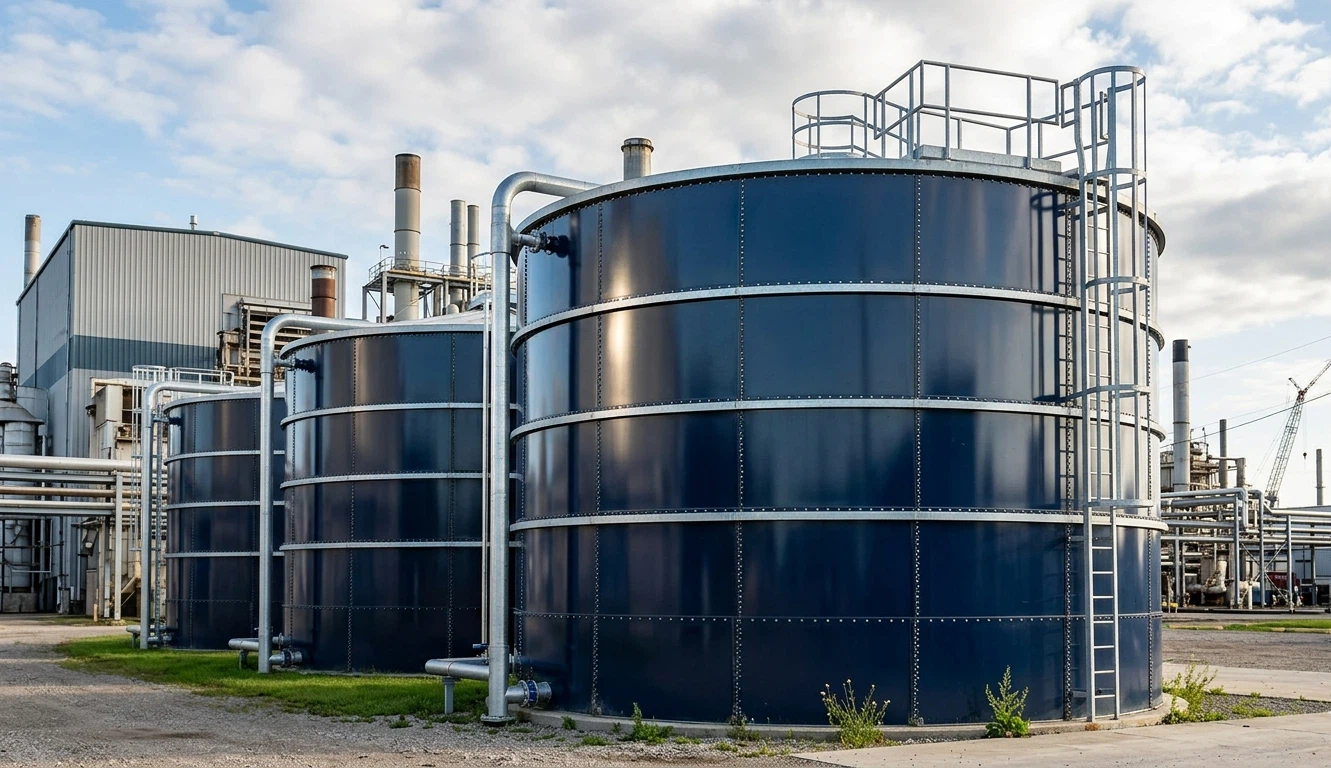
A baffle wall water tank is not just a storage vessel with internal panels. It is a hydraulic control strategy for projects where chlorine contact time, flow path, and disinfection efficiency matter. In many potable water and treatment systems, tank volume may look sufficient on paper, but poor internal flow can still allow short-circuiting, dead zones, and uneven disinfectant exposure.
This guide explains how a baffle wall water tank supports better T10 Contact time, why storage volume alone is not enough, and what buyers should check before specifying baffle walls for municipal, industrial, or treatment applications.
جدول المحتويات
Why Tank Volume Alone Does Not Guarantee Disinfection
A large tank does not automatically deliver effective disinfection. If incoming water travels quickly from inlet to outlet, part of the flow may leave before receiving enough disinfectant contact. The U.S. EPA guidance explains that disinfectant contact time, also referred to as T10, estimates the time during which 90% of water is retained in a basin or treatment unit. It also notes that baffling factors are used to estimate contact time based on basin configuration.
A large tank does not automatically deliver effective disinfection. If incoming water travels quickly from inlet to outlet, part of the flow may leave before receiving enough disinfectant contact. The U.S. EPA guidance explains that disinfectant contact time, also referred to as T10, estimates the time during which 90% of water is retained in a basin or treatment unit. It also notes that baffling factors are used to estimate contact time based on basin configuration.
This is where a baffle wall water tank becomes important. Baffles force water to follow a longer, more controlled route. Instead of assuming theoretical detention time equals real contact time, designers can improve hydraulic behavior and reduce the gap between design volume and actual disinfection performance.
Capacity is only one part of the story. Flow direction, inlet position, outlet position, internal geometry, and baffling arrangement can all affect whether the disinfectant has enough time to work.
What a Baffle Wall Water Tank Actually Does
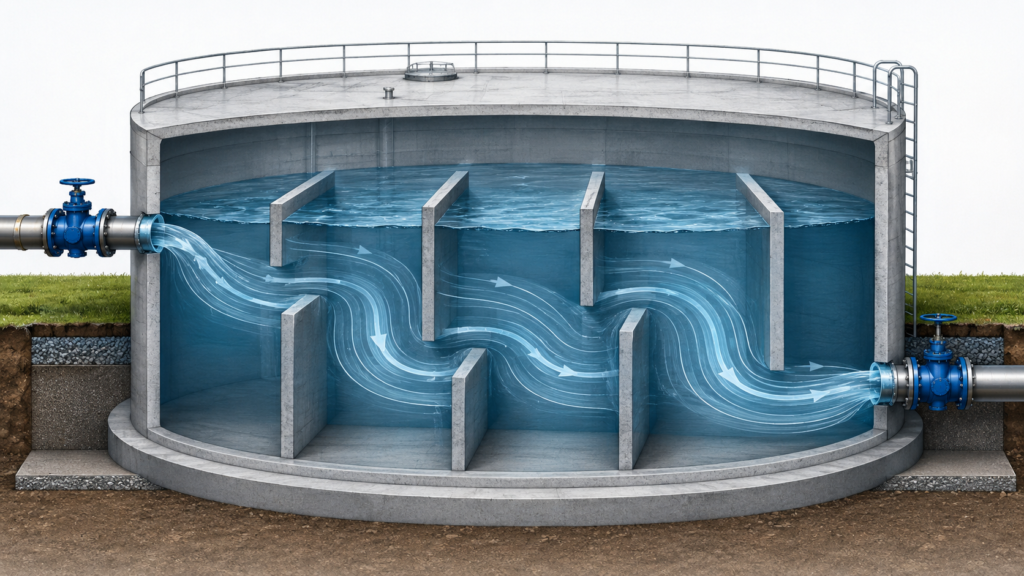
A baffle wall water tank uses internal walls, partitions, or flow-directing panels to guide water through the storage volume. The goal is not simply to divide the tank into compartments. The goal is to reduce short-circuiting and create a more predictable flow path.
In an unbaffled tank, some water can move directly from inlet to outlet, while other water may remain in low-velocity areas. A baffle wall water tank helps push more of the water volume through the intended contact zone.
The result can be better hydraulic retention time, more stable chlorine contact time, and improved use of available tank volume. For potable water storage, this can support more reliable disinfection performance. For wastewater or industrial systems, it can improve contact, mixing control, and process consistency.
Buyer Insight: A baffle wall should be treated as part of the hydraulic design, not as a simple accessory. Its value depends on flow rate, tank shape, inlet and outlet arrangement, and maintenance access.
Understanding T10 Contact Time in Water Tank Design
T10 Contact time is one of the most useful concepts for evaluating disinfection contact performance. Pennsylvania DEP explains that T10 is the time it takes for 10% of water flowing through a treatment segment to exit that segment, and tracer studies are used to determine effective contact time.
That matters because theoretical detention time can be misleading. A tank may hold a large volume, but if short-circuiting is strong, the first portion of water may exit too quickly. A baffle wall water tank is designed to increase effective contact time by reducing this early exit behavior.
For chlorine disinfection, contact time is part of the CT concept, where disinfectant concentration and time together affect inactivation. The Walkerton Clean Water Centre fact sheet explains that CT is the product of disinfectant concentration and contact time, and that baffling factors help estimate effective contact time for CT calculations.
Improving Disinfection Efficiency with Tank Baffle Walls
Improving disinfection efficiency with tank baffle walls starts with hydraulic control. The longer and more controlled the water path, the better the opportunity for disinfectant to contact the water before it leaves the tank.
A baffle wall water tank can help by:
- Extending the inlet-to-outlet flow path
- Reducing short-circuiting
- Limiting dead zones
- Increasing effective hydraulic retention
- Supporting more stable chlorine contact time
- Improving the practical use of tank volume
- Helping operators achieve more predictable CT performance
For public water systems, this is especially important. If contact time is overestimated, disinfection performance may be weaker than expected. If contact time is improved through better tank design, operators may have more confidence in the system’s hydraulic behavior.
Common Flow Problems in Unbaffled Water Tanks
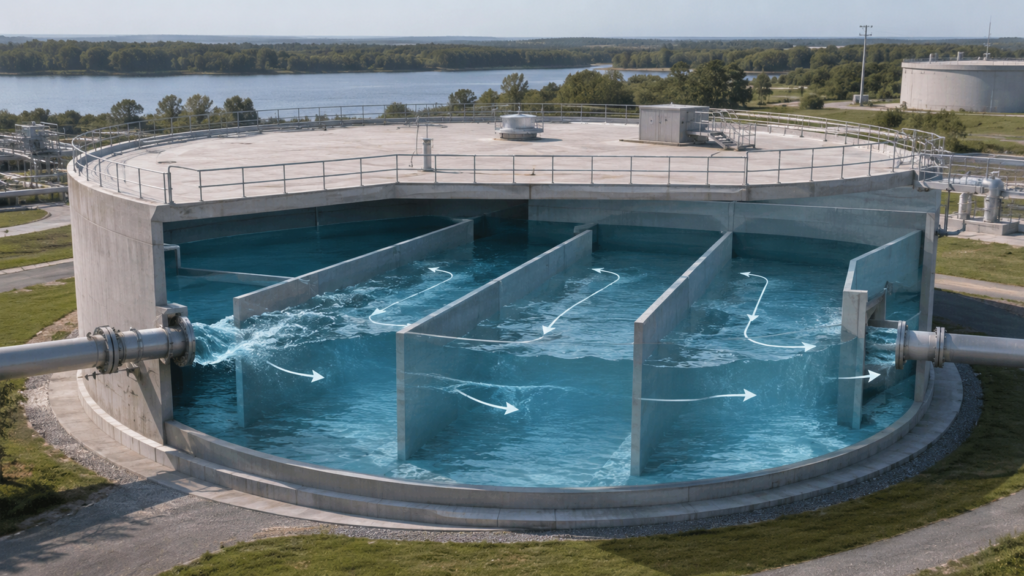
A tank without internal flow control can develop several hydraulic problems. These issues are common in storage and contact tanks where the inlet and outlet are poorly separated or where the tank shape encourages uneven flow.
Typical problems include:
1.Short-circuiting from inlet to outlet
2.Dead zones with low circulation
3.Poor chlorine distribution
4.Uneven hydraulic retention time
5.Sediment accumulation in low-flow areas
6.Lower effective disinfection contact time
7.Unstable outlet water quality
A baffle wall water tank is often used to reduce these risks, but the design must match the system. Simply adding more walls does not always solve the problem. In some cases, poor baffle placement may increase head loss, complicate cleaning, or create new areas where sediment collects.
Where Baffle Wall Water Tanks Are Most Useful
A baffle wall water tank is most useful when contact time or flow control directly affects system performance.
Municipal drinking water storage is a common application. Baffles can help improve effective disinfection contact and reduce the chance that incoming water leaves too quickly. For treatment plants, baffles can support CT compliance calculations when properly designed and verified.
Chlorine contact tanks are another strong fit. In these systems, the purpose of the tank is not only to store water but to provide enough contact time for disinfection. A baffle wall water tank can make the flow path more plug-flow-like and reduce hydraulic inefficiency.
Wastewater disinfection systems can also benefit, especially where chlorine, UV-preconditioned flow, or other treatment stages require more predictable retention. Industrial process water tanks may use baffles to improve mixing control, reduce stagnant zones, and create more consistent process conditions.
For fire water storage tanks, baffles may not always be required for disinfection. However, if water quality maintenance, periodic turnover, or treated water storage is part of the project requirement, a baffled configuration may be worth reviewing.
Design Factors That Affect T10 Contact Time
Key design factors include:
- Inlet and outlet location
- Tank length-to-width ratio
- Flow rate and water level variation
- Number of baffle walls
- Baffle wall spacing
- Opening size and flow direction
- Internal columns, supports, or obstructions
- Cleaning and inspection access
- Material compatibility
- Required head loss limit
A baffle wall water tank should be designed around the required contact objective. A potable water tank may need different baffling than a wastewater contact tank or industrial process vessel. The best layout supports flow control while still allowing maintenance, inspection, and long-term operation.
Pro Tip: Do not specify baffles only by saying “add internal walls.” Define the hydraulic purpose first: improved T10 Contact time, reduced short-circuiting, better mixing control, or more stable disinfectant contact.
Baffle Wall Design Is Not Only About More Wall
More baffles do not always mean better performance. A highly restricted path can increase head loss, trap sediment, or make cleaning difficult. A good design balances flow control with practical operation.
A baffle wall water tank should be reviewed for hydraulic performance, structural support, material durability, installation feasibility, access for cleaning, compatibility with disinfection chemicals, and long-term lifecycle value.
This is why supplier capability matters. A tank supplier should understand not only fabrication, but also how internal configuration affects water movement. The goal is to create a tank that supports disinfection efficiency without making operation harder.
How to Choose a Baffle Wall Water Tank Supplier
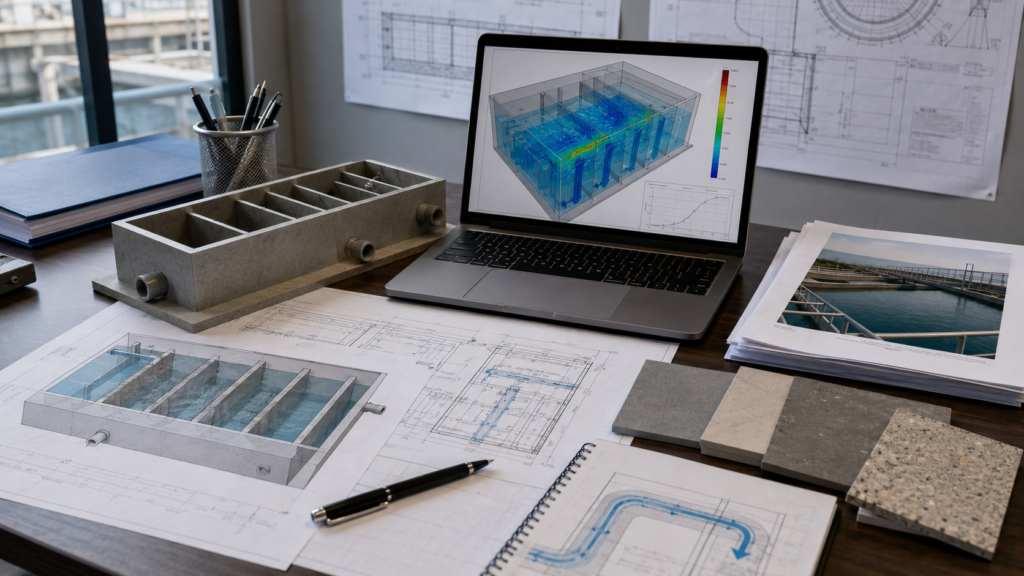
A qualified supplier should be able to discuss hydraulic purpose, not only tank size. Buyers should ask whether the supplier can support custom inlet and outlet positions, baffle arrangement, drawings, material selection, installation method, and access planning.
Important questions include:
- What is the target T10 Contact time?
- What flow rate should the tank handle?
- Is the tank for potable water, wastewater, or process water?
- What disinfectant is used?
- Are the baffle walls removable or fixed?
- How will the tank be cleaned?
- Can the supplier provide technical drawings?
- Are materials suitable for the water quality requirement?
- Can the design support future inspection and maintenance?
A baffle wall water tank should be evaluated as a functional water treatment component, not only a fabricated storage product.
خاتمة
A baffle wall water tank helps bridge the gap between storage volume and real disinfection performance. By improving flow path, reducing short-circuiting, and supporting better T10 Contact time, internal baffle walls can make water storage systems more hydraulically effective.
For municipal water projects, treatment plants, and industrial systems, the right tank design should consider more than capacity. It should account for contact time, flow behavior, maintenance access, material compatibility, and long-term operation. A well-designed system can support improving disinfection efficiency with tank baffle walls while helping buyers make more confident water treatment decisions.
التعليمات
What is a baffled water tank?
A baffled water tank is a water storage or treatment tank with internal baffle walls that guide flow, reduce short-circuiting, and improve effective contact time.
What is T10 Contact time?
T10 Contact time is the time when the first 10% of water exits a tank or treatment segment. It is used to estimate effective disinfection contact time.
How do tank baffle walls improve disinfection efficiency?
They extend the flow path, reduce inlet-to-outlet short-circuiting, limit dead zones, and help increase effective chlorine contact time.
Do all water tanks need baffle walls?
No. Baffles are most useful when disinfection contact time, hydraulic retention, or controlled flow path is important.
Can baffle walls be added to an existing water tank?
Sometimes. It depends on tank structure, access, material compatibility, flow rate, and maintenance requirements.
Are more baffle walls always better?
No. Too many baffles can increase head loss, complicate cleaning, or create sediment zones. Design should match the hydraulic objective.